







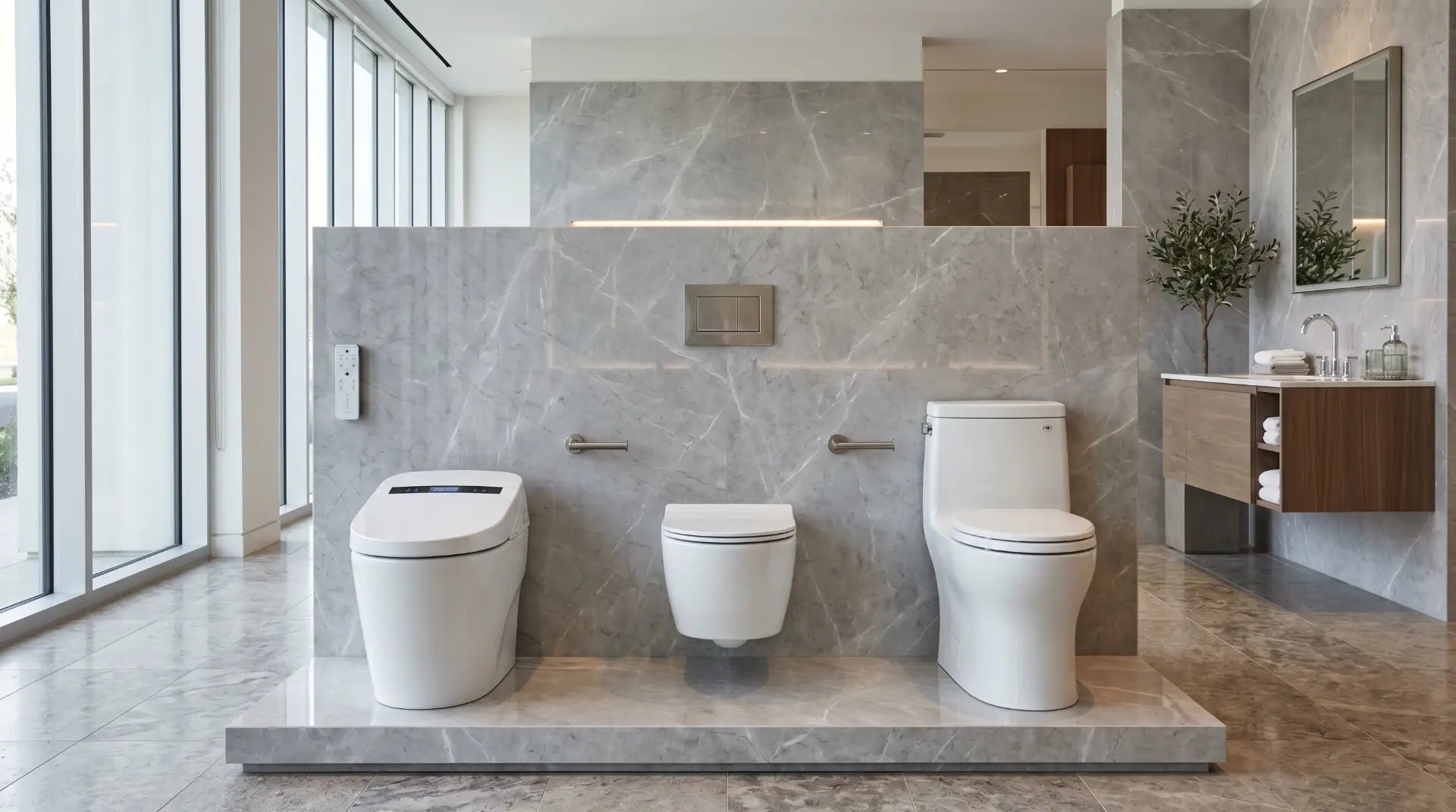
Toilets are the most-used fixture in any home - and one of the least researched before purchase. This complete toilet buying guide covers every type, every specification that actually matters, the features worth paying for, and the marketing claims that sound important but aren't, so you buy exactly the right toilet the first time.
The toilet buying decision confuses more homeowners than almost any other bathroom fixture - not because it's inherently complex, but because toilet specifications are poorly explained in most product listings and almost never covered together in one place. What GPF means in practice, why rough-in distance makes or breaks whether a toilet fits your bathroom, what the actual difference between a 1-piece and 2-piece toilet is beyond the obvious - these are the questions that determine whether your toilet purchase goes smoothly or ends in a return and reinstallation. This complete toilet buying guide covers all of them.
The guide is organized as a complete reference: it covers every toilet type with real-world pros and cons, explains every specification that matters, gives you a decision tree to find your type in under three minutes, and ends with a pre-purchase checklist you can use before confirming any order. It also covers what not to buy - the features that sound premium in product listings but add cost without adding real value, and the specifications that signal a toilet that will underperform from day one.
Before you look at a single product listing: (1) Measure your rough-in distance - from the finished wall behind the toilet to the center of the floor drain. This is almost certainly 12 inches, but confirm it. (2) Note your bathroom's floor-to-ceiling height and whether wall installation is possible if you're considering wall-mount. (3) Measure the depth from the wall to the front of the tank on your current toilet - this tells you the footprint constraint you're working within. Every toilet recommendation in this guide assumes you know these three numbers. Without them, you're guessing, and toilet returns are expensive and time-consuming.
For most US bathrooms: a comfort-height elongated 1-piece or 2-piece toilet at 1.28 GPF on a 12-inch rough-in. Type comes last - rough-in, height, and bowl shape come first.
The right toilet for most American homes in 2026 is a comfort-height (17-inch rim) elongated bowl toilet, WaterSense-certified at 1.28 GPF, on the standard 12-inch rough-in. Whether it's a 1-piece or 2-piece is largely an aesthetic and budget decision - both perform equally well when quality is matched. Wall-mount is the right choice when floor space is at a premium and you're willing to invest in in-wall carrier and professional installation. Smart toilets (integrated bidet seats, auto-flush, heated seats) are worth the premium for primary bathrooms used daily. The rest of this guide explains every dimension of that decision in detail.

A 1-piece toilet is manufactured as a single unit - the tank and bowl are cast and fired together from the same piece of vitreous china. There is no seam, no coupling bolts, and no gasket between the tank and bowl because there is no junction to seal. The result is a cleaner profile that is significantly easier to clean than a 2-piece model: no crevice between tank and bowl where grime and bacteria accumulate, no bolt caps to remove, no condensation drip points at a seam. This is the primary daily-use advantage of the 1-piece format - and for buyers who prioritize bathroom hygiene and cleaning ease, it's decisive.
The tradeoffs are price and weight. A quality 1-piece toilet typically costs $100-$400 more than an equivalent 2-piece. The fused unit is also significantly heavier - 80 to 120 pounds versus 50 to 80 pounds for a 2-piece - which makes solo installation genuinely difficult. Shipping damage risk is higher because the entire unit is one piece. If the tank is ever damaged, the entire toilet must be replaced. For most households, these tradeoffs are worthwhile given the cleaning advantage, but they're real considerations in price-sensitive purchases.
- Cleaning ease is a daily priority - no tank-bowl seam to scrub around
- You want a lower, sleeker profile than a standard 2-piece provides
- Budget allows $400-$800+ for a quality unit (TOTO Ultramax II, Kohler Santa Rosa, American Standard Champion)
- Two-person installation is available - the unit is heavy and awkward alone

A 2-piece toilet ships as two separate units - a tank and a bowl - that are bolted together during installation using tank bolts and a flush valve gasket. This is the most common toilet format in American homes, representing the majority of all residential toilet installations. The separate construction means lower per-unit shipping cost, easier maneuvering during installation (each piece weighs 30-50 pounds versus 80-120 for a 1-piece), and the ability to replace the tank independently if it's ever damaged without replacing the entire toilet.
The tank-bowl seam is the format's primary maintenance disadvantage - the crevice between the two units requires specific attention during cleaning and is where limescale, mold, and bacteria accumulate faster than on any other surface of the toilet. The rubber gasket at the tank-bowl junction also occasionally fails over time (5-15 year typical lifespan depending on water quality and gasket material), requiring a repair that is straightforward for a competent plumber but requires the tank to be removed. For most households these maintenance considerations don't eliminate the 2-piece - they're manageable with regular cleaning. At the price point most homeowners are working in ($150-$500), the 2-piece is the dominant choice by a wide margin.
- Budget is the primary driver - equivalent quality at $150-$300 less than 1-piece
- DIY installation is planned - two lighter pieces are significantly easier to manage alone
- Guest bathroom or rental property where cleaning frequency is lower and cost efficiency matters
- You want the widest selection of styles, brands, and configurations at any price point

A wall-mount toilet consists of a bowl that attaches to a carrier frame installed inside the bathroom wall, with the cistern (tank) concealed entirely within the wall cavity. The floor beneath the bowl is completely clear - there is no base, no floor gasket, and no footprint on the tile. This makes wall-mount toilets the easiest of all types to clean around on the floor (one pass of a mop covers the entire floor surface uninterrupted), and their floating appearance is one of the most visually distinctive design elements in a modern bathroom.
The installation is significantly more involved than floor-mounted types. A steel carrier frame must be installed inside the wall during rough-in (either in new construction or by opening the wall in a remodel), the cistern is mounted within the wall cavity, and the bowl hangs from carrier bolts that extend through the finished wall surface. Total installation cost in most US metro markets (New York, Los Angeles, Chicago, Miami, Atlanta, Seattle) runs $600-$1,400 including the in-wall carrier and professional installation - versus $150-$400 for a standard floor-mount installation. The in-wall cistern is also harder to access for repairs, though modern concealed cisterns are designed with accessible flush panels for servicing. For the right bathroom and the right buyer, the result is worth it. For a guest bathroom on a budget renovation, it is not.
- Small bathroom where clear floor space is the primary design priority
- New construction or gut renovation where the wall can be framed for the carrier
- Modern or minimalist bathroom aesthetic where the floating bowl is a key design element
- Budget allows $1,200-$2,500+ total (bowl + carrier + installation)
- Accessibility is a consideration - adjustable height can be set to exactly match any user's needs

Smart toilets (also called integrated bidet toilets or washlet toilets) combine a floor-mounted or wall-mount toilet bowl with an integrated electronic bidet seat that includes some combination of: warm water wash (adjustable temperature and pressure), heated seat, warm air dryer, auto-open/close lid, auto-flush, seat warming, night light, and deodorizer. TOTO pioneered this category in North America with their Washlet system and the Neorest line; Kohler's Veil and Innate lines, and American Standard's Advanced Clean series are comparable US alternatives. All are available at Bathify.
The practical daily benefit of a smart toilet system is more significant than most buyers expect before trying one. A quality integrated warm-water wash bidet with heated seat reduces toilet paper consumption by 80-90%, produces genuinely better hygiene than paper alone, and the heated seat in a cold US winter (particularly relevant in Minneapolis, Chicago, Denver, Boston, and anywhere in the Mountain West) is a luxury that users describe as something they cannot imagine giving up. The price premium is real - integrated systems start at $800 and quality TOTO or Kohler units run $1,200-$5,000+ - but for a primary bathroom used by two people daily, the per-use cost math over 10 years makes the premium more defensible than most buyers initially assume.
- Primary bathroom used twice daily by two adults - the usage frequency justifies the cost premium
- A GFCI outlet is already present or can be added within reach of the toilet
- Hygiene improvement and reduced toilet paper consumption are priority outcomes
- Any household member has mobility limitations that make paper-based cleaning difficult
- You want heated seat - a non-negotiable for cold-climate households in winter
Measure before you commit to bowl shape: Stand at your toilet, face the wall opposite the toilet, and measure from the back of the tank to the nearest obstacle. Subtract the tank depth (typically 6-8 inches) and the bowl depth of the toilet you're considering (listed as overall depth in specs). If what remains is less than 21 inches, you have a clearance problem regardless of which bowl shape you choose - address the room layout first. If it's between 21 and 26 inches, choose round. If it's 27 inches or more, elongated is the right call.
Toilet seat height - measured from the finished floor to the top of the seat - is one of the most consequential comfort decisions in toilet selection, and one of the least discussed. Standard height toilets measure 14 to 15 inches to the rim (15 to 16 inches with seat). Comfort height toilets measure 16 to 18 inches to the rim (17 to 19 inches with seat). The ADA specifies 17 to 19 inches to the top of the seat for accessible installations, which is why comfort height is also called ADA height or chair height in product listings - all three terms describe the same specification.
| Height Type | Rim Height | Seat Height | Best For | Not Ideal For |
|---|---|---|---|---|
| Standard Height | 14-15 inches | 15-16 inches | Children, shorter adults (under 5'4"), households where children use the toilet regularly | Tall adults (6'+), elderly users, anyone with knee or hip joint issues |
| Comfort Height (ADA) | 16-18 inches | 17-19 inches | Most adults (5'4"-6'4"), elderly users, ADA-compliant installations, new construction default | Households where young children are primary users - standing requires more effort |
The flush system is the single most important performance specification in any toilet. A beautiful toilet that flushes poorly will be a daily frustration. A less attractive toilet that clears the bowl completely on every flush with minimal water use will be a daily success. Understand these three specifications before choosing any toilet.
GPF is the volume of water used per flush cycle. The EPA's WaterSense program certifies toilets that use 1.28 GPF or less - and qualifying WaterSense toilets must also meet a minimum flush performance standard (MaP score of 350g or more, discussed below). The legal maximum in the US is 1.6 GPF for full flushes. In California, Colorado, and several other water-restriction states, the legal limit is lower (1.28 GPF). Most quality toilets sold at Bathify today are WaterSense certified at 1.28 GPF. Older homes replacing a 3.5 or 5 GPF toilet from the 1980s or 1990s will see dramatic water savings - up to 20,000 gallons per year per toilet for a family of four.
Dual flush toilets have two flush modes: a reduced volume flush (typically 0.8 GPF) for liquid waste, and a full volume flush (typically 1.28 GPF) for solid waste. When used correctly by all household members, dual flush reduces average water consumption per flush to approximately 0.9-1.0 effective GPF - a meaningful saving in high-usage bathrooms. The tradeoff: the reduced flush on some dual flush models has less clearing power than a single-mode 1.28 GPF design, because the 0.8 GPF mode doesn't always generate enough velocity to clear the trap efficiently. This is the "weak flush" complaint that appears in dual flush reviews - and it's often a function of the specific product, not the technology category. Look for dual flush toilets with a MaP score above 500g on the full flush mode before purchasing.
MaP (Maximum Performance) testing is an independent protocol that measures how much solid waste (in grams) a toilet can clear in a single flush. The EPA WaterSense minimum is 350g. Good toilets score 600-800g. The best toilets - TOTO's Tornado Flush system, Kohler's Class Five, American Standard's VorMax - score 800-1,000g or higher. A toilet with a 1.28 GPF rating and a MaP score of 600g+ will clear the bowl completely on every flush under normal residential use. A toilet with 1.6 GPF and a MaP score of 350g will struggle. Always check the MaP score - it predicts real-world performance better than any other single number in the spec sheet.
Look up MaP scores before you commit to any toilet: The complete MaP database is publicly available at map-testing.com. Search any toilet model before purchasing. A score below 500g is concerning at any price point. A score of 800g+ means the toilet will clear the bowl completely under any realistic residential load. This single check prevents 90% of "weak flush" buyer regret that appears in one-star toilet reviews.
| Flush Type | GPF | Best For | Watch Out For |
|---|---|---|---|
| Single Flush (1.28 GPF) | 1.28 GPF | Reliability and simplicity - one flush mode, optimized for consistent performance | Slightly higher per-flush water use vs. dual flush on liquid waste; but simpler and often more reliable |
| Dual Flush (0.8 / 1.28 GPF) | 0.8 or 1.28 GPF | Water conservation in high-use households; eco-conscious buyers who will actually use both modes | Reduced mode may leave residue if MaP score is low; household members must remember to use correct mode |
| Pressure-Assist | 1.0-1.6 GPF | Commercial settings; households with low water pressure; drain lines with steep drop needed | Noticeably louder than gravity flush (sounds like airline lavatory); not suitable for main-level or quiet-zone bathrooms |
| Tornado Flush / Rim Jet | 1.28 GPF | Maximum bowl cleaning - water enters from multiple rim jets creating a cyclone wash pattern | Technology-specific - TOTO Tornado Flush is the most refined; generic "tornado" clones vary widely in actual performance |
Rough-in distance is the distance from the finished wall behind the toilet to the center of the floor drain (the hole the toilet sits over). It is the single measurement that determines whether a toilet physically fits your bathroom - and it is the measurement most frequently skipped by buyers who then discover the toilet doesn't fit after delivery. In most US homes built after 1960, the rough-in is 12 inches. In older homes (pre-1950, particularly in the Northeast and Midwest - homes in Boston, Philadelphia, Chicago, Pittsburgh, and similar cities) the rough-in may be 10 or 14 inches. Some older homes have non-standard rough-ins of 11, 13, or even 15 inches.
| Rough-In Size | How Common | Typical Home Era / Region | Notes |
|---|---|---|---|
| 10-inch | Uncommon | Pre-1950 homes; older Northeast/Midwest housing stock | Significantly fewer toilet models available at 10"; confirm before ordering - Toto, Kohler, and American Standard each have 10" versions of their most popular models |
| 12-inch | Standard - 80%+ of US homes | All eras, all regions - the default US rough-in | Every toilet brand and model offers 12" rough-in; widest selection available |
| 14-inch | Uncommon | Pre-1960 homes; some older Southern housing stock | Limited selection vs. 12"; most major brands offer 14" versions of flagship models on special order |
| Feature | Worth Paying For? | Why |
|---|---|---|
| Glazed trapway (fully glazed) | Yes - always | The trapway is the internal passage waste travels through. A fully glazed trapway has a smooth, non-porous surface that resists buildup and reduces clogs. Skirted and concealed trapways (where the outer surface of the trapway is also covered) additionally make cleaning the outside of the toilet much easier. Specify this on any toilet over $300. |
| Slow-close seat | Yes - standard | Hinges that prevent the seat from slamming - standard on any quality toilet and adds essentially no cost. Avoid any toilet listing that doesn't include or offer a soft-close seat as a base feature or reasonable add-on. |
| CeFiONtect / EverClean / antimicrobial glaze | Yes - on primary baths | TOTO's CeFiONtect and American Standard's EverClean are ion-barrier glazes that make the china surface so smooth that waste, bacteria, and mineral buildup have nothing to adhere to. Less scrubbing, longer time between deep cleans. Real difference in a daily-use primary bathroom; less critical in a guest bath used twice a week. |
| WaterSense certification | Yes - non-negotiable | EPA certification confirming 1.28 GPF or less AND passing a minimum performance test. Do not buy any toilet that is not WaterSense certified - the combination of efficiency and performance standards the certification requires is the baseline for any quality toilet in 2026. |
| Skirted/concealed trapway | Yes - cleaning ease | The exterior of the trapway (the curved passage at the back base of the toilet) is covered by a smooth skirt of china rather than exposed. Makes cleaning the base of the toilet dramatically easier - no exterior curves to navigate with a brush. Standard on 1-piece and many premium 2-piece models. |
| High MaP score (800g+) | Yes - performance | The objective performance measurement. Every $50 spent on a higher-quality toilet is better than a $50 premium on any other feature if MaP score is below 600g on the base model. Always check. |
| Heated seat | Yes - cold climates | Genuinely appreciated in cold-climate US cities (Minneapolis, Chicago, Denver, Boston, Seattle in winter). Available as a standalone seat upgrade ($150-$400) or as part of a smart toilet system. Once experienced, rarely given up. |
| Touchless flush | Situational | Useful in households with hygiene-sensitive members or for powder rooms with high guest traffic. Battery-powered and easy to retrofit on most existing toilets. Not a meaningful upgrade in single-household primary bathrooms where flush handles are cleaned regularly. |
| Bluetooth speakers / music | No | A feature on some premium smart toilets that adds cost without adding meaningful daily value. Bluetooth range doesn't extend outside the bathroom, and any phone provides better audio via any Bluetooth speaker. This is a showroom feature, not a useful one. |
| LED ambient lighting (basin/bowl) | Mostly no | LED nightlight in the bowl or under-bowl ambient glow: the nightlight function (finding the toilet without full lights) is genuinely useful; the ambient under-glow is a gimmick that most users turn off within three months. Pay only for nightlight models that serve an actual functional purpose. |
| Brand | Strength | Best Product Line | Price Range | Who It's For |
|---|---|---|---|---|
| TOTO | Flush technology (Tornado Flush), CeFiONtect glaze, and the most complete integrated bidet/smart toilet line in North America (Washlet, Neorest) | Drake II (best mid-range), Ultramax II (best 1-piece value), Neorest (best smart toilet) | $300-$5,000+ | Best for buyers who want the highest flush performance at any price, or the best smart toilet. The most specified brand by bathroom designers and plumbers for daily-use primary bathrooms. |
| Kohler | Design variety, AquaPiston flush valve reliability, and complete style compatibility with Kohler's broader vanity and fixture ecosystem | Cimarron (best value 2-piece), Santa Rosa (best 1-piece), Veil (best smart toilet) | $200-$3,500 | Best for buyers who want design consistency across Kohler fixtures (faucets, showers, vanity hardware) in a single-brand bathroom. |
| American Standard | VorMax flush (highest residential MaP scores available), EverClean glaze, and the most aggressive value positioning of the three premium brands | Champion 4 (highest MaP in its class), Cadet 3 (best value), ActiClean (self-cleaning bowl) | $150-$1,500 | Best for buyers who want maximum flush performance at the lowest price, or who are replacing a toilet in a higher-use household (large family, rental property) where performance per dollar matters most. |
| Swiss Madison | Modern wall-mount and 1-piece designs at accessible price points; strong selection of European-style skirted toilets | Sublime II (wall-mount), Concorde (1-piece), Calice (round) | $200-$700 | Best for design-forward buyers who want the wall-mount or skirted European aesthetic without the TOTO/Kohler premium. |
| WS Bath Collections | Italian-designed wall-mount and contemporary toilets; available at Bathify with free shipping | Free Collection, Ego, Kata wall-mount series | $500-$1,500 | Best for luxury remodel buyers who want European design heritage and design-exclusive aesthetics in a wall-mount configuration. |
| Price Range | Type Available | What You Get | What You Give Up | Verdict |
|---|---|---|---|---|
| Under $200 | 2-piece only | WaterSense compliance, basic vitreous china, standard flush, limited warranty (1 year typical) | Glazed trapway, slow-close seat usually not included, MaP scores often 350-500g, limited color options beyond white | Guest bath or rental only |
| $200-$450 | 2-piece primary; some 1-piece entry | Quality brands (TOTO, Kohler, American Standard entry), WaterSense at 1.28 GPF, slow-close seat, better MaP scores (500-700g), limited glaze technology | Antimicrobial glaze, skirted trapway, comfort height may cost more, limited design options | Good value for most bathrooms |
| $450-$900 | Quality 1-piece and 2-piece; entry wall-mount | CeFiONtect / EverClean glaze, skirted trapway, comfort height standard, MaP 700-1,000g, slow-close seat included, 5-year warranty typical | Smart features, integrated bidet, designer aesthetics at this price point are limited | Best value tier for primary bathrooms |
| $900-$2,000 | Premium 1-piece, wall-mount, entry smart toilet | Best flush performance available, integrated washlet seat options, designer aesthetics (WS Bath, Swiss Madison premium, Kohler Veil), skirted/concealed everything | Fully integrated smart toilet functionality (partial at this range) | Primary bathroom with design priority |
| $2,000+ | Smart toilet / Neorest / Kohler Veil premium | Full smart toilet integration (auto-flush, heated seat, integrated bidet/washlet, deodorizer, auto-open), best available glaze technology, lifetime on china | Price - the only tradeoff is investment level | Primary bath, luxury renovation, aging-in-place |
A bidet seat retrofit - a replacement toilet seat with a built-in warm-water wash nozzle - is the highest-value upgrade available in the toilet category for most households. A quality bidet seat from TOTO (Washlet), Kohler (C3 series), or Bio Bidet retrofits any standard elongated or round toilet bowl in 20 minutes, costs $200-$900 depending on features, and requires only a water supply connection and a nearby GFCI electrical outlet. The functional improvement over standard paper cleaning is significant and essentially universal among users - hygiene, comfort, and the elimination of dry-skin irritation from paper all improve immediately and measurably.
| # | Red Flag | Why It Matters |
|---|---|---|
| 1 | No MaP score listed or available | Every quality toilet from a reputable brand has a publicly available MaP score. If you can't find the MaP score for a specific model in the map-testing.com database, the manufacturer either doesn't want you to know it (too low) or hasn't tested it (new or poorly-made product). Neither is acceptable in a toilet purchase. |
| 2 | MaP score below 500g | A score of 350-499g means the toilet struggles with solid waste removal under realistic residential loading. Expect regular double-flushing, occasional clogs, and a 1-star "weak flush" review experience. Minimum acceptable MaP is 500g; 600g+ is good; 800g+ is excellent. |
| 3 | 1.6 GPF on a new toilet with no WaterSense certification | In 2026, any toilet requiring 1.6 GPF without WaterSense certification is either old stock or a low-quality product that couldn't pass performance testing at 1.28 GPF. Certified 1.28 GPF toilets from TOTO, Kohler, and American Standard outperform uncertified 1.6 GPF alternatives in MaP tests. |
| 4 | "Easy to install" as a primary selling point | A toilet's primary merits should be flush performance, water efficiency, and material quality - not ease of installation. "Easy to install" as a lead feature typically indicates a budget product aimed at DIYers who will accept lower quality for lower cost. The quality features should be the lead; installation ease is a secondary benefit. |
| 5 | No warranty information, or warranty under 1 year | Quality toilet manufacturers offer minimum 1-year warranty on all parts, and typically 5-year or limited lifetime warranty on the vitreous china. A warranty of less than 1 year, or no warranty stated, is a strong signal that the manufacturer doesn't stand behind their product's durability. |
| 6 | Vitreous china not specified as the bowl material | All quality residential toilets are made of vitreous china - a ceramic material fired at high temperature that creates a non-porous, stain-resistant, extremely durable surface. Budget products sometimes use lower-grade ceramics or resin blends that are porous (stain more easily) and less durable. If the listing doesn't say "vitreous china," ask or avoid. |
| 7 | Rough-in not stated | Any legitimate toilet listing includes the rough-in distance (almost always 12 inches, but it must be stated). If rough-in is not in the spec sheet, the product listing is incomplete and the manufacturer's customer service responsiveness before purchase is likely reflective of their responsiveness after purchase. |
- Rough-in distance measured from finished wall to drain center - confirmed (typically 12", never assume)
- Floor-to-ceiling height confirmed (relevant for wall-mount carrier installation clearance)
- Front clearance measured - distance from back wall to nearest forward obstacle confirms elongated vs. round suitability
- Existing toilet overall depth noted - replacement should match or the rough-in gap to wall will change
- WaterSense certification confirmed - not just "1.28 GPF" stated but EPA WaterSense badge or logo
- MaP score looked up at map-testing.com - minimum 500g; 600g+ preferred; 800g+ ideal
- Rough-in stated explicitly in product specs - matches your measured rough-in
- Bowl shape confirmed (elongated or round) - matches your clearance measurement
- Seat height confirmed (standard 15-16" or comfort height 17-19") - appropriate for primary users
- Vitreous china confirmed as bowl/tank material - not a resin or composite alternative
- Warranty stated - minimum 1 year on parts; 5 years or lifetime on vitreous china preferred
- Slow-close seat included or available as add-on
- For wall-mount: in-wall carrier frame is compatible with your wall construction; budget for professional installation
- For smart toilet / bidet seat: GFCI electrical outlet confirmed within 4-6 feet of toilet location
- Water supply valve shutoff confirmed accessible and functional before installation day
- Wax ring or gasket included or sourced separately (most toilets do not include the wax ring)
- Closet bolts (hold-down bolts) in serviceable condition - replace if corroded during installation
Measure rough-in first. Confirm MaP score. Choose comfort height elongated for any adult primary bathroom. Then choose type by budget and aesthetic.
The complete toilet buying decision in order: measure rough-in (12" is standard, but confirm). Check MaP score before any other specification - performance is the non-negotiable. Choose comfort height (17-19" seat) for any bathroom primarily used by adults. Choose elongated bowl if floor clearance allows (24"+ in front of bowl). Then choose type: 1-piece for cleaning ease and aesthetics, 2-piece for cost and DIY-installation, wall-mount for design and space, smart toilet for daily hygiene upgrade in a primary bathroom.
For the most common US primary bathroom in 2026 - a master bath or main family bath with 12-inch rough-in, adequate clearance for elongated, and adult daily users - the right toilet is a comfort-height elongated 1-piece or 2-piece at 1.28 GPF WaterSense certified, MaP 600g+, from TOTO, Kohler, or American Standard, in the $350-$700 range. Add a TOTO Washlet bidet seat for $300-$600 more and you have a primary bathroom toilet setup that outperforms anything available 10 years ago at twice the price.
Shop Bathify's complete toilet collection - 1-piece, 2-piece, wall-mount, and bidet seats - all with free shipping across the continental US on orders over $50. Every listing includes brand, type, GPF, and rough-in specification so you can match your measurements before ordering.
Shop toilets at Bathify - free shipping across the USA
Browse 1-piece, 2-piece, wall-mount, and smart toilets from TOTO, Kohler, American Standard, and more - all with free shipping on orders over $50 to the continental US.


