







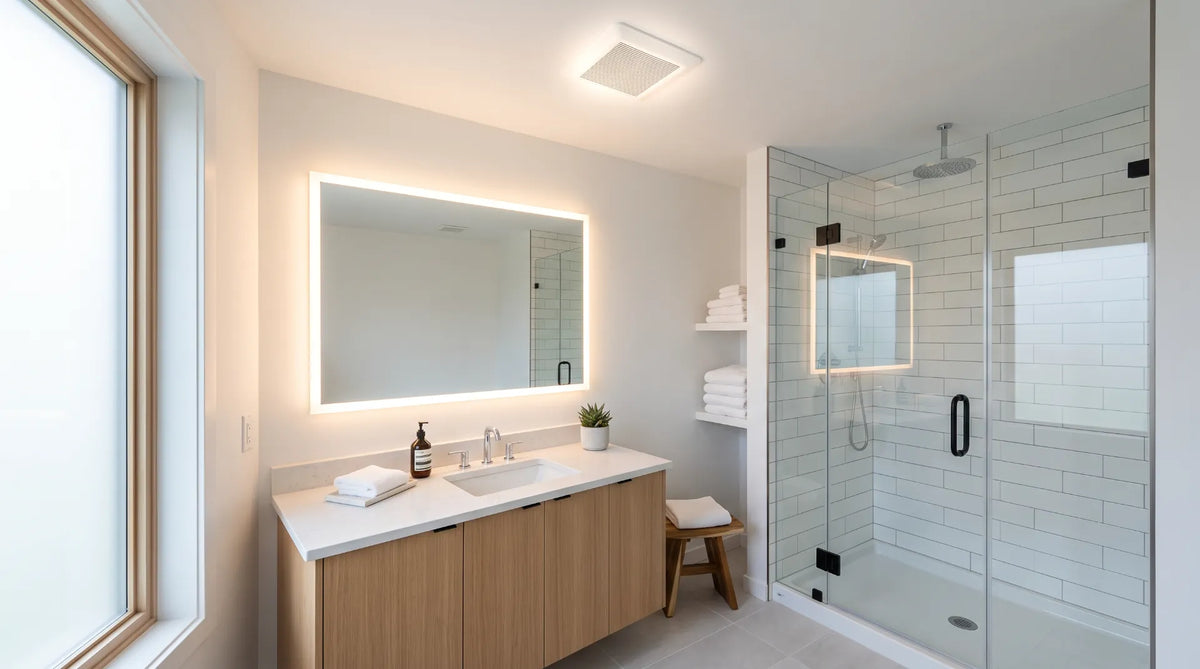
Three numbers decide almost every bathroom fan purchase: the CFM your room actually needs, the sone rating you can live with, and the price that comes with both. This guide walks through the exact calculator formula, a full sizing chart, and the features worth paying for.
How to choose a bathroom exhaust fan comes down to four decisions, in this order: the CFM your room requires, the sone rating you're willing to live with every day, the control features that match how the bathroom actually gets used, and whether your ceiling or wall cavity can accept the duct run the fan needs. Get the first two right and the fan will clear steam properly and you won't dread turning it on. Get the last two right and the installation stays a weekend project instead of a wall-opening one.
At Bathify, we hear the same version of this question from renovation customers almost every week: "what size fan do I actually need?" It's a fair question, because most big-box packaging lists CFM and sone numbers without explaining what either one means for a specific bathroom. This guide is the full walkthrough - a CFM calculator you can run in under a minute, a sizing chart for every common bathroom size, and the sone, certification, and budget context to pick a specific unit with confidence.
Know your bathroom's square footage already? Jump straight to the CFM calculator. Noise is your main concern? Go to sone ratings. Just want the short answer for your exact bathroom size? Scroll to the sizing chart or the quick decision guide at the bottom. The FAQ closes out with direct, standalone answers to the questions we get asked most.
Every bathroom exhaust fan purchase is really four smaller decisions stacked together. Understanding each one before you start comparing specific models is what keeps you from buying on price alone and regretting it the first humid morning.
Cubic feet per minute of air the fan can move. Undersized and steam lingers on mirrors and drywall; oversized wastes conditioned air and adds noise for no benefit. Calculated from room size below.
The HVI's standardized loudness rating. A fan you run for 20-30 minutes after every shower needs a sone rating low enough that you won't switch it off early out of annoyance.
Standard switch, built-in timer, humidity-sensing auto-on, or a combo unit with a light or heater. The right choice depends on who uses the bathroom and how reliably they'll run the fan on their own.
Whether the fan can duct to the exterior from its planned location, and whether that's a straightforward swap or a project that needs an electrician and a duct run through the attic.
This bathroom fan CFM calculator is the same three-step method HVI-certified manufacturers build their sizing charts from, and it's simple enough to run with a tape measure and no app. Here's how our team walks customers through it.
Multiply the bathroom's length by its width in feet to get square footage. A standard 5-foot by 8-foot bathroom is 40 square feet. Round up to the nearest whole number if the walls aren't perfectly square - it's safer to slightly oversize than undersize.
For any bathroom under 100 square feet, multiply the square footage by 1 to get the minimum required CFM. That 40-square-foot bathroom needs a minimum 40 CFM fan. We recommend sizing 20-30% above that code-minimum number, because real-world duct bends, elbows, and roof or wall caps all reduce a fan's rated airflow once it's actually installed - a fan rated for 50 CFM in a lab rarely moves a full 50 CFM through 15 feet of ducting with two 90-degree turns.
Once a bathroom hits 100 square feet, or has more than one shower, tub, or toilet, the square-footage rule stops being reliable on its own. Instead, add 50 CFM for the toilet, 50 CFM for the sink, and 50-100 CFM for the shower or tub, then use whichever number is higher: the fixture total or the square-footage calculation. Large primary bathrooms with a separate soaking tub and shower often land at 150 CFM or more, and are frequently better served by two exhaust points than one oversized fan.
6' × 8' primary bathroom with a shower/tub combo (48 sq ft): Square-footage rule = 48 CFM minimum. Add the recommended 20-30% buffer and you land at roughly 60-65 CFM, which puts you in the 80-110 CFM range once you round up to a commonly available fan size - the range where most primary bathrooms end up regardless of which method you started with.
12' × 10' primary bathroom with a separate shower and soaking tub (120 sq ft): Square-footage rule = 120 CFM. Fixture method = 50 (toilet) + 50 (sink) + 100 (shower) + 100 (soaking tub) = 300 CFM. Because the fixture total is dramatically higher, this bathroom is a strong candidate for two exhaust points - one over the shower/tub zone, one over the toilet/sink zone - rather than a single 300 CFM fan, which would be both loud and hard to duct from one location.
For anyone who wants the answer without running the calculator, this is the same sizing chart we walk customers through, expanded with the fixture-heavy cases the basic square-footage rule doesn't cover well.
Bathify's own experience matching mirrors and medicine cabinets to renovation plans backs this pattern up from the other direction: the large majority of the primary bathrooms our customers design around a single vanity and shower or tub combo fall in that 36-50 square foot band - which is exactly why the 80-110 CFM fan is the size most homeowners end up shopping for, whichever calculation method they start with.
A sone is the standardized unit HVI-certified fans use to rate perceived loudness, and unlike the decibel scale, it's linear: a 2-sone fan sounds roughly twice as loud as a 1-sone fan, not just incrementally louder. The sone as a unit of loudness was defined specifically to match how the human ear perceives volume, which is why it's a more useful shopping spec than decibels for comparing two fans side by side.
At Bathify, we tell customers to treat the sone rating as seriously as the CFM number, because it directly determines whether a fan actually gets used. A fan that's technically sized correctly but sounds like a hair dryer gets switched off after five minutes instead of the 20-30 minutes needed to fully clear humidity - which defeats the sizing math entirely.
| Sone Range | Perceived Loudness | Best For |
|---|---|---|
| 0.3 - 1.0 | Whisper-quiet - rustling leaves or a quiet refrigerator hum | Primary bathrooms used daily, bedrooms adjacent to the bath |
| 1.0 - 1.5 | Very quiet - easy to hold a conversation over | Most primary and guest bathrooms |
| 1.5 - 2.0 | Noticeable but not intrusive - the ENERGY STAR ceiling for most residential fans | Powder rooms, secondary bathrooms, budget-driven projects |
| 2.5 - 4.0+ | Loud - typical of older, builder-grade fans | Nowhere, if you can avoid it - usually a sign it's time to replace an old fan |
Once CFM and sone rating are settled, the remaining decision is which control type and feature set fits the household using the bathroom. Our team generally sorts this into six categories:
| Fan Type | Best For | What It Adds |
|---|---|---|
| Standard switch | Guest bath, powder room | Simple, inexpensive, relies on someone remembering to use it |
| Timer switch | Households that reliably run the fan but forget to turn it off | Auto-shutoff after a set run time, usually 20-60 minutes |
| Humidity-sensing | Kids' bathrooms, guest baths, hands-off households | Turns on automatically once humidity rises, shuts off once it clears |
| Fan + light combo | Small bathrooms with limited ceiling space | One housing, one ceiling cutout, for the exhaust fan and the light fixture |
| Fan + heater combo | Cold-climate primary bathrooms | Radiant heat lamp or fan-forced heat alongside the exhaust function |
| Inline / remote-mount | Bathrooms where absolute quiet matters most | Motor sits remotely in the attic or wall cavity; can serve two bathrooms |
The decision between a timer switch and a humidity-sensing fan is common enough that we've written a full comparison of it: see humidity-sensing vs. timer bathroom fans. If a cold-climate primary bathroom has you weighing a heater combo unit, our fan + light + heater combo guide breaks down whether the extra cost is worth it for your climate and usage.
Two certifications matter more than any marketing language on the box, and Bathify recommends checking both before adding a specific model to your cart.
HVI certification: The Home Ventilating Institute independently tests and verifies the CFM and sone numbers manufacturers publish, with random re-testing to confirm certified products keep meeting their rated performance. An HVI-certified rating is the only way to compare two fans' CFM and sone claims on equal footing - uncertified numbers are sometimes measured under more favorable lab conditions than a real installation.
ENERGY STAR certification: Beyond the sone limits covered above, ENERGY STAR-certified bathroom fans must also hit minimum efficiency thresholds measured in CFM per watt - roughly 2.8 CFM/W for fans in the 10-89 CFM range and 3.5 CFM/W for 90-200 CFM fans. A more efficient fan costs less to run continuously, which matters if you're pairing it with a humidity sensor that may keep it on for extended periods.
Duct size compatibility: Most residential bathroom fans are built for either 4-inch or 6-inch round duct. Our advice to anyone replacing an existing fan: measure the current duct collar before ordering a replacement, since a mismatched duct size is one of the most avoidable installation headaches in a straightforward fan swap - it turns a same-day replacement into a duct-transition project.
The single detail that turns a simple fan purchase into a bigger project is the duct path. A bathroom exhaust fan must terminate outside the building envelope - through a roof cap or a wall or soffit vent cap - never into an open attic space, where it deposits moisture onto roof sheathing and insulation instead of removing it from the house. Before choosing a specific fan, confirm there's a reasonably short, straight path from the planned fan location to an exterior wall or roof section, and that any duct crossing unconditioned attic space can be insulated to prevent condensation forming inside the ductwork.
Most fans also need a dedicated or GFCI-protected circuit, which is worth confirming against your bathroom's existing wiring before you're mid-installation. For the full step-by-step process, see our bathroom fan installation guide, and if you're working around a bathroom with no attic access or exterior wall nearby, our venting without an attic guide covers the alternatives. Local code requirements vary, so it's worth a quick check against your jurisdiction's adoption of the International Residential and Mechanical Codes before finalizing a plan - our bathroom fan code guide covers the baseline requirements most US jurisdictions follow.
Price scales with sone rating and features more than with CFM alone - a quiet 80 CFM fan often costs more than a loud 110 CFM one. Here's the realistic range by category.
| Fan Type | Typical Sone Range | Typical Price |
|---|---|---|
| Standard, builder-grade | 2.5 - 4.0+ | $25 - $60 |
| Quiet / low-sone | 0.3 - 1.5 | $80 - $220 |
| Humidity-sensing | 0.7 - 2.0 | $90 - $250 |
| Fan + light combo | 1.0 - 3.0 | $70 - $200 |
| Fan + heater combo | 1.0 - 3.0 | $100 - $300 |
| Inline / remote-mount | 0.3 - 1.0 | $150 - $400+ |
Add professional installation if the project involves new ducting, a new circuit, or a ceiling location without existing access - electrician and duct work commonly adds $150-$400 on top of the fan's price, depending on the complexity of the run.
In the interest of being straightforward: Bathify's current catalog doesn't include mechanical exhaust fans. We've built this sizing guide because getting the CFM and sone math right is something every one of our renovation customers has to deal with, whether they're buying the fan from us or not.
Where Bathify does come in is everything the fan is protecting. A bathroom that's properly ventilated is exactly what lets an LED mirror's anti-fog heating, a medicine cabinet's interior finish, and a wood-finish storage cabinet actually last. Most of the LED mirrors we carry in the $150+ range already include anti-fog heating as standard equipment - see our LED mirror collection - and pairing that with a correctly sized exhaust fan is the combination that keeps a primary bathroom mirror clear and a medicine cabinet's interior dry between showers.
If you're specifically shopping for the fan itself, our companion piece Best Bathroom Exhaust Fans for 2026 rounds up specific models by category once you know the CFM and sone numbers you're targeting.
Calculate the CFM first, then buy to the sone rating you'll actually tolerate
Standard primary bathroom, 36-50 sq ft: 80-110 CFM, 1.5 sones or below if you want to actually run it the full 20-30 minutes after a shower. Add a timer switch if no one in the household reliably remembers to turn it off.
Powder room or small bath, under 35 sq ft: 50-80 CFM. Sone rating matters less here since run time is shorter, so a standard or timer-switch fan is usually sufficient.
Large primary suite, 80 sq ft or more, or multiple fixtures: Run the fixture method (50 CFM per toilet, sink, shower/tub) and compare against the square-footage number. Consider two exhaust points instead of one oversized fan.
Kids' bathroom or guest bath used by people who won't remember the fan: A humidity-sensing model, sized per the chart above, removes the guesswork entirely.
Cold-climate primary bathroom: A fan + heater combo, sized to the room's CFM requirement first - don't let the heater feature drive you toward an undersized fan just because the combo unit's baseline CFM is lower.
Finish the Bathroom Around Your New Fan
Once ventilation is sorted, Bathify carries the LED mirrors, medicine cabinets, and storage that hold up best in a properly humidity-controlled bathroom. Free shipping on orders over $50, shipped across the USA.


