







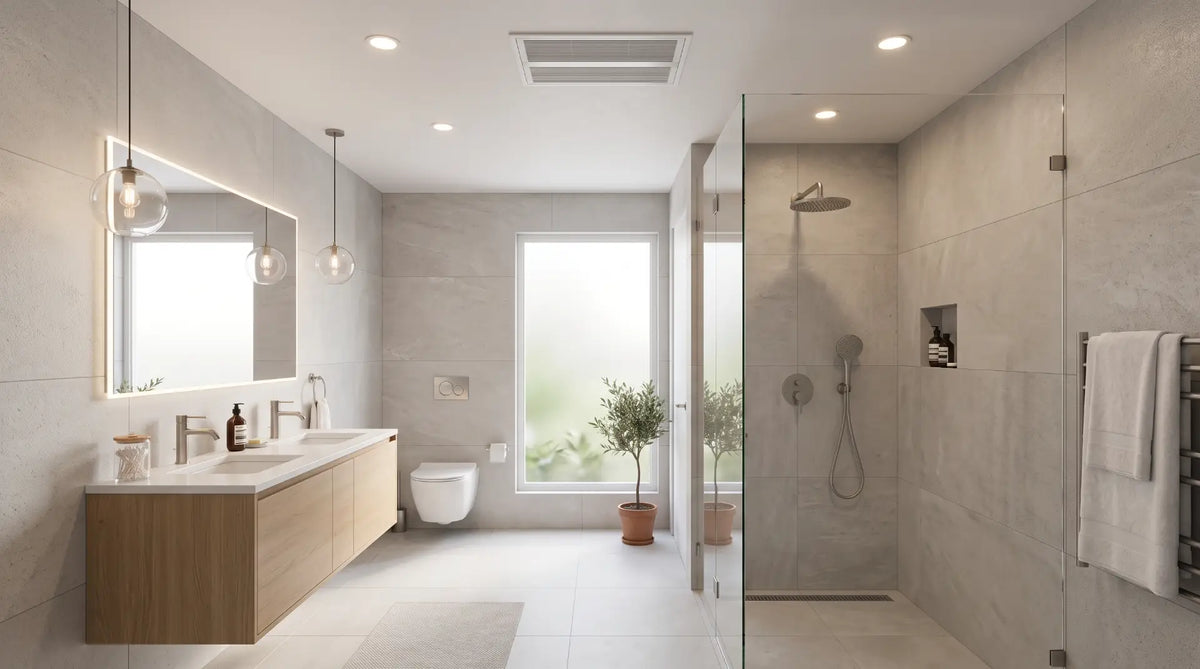
Every bathroom fan lists a sone rating, and almost nobody knows what the number means until they've already bought a fan that's louder than expected. Bathify breaks down what a sone actually measures, what counts as quiet, and how to read the spec sheet correctly.
A sone rating measures how loud a bathroom fan sounds to a human listener, not just how much raw sound energy it produces - and at Bathify, we consider it the single most useful spec on a fan's box for predicting whether you'll actually be happy running it every day. The scale is built around a simple reference point: 1 sone is defined as roughly the loudness of a quiet refrigerator humming in an otherwise silent kitchen. From there, the scale is linear to human perception - a 2-sone fan sounds about twice as loud as a 1-sone fan, and a 4-sone fan sounds about twice as loud again. That's a meaningfully different scale from decibels, and it's why sones - not decibels - are the number to compare when shopping for a bathroom fan.
Every residential bathroom exhaust fan sold in the US is required to publish a sone rating, tested under a standardized method, alongside its CFM (airflow) rating. This guide explains exactly what that number means, what rating actually counts as quiet in daily use, why the fan in your ceiling might sound louder than its box claims, and how Bathify's team thinks about noise when it comes up in ventilation questions from customers.
Bathify's team consistently sees the same pattern: the number one reason people stop running their bathroom fan long enough to actually clear humidity is that it's too loud to leave running. A fan's sone rating isn't a cosmetic spec - it directly affects whether the ventilation habits that prevent mold and lingering humidity actually get followed day to day.
Decibels (dB) measure the physical intensity of a sound wave on a logarithmic scale - the standard unit used across acoustics, from jet engines to whispers. Sones measure perceived loudness on a linear scale, built specifically to match how the human ear actually experiences changes in volume. The distinction sounds academic, but it changes how you should read a spec sheet: a jump from 30 dB to 40 dB represents a sound that's roughly ten times more intense physically, but the way our brains process that change doesn't map neatly onto that ratio - whereas a jump from 1 sone to 2 sones is specifically calibrated to sound exactly twice as loud to a listener. For a deeper technical explanation of how the sone scale was developed and how it relates to phons and decibels, Wikipedia's entry on the sone is a solid reference.
| Sones | Approx. dB | Comparable To | Bathify's Take |
|---|---|---|---|
| 0.3 - 0.5 | ~26-32 dB | A whisper, rustling leaves | Premium quiet - noticeable only in a silent room |
| 1.0 | ~40 dB | A quiet refrigerator hum | Bathify's recommended baseline for daily comfort |
| 1.5 - 2.0 | ~44-48 dB | Quiet conversation, light rainfall | Acceptable for most households, noticeable but not intrusive |
| 3.0 - 4.0 | ~52-56 dB | A running dishwasher nearby | Distracting for extended run times |
| 5.0+ | ~60+ dB | A vacuum cleaner | Common on older, worn, or budget fans - due for replacement |
Our team at Bathify recommends different sone targets depending on the room and how the fan will actually be used, since the "quietest possible" option isn't always the most practical purchase.
This is the bathroom where quiet matters most, since fully clearing humidity means running the fan for 20-30 minutes after every shower. A loud fan here is the one most likely to get switched off early out of simple annoyance.
Since these rooms see brief use without a shower's humidity load, a moderately quiet fan is sufficient and often more affordable, without sacrificing comfort in a room nobody lingers in.
A bathroom adjoining or near a bedroom deserves the quietest practical option, since late-night or early-morning use is the scenario where fan noise is most noticeable and disruptive to others.
In a lower-traffic space where noise sensitivity is lower, prioritizing CFM and price over sone rating is a reasonable trade-off Bathify's team sees customers make regularly.
Sone and CFM ratings on bathroom fans aren't self-reported by manufacturers without oversight - they're independently tested and certified by the Home Ventilating Institute (HVI), a nonprofit industry certification body that verifies fan performance under standardized laboratory conditions. Our team at Bathify recommends looking for the HVI Certified label specifically, since it confirms the sone and CFM numbers on the box were measured consistently against every other certified fan on the market - not under a manufacturer's own more favorable test setup. A fan without HVI certification isn't automatically bad, but its published specs carry less certainty, which matters more the more noise-sensitive your installation is.

A fan's certified sone rating is measured under ideal lab conditions - a straight, correctly sized duct and a properly sealed housing - so nearly every real installation runs a little louder than the number on the box. Understanding why helps you avoid blaming the fan itself when installation is actually the culprit.
Undersized or overly bent ductwork. A duct that's too narrow for the fan's CFM rating, or one with several tight 90-degree bends, forces the motor to work harder against resistance - and a straining motor is a louder motor. This is one of the most common causes our team sees behind a fan that sounds nothing like its rating.
A housing that isn't mounted securely. If the fan housing isn't firmly secured to ceiling joists, vibration can transfer into the surrounding drywall and resonate - adding a rattling or buzzing noise the sone rating doesn't account for at all.
Dust and lint buildup on the blower wheel. Over time, debris throws the blower wheel slightly out of balance, which increases both noise and vibration. Regularly cleaning the fan grille and blower wheel (unplug the fan first) restores much of a fan's original quiet performance.
An aging motor. Bearings wear down over years of use, and a 10+ year old fan frequently runs noticeably louder than its original rating even with no visible damage. At that point, replacement - not troubleshooting - is usually the right call.
Beyond the sone rating itself, a few design and installation choices consistently correlate with a quieter fan in practice, and Bathify's team points to these when customers ask how to guarantee a quiet result rather than just hoping the spec sheet holds up.
Larger, slower-spinning motors generally run quieter than small motors spinning fast to hit the same CFM target - this is part of why premium fans can be both quiet and powerful rather than one or the other. In-line (remote-mounted) fan systems place the actual motor in the attic or a remote location away from the bathroom ceiling, connected by ductwork, so only airflow - not motor noise - is present in the room itself; these are markedly quieter than a fan with its motor directly in the bathroom ceiling. Insulated duct reduces the amount of motor noise that travels through the ductwork into the room. Rigid metal duct over flexible duct, when routing allows for it, moves air more efficiently with less turbulence noise. For a full breakdown of fan types, CFM sizing, and top-rated options in the US market, see Bathify's fan sizing guide and best bathroom exhaust fans roundup.
Our team at Bathify hears the same handful of misunderstandings repeatedly when noise comes up in ventilation questions, and clearing them up upfront saves a lot of buyer's remorse.
Assuming a lower sone rating means lower CFM (airflow). These are independent specifications. A well-engineered fan can be both quiet and powerful; don't sacrifice needed airflow just to chase the lowest sone number, and don't assume a higher-CFM fan has to be loud.
Comparing decibels across brands without converting mentally to the sone scale. Since sones are linear to perception and decibels are logarithmic, a small decibel difference between two fans can represent a much larger perceived difference than it appears - always compare sones directly when they're available, which is standard on nearly every fan sold in the US.
Ignoring installation quality and assuming the printed rating is guaranteed. As covered above, ductwork, mounting, and maintenance all affect real-world noise independent of the certified rating. A great sone rating on a poorly installed fan can still be disappointing.
Buying the loudest budget option because it was cheapest, then never running it long enough. Bathify's team sees this pattern often - a fan too loud to comfortably run for the 20-30 minutes needed to clear humidity effectively defeats its own purpose, regardless of its CFM rating. Spending a bit more for a quieter fan often produces better real-world humidity control than a louder, marginally cheaper one that gets switched off early.
Bathify does not currently sell exhaust fans directly, so for fan selection by sone rating and CFM, our team points customers to the companion guides linked throughout this article. What Bathify's collection does offer is the rest of a genuinely quiet, low-friction bathroom routine that pairs well with a properly chosen fan.

Once you've solved the noise problem and can comfortably leave your fan running the full 20-30 minutes after a shower, an anti-fog mirror like the Alder means you're not standing around waiting for the mirror to clear either - the built-in heating element keeps condensation from forming on the glass in the first place, so getting ready starts immediately.
The Bathify sone rating cheat sheet
Primary bathroom, used daily: Target 0.5-1.0 sones. This is the fan you need to comfortably run for 20-30 minutes after every shower, so quiet operation directly supports better humidity and mold control.
Bathroom near a bedroom: Target under 1.0 sone, prioritizing quiet even over a small CFM trade-off, since nighttime and early-morning noise sensitivity is highest here.
Powder room or guest bath: 1.5-2.5 sones is perfectly comfortable given the short, occasional use these rooms see.
Always check for HVI certification so the sone and CFM numbers you're comparing were measured under the same standardized conditions as every other certified fan.
Remember that installation affects real-world noise as much as the fan itself - correct duct sizing, secure mounting, and periodic cleaning all matter. For full sizing and model guidance, see Bathify's fan buying guide.
Finish Your Quiet Bathroom at Bathify
Anti-fog LED mirrors and silent towel warmers that pair perfectly with a properly chosen, low-sone exhaust fan. Free shipping on orders over $50. Shipped across the USA.


