







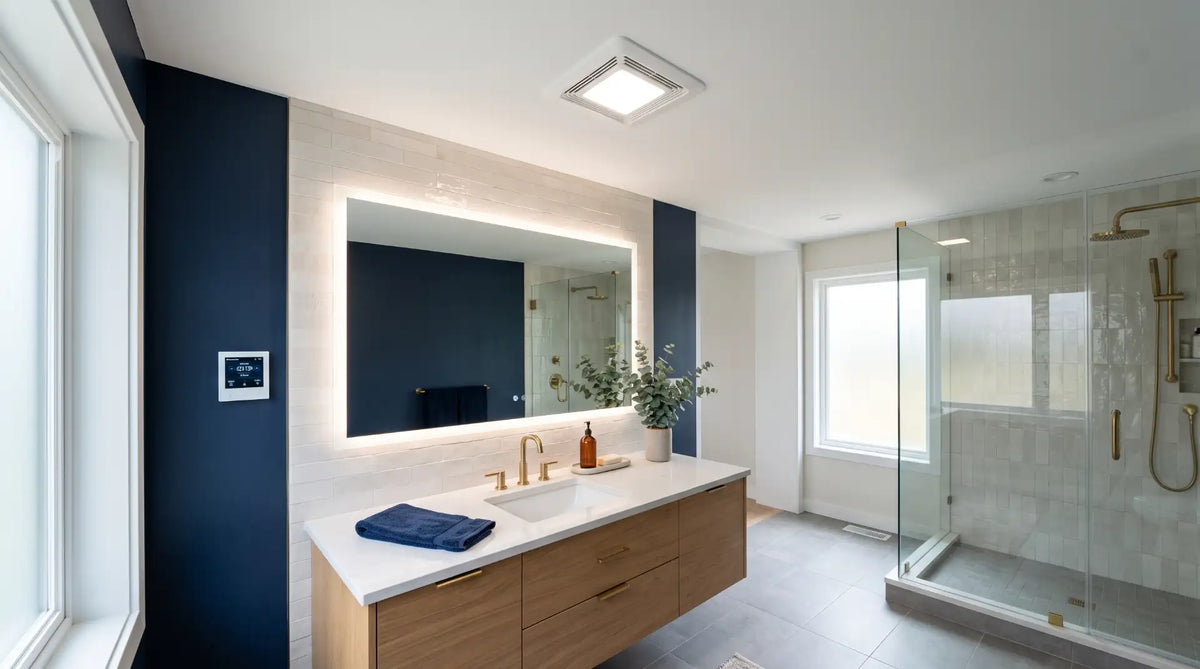
Two ways to control the same exhaust fan - one reacts to moisture in the air, the other runs for a fixed number of minutes. Here's how each actually works, what they cost, and which one fits your bathroom.
For a full bathroom with a shower or tub used daily, get a humidity-sensing fan - it turns on automatically when moisture actually rises and shuts off once the air clears, which does more to prevent mold and mildew than any manual habit ever will. For a powder room or half-bath with no shower, a timer fan set to 15-20 minutes is simpler, cheaper, and perfectly adequate since there's no real moisture load to manage. That's the short version. The rest of this guide walks through exactly how each control type works, what they cost, how they install, and which one fits which bathroom - because at Bathify we hear this exact question constantly from customers planning a renovation around the fixtures a good fan is meant to protect.
This is a supporting guide in our full bathroom ventilation and exhaust fan guide. If you haven't sized your fan yet, start with how to choose a bathroom exhaust fan by CFM and sones before deciding on a control type.
Bathify's catalog doesn't include mechanical exhaust fans - our focus is on the vanities, mirrors, faucets, toilets, tubs, showers, sinks, lighting, and storage that a well-ventilated bathroom is built around. We wrote this guide because ventilation questions come up constantly in the renovation conversations our team has with customers, and the fan's control type directly affects how well the anti-fog mirrors, medicine cabinets, and finishes we sell hold up over time.
A humidity-sensing bathroom fan - sometimes called a humidistat fan - uses a built-in hygrometer to continuously monitor relative humidity in the bathroom air. Rather than reacting to a fixed humidity percentage, most quality humidity-sensing fans track a rolling ambient baseline for the room and trigger the fan when humidity rises sharply above that baseline - typically 5-10 percentage points - which is the signature of an active shower or bath rather than normal day-to-day humidity drift. The fan then runs until humidity returns to baseline, at which point it shuts off automatically.
This adaptive-baseline approach is what separates a good humidity-sensing fan from a cheap fixed-threshold one. A fixed-threshold sensor set to, say, 70% relative humidity will run constantly in a naturally humid climate where ambient bathroom humidity sits near that number even without a shower running - or it will fail to trigger at all in a dry climate where a shower only pushes humidity to 55%. Adaptive models solve this by measuring the change in humidity rather than the absolute number, which is why we generally point Bathify customers in humid regions toward models that explicitly advertise adaptive or auto-calibrating humidity sensing rather than a simple fixed-percentage dial.
Look for adjustable sensitivity. The best humidity-sensing fans let you fine-tune the trigger threshold - useful if your fan runs too often (lower sensitivity) or not reliably during quick showers (raise sensitivity). Our team at Bathify suggests starting at the manufacturer's default and adjusting only after living with it for a week or two, since most humidity swings from normal daily activity settle out on their own.
A timer bathroom fan runs for a fixed, pre-set duration once activated - commonly 10, 20, 30, or 60 minutes, depending on the model or the external timer switch installed in place of a standard wall toggle. Activation is manual (you flip the switch) or, on some models, tied to motion detection or to the bathroom light switch turning on. Either way, the fan has no awareness of actual humidity level; it simply runs for the programmed window and then shuts off, regardless of whether the air has cleared or is still damp.
The simplicity is the appeal. A timer fan is mechanically simpler than a humidity-sensing model, which generally makes it less expensive and, in our experience recommending fans to Bathify customers, less prone to the false-trigger or no-trigger issues that a poorly calibrated humidity sensor can produce. The tradeoff is that it depends entirely on the household remembering to run it, and on the pre-set duration actually matching how long the room needs to dry out - a 10-minute timer after a 20-minute shower will shut off long before the moisture has cleared.
Pros: Runs automatically when moisture is actually present; shuts off on its own; no habit required from the household; catches moisture from long showers or baths that a short timer would miss.
Cons: Costs $20-$60 more than a comparable timer fan; sensor can misfire in naturally humid climates without an adaptive baseline; slightly more to go wrong mechanically over the fan's lifespan.
Pros: Simpler mechanism, generally lower price; predictable, consistent run time you control directly; fewer components that can fail.
Cons: Depends on someone remembering to turn it on; fixed duration may run too short for a long shower or too long after a quick hand-wash; provides no real-time feedback on whether the room has actually dried out.
The fan unit itself is the smaller part of the cost gap. A timer-only bathroom fan in the 80-110 CFM range most primary bathrooms need typically runs $40-$120 depending on brand, sone rating, and features. A comparable humidity-sensing model from the same product line usually adds $20-$60 to that price for the built-in sensor module. Combo models with both a humidity sensor and a manual override timer sit at the top of that range or slightly above it.
Installation labor is generally the same for either control type when it's a straightforward swap on existing wiring - most electricians charge a flat rate for a bathroom fan replacement regardless of whether it's humidity-sensing or timer-controlled. The cost difference shows up mainly in the unit price, not the labor bill, which is worth keeping in mind if a quote seems to price humidity sensing dramatically higher than the fan's retail price would suggest.
Both fan types wire into the same standard bathroom electrical circuit used for a light switch or an existing exhaust fan, and neither requires specialized wiring beyond what any bathroom fan installation already needs. The practical difference is in the control module rather than the wiring itself. A humidity-sensing fan has the sensor built into the fan housing, so it typically installs the same way a standard fan does - mount, duct, and wire to the circuit - with the sensor calibrating automatically over the first few days of use.
A timer fan can be built-in (a fixed internal timer) or use an external timer switch wired in place of a standard toggle, which does require swapping the wall switch box in addition to the fan itself - a small extra step but not a complex one for a licensed electrician. If you're doing this as part of a broader renovation, our bathroom fan installation guide walks through the full process, and if your bathroom lacks a straightforward vent path, see how to vent a bathroom fan without an attic or outside wall.
Confirm sensor placement before drywall closes up. A humidity sensor mounted too close to the shower stall can trigger on ambient steam that hasn't actually reached the rest of the room, while one mounted too far away may lag behind real humidity changes. If you're doing new construction or a full gut renovation, ask your electrician about sensor placement relative to the shower before the wall is closed.
At Bathify, we recommend matching the control type to how the bathroom is actually used rather than defaulting to whichever fan is cheapest or most talked-about. The right answer changes depending on the room.
Primary or full bathroom with a shower/tub, used daily: Humidity sensing is worth the extra $20-$60. It's the bathroom most likely to see inconsistent fan habits across a household, and it's the one where uncleared moisture does the most damage over time to grout, paint, and the finishes on your vanity and mirror.
Powder room or guest half-bath, no shower: A basic timer fan set to 10-15 minutes is enough. There's no real moisture load to manage, so the added cost of a sensor doesn't buy you much - our team generally steers customers away from over-spending here.
Rental property or multi-household bathroom: Humidity sensing removes the dependency on any one person remembering to turn the fan on, which matters more in a shared or tenant-occupied space where fan habits vary.
Naturally humid climate (Gulf Coast, Southeast, coastal regions): Either an adaptive-baseline humidity sensor or a timer with manual override works, but a fixed-threshold sensor can misfire constantly. If you're unsure which sensor type a model uses, a timer fan is the more predictable choice.
US building codes generally require mechanical ventilation in bathrooms without an operable window, following minimum airflow guidance from the Home Ventilating Institute (HVI) and referenced by the International Residential Code (IRC) that most US jurisdictions adopt in some form. HVI's baseline guidance is roughly 1 CFM per square foot for bathrooms under 100 square feet, with a minimum of 50 CFM regardless of room size - though local code can vary, so always confirm the exact requirement with your local building department before finalizing a fan choice.
Neither humidity sensing nor a timer is itself a code requirement - code generally specifies airflow capacity (CFM) and, in some jurisdictions, that the fan run continuously or be controlled in a way that ensures adequate ventilation, not a specific control mechanism. That said, some updated energy codes and ENERGY STAR guidance favor humidity-sensing or automatic controls specifically because they reduce the chance of a fan being left off when it's actually needed, which is a meaningful factor in moisture-related code compliance for new construction. For the full sizing conversation, see do you need a bathroom fan by code in the USA.
| Feature | Humidity-Sensing Fan | Timer Fan |
|---|---|---|
| Activation | Automatic, based on measured humidity change | Manual switch or motion trigger |
| Shut-off | Automatic once humidity returns to baseline | Fixed duration regardless of actual moisture |
| Typical added cost | +$20-$60 vs comparable timer model | Lower baseline cost |
| Wiring complexity | Same as standard fan wiring | Same, or add external timer switch |
| Best for | Full baths, showers used daily, rentals | Powder rooms, half-baths, predictable use |
| Risk in humid climates | Possible over-triggering without adaptive baseline | None - runs on manual control |
| Depends on household habit | No | Yes |
| Combo (sensor + manual timer) available | Yes, in many mid/premium models | Yes, same models |
To be direct: Bathify does not sell bathroom exhaust fans, so we won't pretend to hand you a "top fan picks" list of products we carry - for that, see the buying-guide links in this series, or talk to a licensed installer or local supplier who can walk you through current fan models. What we do carry are real, complementary fixtures that pair well with a properly ventilated bathroom - they don't replace what a good fan does, but they round out the result you're actually after: a bathroom that doesn't fog, peel, or mildew.

Most LED mirrors in Bathify's collection above the entry price point include a built-in anti-fog heating element - a low-voltage pad behind the glass that keeps the mirror surface clear while you're getting ready. It's a nice-to-have alongside good exhaust ventilation rather than a stand-in for it: your fan (humidity-sensing or timer) is still what's doing the real work of clearing moisture from the room, but a heated mirror means you're not wiping condensation off the glass with a towel while you wait.
![[Premium Quality Bathroom Products & Accessories Online]-Bathify](https://cdn.shopify.com/s/files/1/0633/9467/6967/products/A750-4.jpg?v=1648818315)
Whichever control type your fan uses, cabinet materials still matter in a room that sees regular humidity swings - tempered glass shelving and sealed cabinet interiors hold up better over time than untreated wood storage. Our medicine cabinet lineup is built for exactly this kind of bathroom environment, as a complement to good ventilation rather than a fix for a fan that's undersized or poorly controlled.

A towel warmer isn't a ventilation product and doesn't replace what your exhaust fan does - it's simply a comfort upgrade that dries towels faster and keeps them from sitting damp between uses. We mention it here because it's a common pairing in bathrooms that are already set up with good ventilation, not because it substitutes for one.
Match the control to how the bathroom is actually used, then size for CFM and sones
Full bathroom, shower or tub, used daily: Humidity-sensing fan. The extra $20-$60 buys automatic operation and removes the dependency on anyone remembering to run it - the single biggest factor in ongoing mold and mildew prevention.
Powder room or half-bath, no shower: Timer fan set to 10-15 minutes. There's minimal moisture load, so the added sensor cost doesn't deliver much return.
Naturally humid climate: An adaptive-baseline humidity sensor if you can confirm the model uses one; otherwise a timer fan with manual override is more predictable than a fixed-threshold sensor.
Rental or multi-household bathroom: Humidity sensing, since it doesn't rely on consistent habits across different occupants.
Whichever you choose, the fan itself is the part that actually clears the air - buy that from a real ventilation brand, sized correctly, and installed by a licensed electrician. Once that's handled, anti-fog mirrors, sealed medicine cabinet storage, and a towel warmer from Bathify are worthwhile upgrades that complement a well-ventilated bathroom, not stand-ins for one.
Shop the Fixtures Your Ventilation Protects
Anti-fog LED mirrors, medicine cabinets, and towel warmers built for humid bathroom conditions. Free shipping on orders over $50. Shipped across the USA.


