







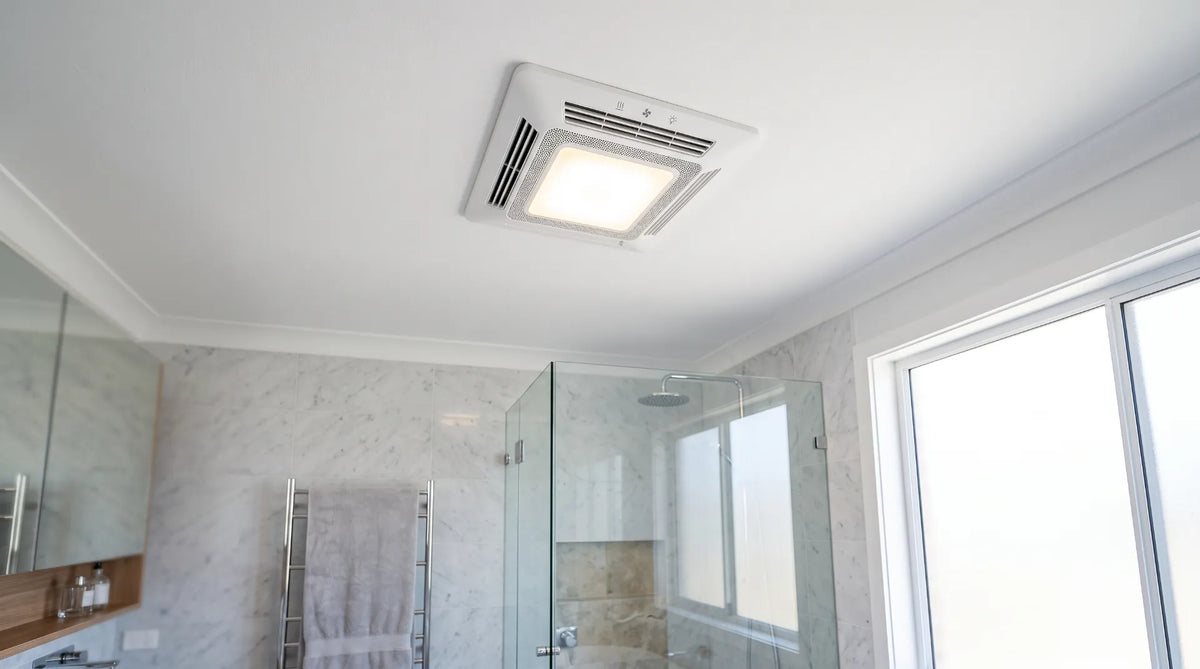
One ceiling cutout, three jobs. At Bathify, we get asked constantly whether a 3-in-1 combo unit is a smart upgrade or a gimmick - here's the honest breakdown of when the heater earns its keep, what it costs to wire correctly, and when you're better off skipping it.
A bathroom fan/light/heater combo is a single ceiling unit that stacks three functions into one housing and one duct cutout: exhaust ventilation, a light fixture, and a supplemental heater. It's part of the same ceiling ventilation family we cover in our bathroom ventilation guide, but with the added question of whether the heating element is worth the extra cost, wiring complexity, and (in most models) a dedicated circuit.
At Bathify, this is one of the most common questions we field from customers renovating an older bathroom or finishing a basement half-bath: does the heater option actually help, or is it an upsell you'll never use? The honest answer depends entirely on whether your bathroom already has a reliable heat source - and that's the question this guide is built to answer.
If you already know you want a combo unit and just need to size it, jump to the CFM section. If you're still deciding whether the heater is worth it at all, read the "Are They Worth It" section first - it's the section most of our customers actually need. The FAQ at the bottom answers the six questions we hear most about combo units directly.
Not every "combo" fan includes a heater, and the terminology gets muddled in product listings - it's worth separating the two categories clearly before comparing specific units.
Combines a standard exhaust fan with an integrated LED light panel in one housing. No heating element, no dedicated circuit requirement in most cases, and typically wires the same as a standard exhaust fan with a light kit. This is the right default for a bathroom that already has adequate heat.
Adds a heating element - either infrared heat lamp bulbs or a PTC ceramic element - to the fan and light. Draws significantly more power (often 1,500W+ for the heater alone), almost always needs its own dedicated circuit, and costs more both to buy and to install. Worth it only when the bathroom genuinely lacks reliable heat.
Once you've decided a heater is worth including, the next decision is which heating technology. These two approaches solve the "cold bathroom" problem in genuinely different ways, and the right choice depends on how you actually use the room.
A heat lamp combo uses one or two 250-watt infrared bulbs mounted alongside the fan and light. Infrared heat warms your skin directly and almost instantly the moment you step under it - the same principle as an outdoor patio heater - but it does very little to raise the ambient air temperature of the room itself, and the bulbs are a wear item that need periodic replacement. At Bathify, we point customers toward heat lamp combos when the priority is instant warmth right after a shower, not a warm room to get dressed in.
A PTC (positive temperature coefficient) combo uses a self-regulating ceramic heating element that warms the air moving through the unit, gradually raising the room's actual temperature over a few minutes rather than warming just the person underneath it. PTC elements are self-limiting by design - the ceramic's resistance rises as it heats, which caps its output and makes it inherently safer than older exposed resistance-coil heaters. Our team recommends PTC combos for anyone getting dressed in the bathroom afterward, since the whole room warms rather than just the spot under the fixture.
Neither heater type is a room heater replacement. Both are spot-heating solutions sized for the few minutes of a morning routine, not for maintaining a steady room temperature the way central heat or a hardwired baseboard heater does. For background on how PTC ceramic heating elements work more generally, Wikipedia's overview of positive temperature coefficient devices is a useful reference.
At Bathify, our answer is: it depends entirely on whether your bathroom already has independent heat. If your bathroom sits on a home's central HVAC system, has a radiator, or has a baseboard heater already keeping it comfortable, a combo heater is redundant - you'll pay more upfront, pay more to wire it correctly, and likely use the heater function rarely if at all. Save the money and buy a straightforward fan/light combo instead.
If your bathroom is a common trouble spot - a converted powder room with no HVAC register, a basement bathroom, a bathroom addition built without extending the ductwork, or simply an older home where the bathroom is consistently the coldest room - a heater combo solves a real daily discomfort. Our customers who buy these units most often describe the same trigger: stepping out of a hot shower into a genuinely cold room, every single morning, in a bathroom that has no other heat source to fix it.
This is the part of the combo decision most homeowners underestimate, and it's the single biggest reason to plan before buying rather than after. A 3-in-1 combo's heating element commonly draws 1,500-1,600 watts on its own - before accounting for the fan motor and light. That load exceeds what a standard 15-amp bathroom circuit can safely handle alongside outlets, a hair dryer, and other fixtures already on the same circuit.
Most manufacturers specify a dedicated 20-amp, GFCI-protected circuit for any combo unit that includes a heater - meaning a new circuit run from the panel in most existing homes, not simply tapping into the bathroom's existing wiring. This is a meaningful cost difference between a fan/light combo (which usually shares the existing lighting circuit without issue) and a fan/light/heater combo (which typically requires an electrician to run new wire). The National Electrical Code requires GFCI protection for bathroom circuits broadly - the National Fire Protection Association's NEC reference page is the authoritative source if you want to confirm current requirements for your jurisdiction.
No - the heater and the fan are functionally independent inside the unit, so the same CFM sizing rules apply to a combo as to a standalone exhaust fan. At Bathify, we still tell customers to size a combo unit exactly the way we'd size any other bathroom fan: square footage of the room times 1 CFM per square foot as a baseline, adjusted upward for a shower, tub, or enclosed toilet room. Our full breakdown of that math, including the sone (noise) rating tradeoffs, is in our CFM and sizing guide.
Where the heater does matter is duct sizing and airflow resistance - if you're running a longer duct run with several bends to vent outside (rather than through an easily accessible roof or wall), oversizing the CFM slightly helps offset the additional static pressure, exactly as it would on a non-heater unit. For guidance on tricky venting situations, see our guide on venting a bathroom fan without attic access.
On most quality combo units, yes - the fan, light, and heater are wired to three independent switch legs, so you can run the fan alone for ventilation, the light alone at night, or the heater alone for a quick warm-up, in any combination. This matters because it means the fan circuit can be paired with a humidity sensor or timer switch exactly as it would on a standalone exhaust fan - our humidity sensor vs timer guide covers that decision in detail and applies equally to a combo unit's fan function.
Our team's advice before buying: confirm independent switching on the spec sheet, not just in the marketing copy. A small number of budget combo units wire the fan and heater onto a single switch leg, which forces the heater on every time you want ventilation running - an easy way to waste electricity and defeats the purpose of separating the functions in the first place.
Based on the questions we hear most often from Bathify customers planning a bathroom remodel, a heater combo makes the most sense in four specific situations: a basement bathroom with no HVAC register reaching it; a converted room (a closet, a mudroom corner, an attic nook) turned into a powder room after the original ductwork was run; an older home with genuinely poor bathroom insulation where the room measurably lags the rest of the house in temperature; and a cold-climate second bathroom that's used infrequently enough that running the main HVAC to warm it feels wasteful for a five-minute shower.
Outside those situations - a primary bathroom on a modern, well-insulated home with a working HVAC register - our recommendation is a standard fan/light combo, or a plain exhaust fan paired with one of Bathify's anti-fog LED mirrors for grooming light and fog control, which is where most of the daily value actually comes from in a bathroom that isn't fighting a genuine cold problem.
| Factor | Fan Only | Fan + Light (2-in-1) | Fan + Light + Heater (3-in-1) |
|---|---|---|---|
| Ceiling cutouts needed | 1 | 1 | 1 |
| Typical dedicated circuit required | No | No | Usually, 20A GFCI |
| Independent fan/light/heater switching | N/A | Most models | Confirm on spec sheet |
| Typical unit price range | $40-$150 | $90-$220 | $150-$350+ |
| Adds room heat | No | No | Yes, supplemental |
| Best bathroom type | Any, with existing light fixture | Any, no separate light needed | Cold, unheated or under-heated bathroom |
Bathify's catalog does not include mechanical exhaust fans or heating combo units - we focus on vanities, mirrors, faucets, toilets, tubs, showers, and bathroom storage. What we do carry, and what genuinely complements a fan/light/heater install, sits on either side of the ventilation decision.
Before or during the install, an anti-fog LED mirror from Bathify pairs directly with the fan's job. A quality combo unit clears humidity from the air; a mirror with a built-in anti-fog heating element keeps the glass itself clear at the same time, so you're not left wiping condensation off the mirror even with good ventilation running. This is one of our most common pairing recommendations for a full bathroom refresh.
If a full 3-in-1 combo isn't the right fit, Bathify's towel warmer collection is worth considering as a lighter-touch alternative. A wall-mounted towel warmer doesn't heat the room's air the way a PTC combo does, but it delivers a warm towel and a modest ambient warmth near the spot you're standing after a shower - a popular choice among Bathify customers who want to take the edge off a cold bathroom without the electrical work a dedicated heater circuit requires.
Buy the heater only if the bathroom is genuinely cold - not by default
Bathroom already has central heat, a radiator, or a working HVAC register: Skip the heater. Buy a straightforward fan/light combo and pair it with a Bathify anti-fog LED mirror for grooming light and condensation control.
Basement, converted room, or older home with a genuinely cold bathroom: A 3-in-1 combo is worth it. Choose a PTC element if you want the room to warm generally, or a heat lamp if instant spot warmth right after the shower is the priority.
Budgeting for the install: Confirm whether your bathroom's existing circuit can support the heater or whether you need a new dedicated 20-amp GFCI circuit - get an electrician's quote before buying, since the wiring often costs more than the unit itself.
Want warmth without the electrical work: A Bathify towel warmer delivers a lighter version of the same comfort with a much simpler install than a heater-equipped ceiling combo.
Finish the Bathroom Refresh at Bathify
Pair your new ventilation with an anti-fog LED mirror, a humidity-resistant medicine cabinet, or a wall-mounted towel warmer. Free shipping on orders over $50. Shipped across the USA.


