







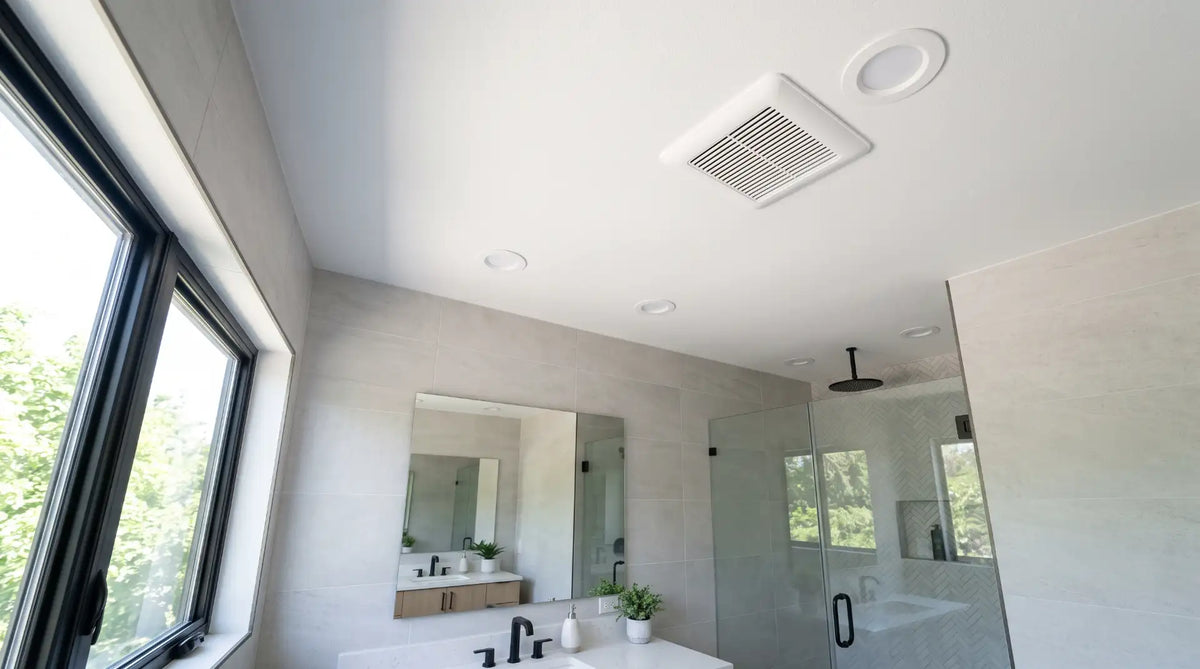
Short answer: not always - but the exception surprises most homeowners. At Bathify, we get this question constantly from customers mid-renovation, so here's exactly what US code requires, when a window is enough, and why our team still recommends a fan even when it isn't required.
In most of the US, a bathroom with a tub or shower is required to have either a mechanical exhaust fan ducted to the outside or an operable window meeting a minimum size threshold - not necessarily both. This comes from the International Residential Code (IRC), the model code that most US states and municipalities adopt as the base for their own building codes, with local amendments. At Bathify, this is the single most common misconception we hear from customers: many assume a fan is always legally mandatory, when in fact a sufficiently sized window has historically been an accepted alternative.
That said, our team at Bathify recommends a mechanical exhaust fan in virtually every bathroom regardless of what the bare code minimum requires, because a window that satisfies code on paper rarely gets used the way ventilation actually needs to happen - open during a hot shower, in the middle of winter, with the bathroom door closed for privacy.
If you just want the yes/no answer for your bathroom, the Quick Answer and Window Exception sections cover it. If you're actively renovating and need the CFM and duct requirements to pass inspection, jump to those sections directly. This guide explains the general US model code - always confirm the specific rule with your local building department, since adopted codes vary by state and city.
The relevant rule sits in the International Residential Code's ventilation requirements for habitable rooms, which extends to bathrooms containing a tub, shower, or combination. The International Code Council (ICC), which publishes the IRC, sets the ventilation air requirement at either natural ventilation through an exterior opening or mechanical ventilation meeting a minimum airflow rate - the two paths this guide walks through below.
It's important to understand the IRC is a model code, not federal law. States, counties, and cities adopt a version of it - often with a lag of several years behind the current published edition, and frequently with local amendments that add or loosen specific requirements. At Bathify, we tell every customer planning a bathroom build or remodel the same thing: treat the IRC as the general framework, and confirm the specific numbers with your local building department or permit office before finalizing a ventilation plan, since that's the code version an inspector will actually enforce.
Under the IRC, a bathroom can satisfy its ventilation requirement with natural ventilation alone - an operable exterior window with a glazed area of at least 3 square feet, at least half of which must be openable, positioned to vent directly to outside air. If a bathroom has a window meeting this threshold, a mechanical exhaust fan is not required to pass a ventilation inspection in most jurisdictions that follow the model code unamended.
This exception explains why plenty of older homes, particularly those built before mechanical ventilation became standard practice, have a bathroom window and no fan at all - and why that setup can still be technically code-compliant today. Our team at Bathify sees this most often in pre-1980s homes with a single small window over the tub, where the original builder relied entirely on natural ventilation and never installed a fan.
When mechanical ventilation is used instead of a window - either by choice or because the bathroom has no exterior wall - the IRC references airflow rates from ASHRAE Standard 62.2, the ventilation and indoor air quality standard published by the American Society of Heating, Refrigerating and Air-Conditioning Engineers. The minimums are straightforward: 50 CFM for a fan installed to run intermittently (switched on manually or by a timer/humidity sensor), or 20 CFM for a fan installed to run continuously, 24 hours a day, at a lower steady rate.
At Bathify, we're direct with customers about this number: 50 CFM is a code floor, not a comfort target. Our own sizing guidance, covered in detail in our CFM and sizing guide, recommends sizing to the room's actual square footage - which frequently lands well above the 50 CFM code minimum, especially for a bathroom over roughly 50 square feet or one with an enclosed toilet room or separate shower stall.

Code-compliant mechanical ventilation requires the exhaust to be ducted to the building's exterior - through a roof cap, a soffit vent, or a wall cap - not simply discharged into an attic, wall cavity, or crawlspace. A fan that runs, sounds functional, and moves air is not code-compliant if that air isn't actually leaving the building envelope.
This is one of the most common issues our team at Bathify hears about from customers inspecting an older home or troubleshooting a persistent mold problem: the fan works, but a previous owner or contractor terminated the duct in the attic instead of running it through the roof or wall. That single mistake dumps months of bathroom humidity directly into the attic space, which is a well-documented cause of hidden attic mold and rotted roof sheathing. For step-by-step guidance on ducting correctly - including bathrooms without easy attic or exterior-wall access - see our venting without an attic guide and our fan installation guide.
Yes - the required CFM depends directly on how the fan is set up to operate. A fan wired to run only when a switch is flipped (intermittent) must meet the higher 50 CFM threshold, since it's only clearing air during active use. A fan wired to run continuously at a lower, steady rate only needs to meet 20 CFM, since it's providing background ventilation around the clock rather than a single burst.
At Bathify, our team generally recommends intermittent operation with a humidity sensor or timer for most primary bathrooms - it uses less electricity overall and directly targets the moments humidity actually spikes, rather than running continuously in a bathroom that's only in heavy use twice a day. A continuous low-speed setup is worth considering for a bathroom with chronic humidity problems regardless of usage pattern, such as one with poor exterior airflow or a persistent mold history. Our humidity-sensing vs timer guide walks through picking between the two intermittent control styles in more detail.
The IRC framework described above is the general US baseline, but it is adopted - and amended - independently by each state, county, and city. Some jurisdictions adopt the current IRC edition with no changes; others still enforce an older edition with different numbers; some add stricter local requirements on top, such as mandating mechanical ventilation in every bathroom regardless of window size, particularly in humid climates or multi-family construction.
Our advice at Bathify is consistent across every customer conversation on this topic: call your local building or permit department, or check their published residential code amendments, before finalizing a renovation plan around the assumption that a window alone will pass inspection. This is a five-minute phone call that prevents a failed inspection later, and it's the only way to get a jurisdiction-specific answer rather than the general model-code answer this guide provides.
Ventilation code requirements are enforced at the point of permitted work - new construction, a permitted addition, or a permitted bathroom remodel - through the inspection process tied to that permit. An existing bathroom that predates current code and was never renovated under a permit is typically not retroactively required to add a fan, even if it wouldn't pass inspection if built today; most residential codes are not enforced retroactively on unpermitted, unchanged existing conditions.
That changes the moment you pull a permit for bathroom work - a full remodel, a plumbing relocation, or in some jurisdictions even a like-for-like fixture swap that triggers a permit review. At Bathify, we tell customers planning any permitted bathroom renovation to budget for ventilation compliance as part of the project from the start, since an inspector reviewing a permitted remodel will apply the current adopted code, not the code in effect when the house was originally built.
A bathroom lacking both an adequate window and a mechanical fan - genuinely out of compliance, not just missing a fan it doesn't strictly need - typically surfaces as a problem in three specific situations: a renovation permit inspection, where it will be flagged and must be corrected before final sign-off; a home sale, where a buyer's inspector commonly notes missing bathroom ventilation as a deficiency; and simply daily living, where unventilated humidity accelerates mold growth, damages painted surfaces and grout, and shortens the life of bathroom fixtures.
Our team at Bathify sees the mold consequence come up more than the code consequence in customer conversations - most people aren't worried about an inspector, they're dealing with a bathroom that's visibly growing mildew because it has no reliable way to clear moisture. If that's your starting point, our mold prevention guide and humidity troubleshooting guide cover the practical fix alongside the code angle addressed here. The ENERGY STAR program also publishes general guidance on ventilation fan efficiency ratings worth reviewing if energy use factors into your decision.
| Factor | Window Only | Fan Only | Window + Fan |
|---|---|---|---|
| Satisfies IRC ventilation requirement | Yes, if ≥3 sq ft, half openable | Yes, if 50 CFM intermittent / 20 CFM continuous, ducted outside | Yes |
| Works during a shower | Poor - loses heat/privacy if opened | Yes, by design | Yes |
| Works in an interior bathroom (no exterior wall) | Not possible | Yes | N/A |
| Controls humidity consistently | Inconsistent | Consistent, sized to room | Best of both |
| Typical cost to add if missing | High (structural, exterior wall required) | $150-$400 installed, existing wiring | N/A |
| Bathify's general recommendation | Acceptable if fan isn't feasible | Preferred default | Ideal where available |
Bathify's catalog does not include mechanical exhaust fans - our focus is vanities, mirrors, faucets, toilets, tubs, showers, and bathroom storage. We built this guide, like the rest of our ventilation series, by pulling directly from the published code sources rather than steering readers toward a product category we happen to sell.
Where Bathify genuinely fits is the bathroom you're finishing once ventilation is sorted. Once a code-compliant fan is installed and humidity is under control, our anti-fog LED mirrors are built specifically for that humidity-controlled environment - most of our mid-range and premium mirrors include anti-fog heating as standard, which keeps the glass clear even in a bathroom that's actively venting moist air. Our medicine cabinets and bathroom storage are similarly built to hold up in a humidity-managed space.
We hear this question often enough to flag it directly: customers frequently ask us whether Bathify sells the fan itself when they're comparing our mirrors and cabinets for the same renovation. We don't - fan and ventilation hardware isn't part of our catalog - but our best bathroom exhaust fans guide covers verified, code-appropriate models from ventilation manufacturers so you have a complete, honest picture before finishing the rest of the room with us.
Check your local code first - then install a fan regardless if you can
Renovating under a permit: Confirm your local building department's current adopted code and CFM requirements before finalizing plans. Don't assume the general IRC framework in this guide applies unmodified in your city or county.
Bathroom has a code-compliant window already: Technically ventilation-compliant, but Bathify still recommends adding a fan for real-world use - a window can't be run during a shower without heat loss or privacy loss.
Interior bathroom, no exterior wall: A mechanical fan ducted outside is your only option - the window exception isn't available, so size to at least 50 CFM intermittent or 20 CFM continuous as the code floor, and higher for actual comfort.
Existing bathroom with neither: Not necessarily an active code violation if unpermitted and unchanged, but a genuine humidity and mold risk worth fixing on its own merits, independent of code enforcement.
Finish a Ventilated Bathroom at Bathify
Once your fan is code-compliant, pair it with an anti-fog LED mirror and humidity-resistant storage built for the job. Free shipping on orders over $50. Shipped across the USA.


