







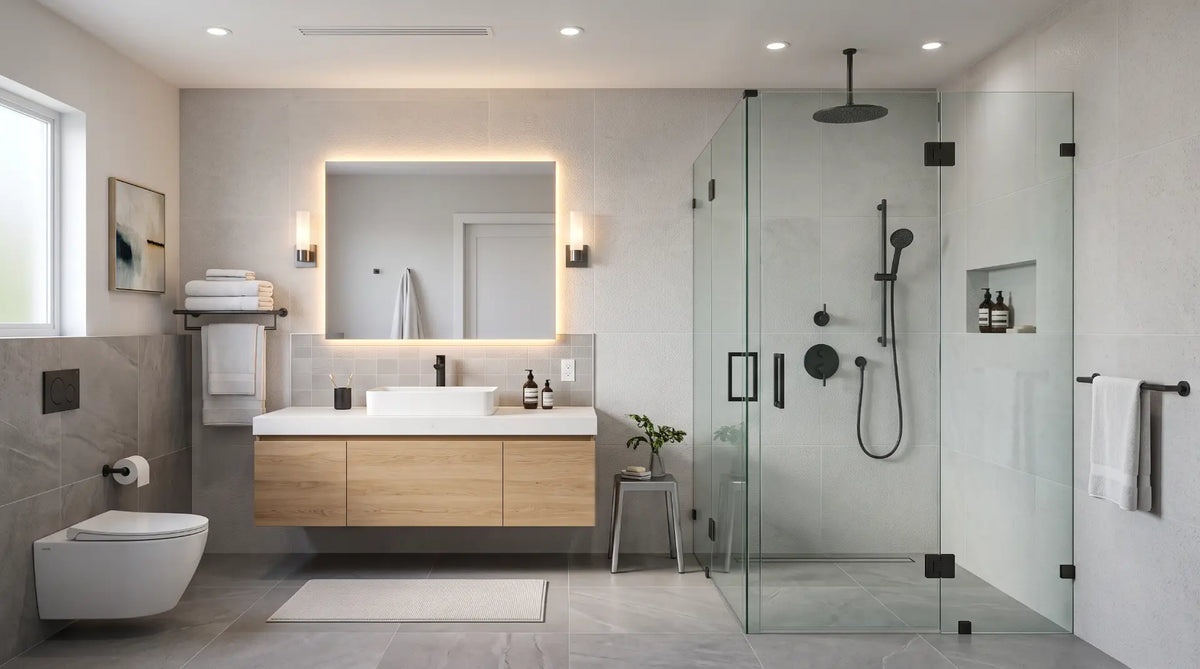
If your mirror is still fogged and the air still feels damp long after you've finished showering, something in your bathroom's ventilation is failing - not just running quietly in the background. Bathify's team walks through the actual causes and the fixes that work for each one.

A bathroom that's still steamy, damp-feeling, or fogged up 30-60 minutes after a shower has a ventilation problem, not a "normal bathroom" problem. At Bathify, this is one of the most frequent questions our team fields from customers - usually phrased some version of "why is my bathroom always so humid, even with the fan on?" The short answer is that a fan running isn't the same as a fan working. Humidity lingers when moist air isn't actually being removed from the room fast enough, and that failure almost always traces back to one of a handful of specific, fixable causes rather than "just how bathrooms are."
This guide walks through the real causes of persistent bathroom humidity, how to tell whether your bathroom's humidity level is actually a problem or just normal shower steam, fixes you can do today with no tools, and the permanent ventilation fixes that solve it for good.
If you want a quick win today, skip to Immediate Fixes. If you want to actually diagnose why your specific bathroom stays humid, read The Real Reasons Bathrooms Stay Humid first - it's written as a checklist you can walk through room by room. If you've already confirmed it's a ventilation issue, go straight to Permanent Fixes.
Our team at Bathify sees the same four causes come up again and again when customers describe a bathroom that "just won't dry out." Most humid bathrooms have one or more of these problems stacked together, which is why fixing only one sometimes doesn't feel like it made a difference.
A fan rated below the room's required CFM (cubic feet per minute) will run constantly without ever fully clearing the air. This is especially common in bathrooms with a shower/tub combo or an enclosed shower stall, which need more airflow than a powder room.
A fan duct that dead-ends in the attic instead of terminating outside just relocates humidity - it doesn't remove it, and it can cause attic condensation and mold as a side effect. Long, bent, or crushed duct runs also cut effective airflow substantially.
Most people switch the fan off the moment they leave the bathroom. The fan's real job continues for 20-30 minutes after - long enough to clear the humidity that's still suspended in the air even once the shower itself has stopped.
An exhaust fan pulls air out of the room, but fresh air has to come in from somewhere to replace it. A bathroom door sealed tight with no gap, and no window or vent, can starve the fan of airflow and reduce how effectively it clears humidity.

A short humidity spike during a shower is not a problem - it's physics. What matters is how long it takes to clear. Our team at Bathify suggests this simple test: time how long after you finish showering it takes for the mirror to stop fogging and the air to feel normal again. Under 20-30 minutes with the fan running is healthy. An hour or more, or humidity that's still noticeable when the next person uses the bathroom, means the ventilation isn't keeping up.
| Sign | Normal | Needs Attention |
|---|---|---|
| Mirror fog | Clears within 15-20 minutes | Still fogged 30-60+ min later |
| Air feel | Dry to the touch shortly after | Damp, sticky air lingers |
| Smell | No lingering odor | Musty smell develops over hours |
| Surfaces | Tile and walls dry within an hour | Visible water droplets persist |
| Paint / grout | No changes over time | Peeling paint, dark grout lines developing |
If you're seeing multiple items in the "needs attention" column, the fix is almost certainly ventilation-related rather than a one-off issue. If you're also noticing dark spotting on grout, caulk, or the ceiling above the shower, that's a related but separate issue - see Bathify's mold and mildew prevention guide for the cleanup and prevention steps.
Before any renovation or fan replacement, these habit-level changes noticeably reduce how humid a bathroom feels and how long that humidity sticks around.
Run the fan for longer than you think you need to. Leave it running 20-30 minutes after your shower ends, not just during it. This single change resolves a large share of "my bathroom stays humid" complaints without touching any hardware.
Crack the door or leave a gap under it. If the fan has nowhere for replacement air to come from, it can't move air efficiently. Undercutting the bathroom door (a standard fix - about 3/4" to 1" of clearance) or cracking it open after showering gives the fan the airflow it needs.
Squeegee the shower and turn the water to cool for the last few seconds. Less standing water means less moisture evaporating into the air after you're done, and a brief cool rinse reduces the volume of hot steam generated in the first place.
Clean the fan grille and check the exterior vent cap. A dust-clogged grille can cut a fan's real-world airflow dramatically even if the motor itself is fine. Outside, make sure the vent cap's flapper opens freely and isn't painted or rusted shut.
Don't dry laundry in the bathroom. A drying rack of wet towels or clothes adds a steady, hours-long moisture load that most bathroom fans simply aren't sized to keep up with alongside normal shower use.
If the quick fixes above only help a little, the underlying issue is almost always the fan itself - its size, its venting, or both. Bathify's team recommends working through these in order, since a bigger fan won't help if the duct behind it is the actual bottleneck.
Work through these in order before replacing anything
1. Confirm the fan is correctly sized. A fan needs roughly 1 CFM per square foot of bathroom floor area as a baseline (more for rooms with a separate shower and tub, per common HVI sizing guidance). An undersized fan is the single most common root cause of chronic humidity.
2. Confirm the duct actually terminates outside. Check the attic or crawlspace where accessible - a duct that dead-ends without reaching an exterior wall or roof cap is doing almost nothing useful and needs to be rerouted, not just have a stronger fan attached to it.
3. Shorten and straighten the duct run where possible. Every 90-degree bend in flexible ducting reduces airflow meaningfully; a shorter, straighter run to the nearest exterior wall dramatically outperforms a long run to a distant roof vent, even with an identical fan.
4. Add a humidity-sensing fan or timer if forgetting to run it long enough is the issue. A humidity-sensing fan switches on automatically once it detects elevated moisture and keeps running until levels normalize, removing the guesswork entirely.
5. Only then consider upgrading fan capacity. If sizing, venting, and run-time are all confirmed correct and humidity is still a persistent issue, moving up to a higher-CFM unit is the appropriate next step.
For the full mechanics of each of these - sizing calculations, venting options when there's no attic or exterior wall access, and step-by-step installation - Bathify's companion guides go deeper than we can cover here: how to choose the right fan size (CFM & sones), venting without attic or exterior wall access, humidity-sensing vs timer fans, and step-by-step DIY installation.
Chronic bathroom humidity isn't just uncomfortable - it's the single biggest driver of the maintenance problems homeowners eventually call a contractor for. Sustained relative humidity above roughly 60% is the condition mold and mildew need to establish themselves in grout, caulk, and ceiling corners, according to guidance from the U.S. Environmental Protection Agency. Left unaddressed long enough, the same moisture also causes paint to bubble and peel, wood vanities and trim to warp or swell, and metal fixtures and hardware to corrode faster than they should. For general background on how relative humidity is measured and why it behaves the way it does in an enclosed space, Wikipedia's overview of relative humidity is a useful reference.
Our team at Bathify treats a chronically humid bathroom as a maintenance issue worth solving early, not a cosmetic annoyance to tolerate - the cost of a better fan or a resealed duct run is almost always smaller than the cost of replacing water-damaged drywall, warped cabinetry, or peeling paint down the line. If you're already seeing dark spotting or a musty smell, our mold and mildew prevention guide covers safe cleanup and when to call a professional.
While ventilation itself is the primary fix, a few fixtures in Bathify's collection directly reduce the visible effects of a humid bathroom and make day-to-day life easier while you're improving airflow.

The most visible symptom of a humid bathroom is a fogged mirror you can't see yourself in for ten minutes after a shower. Our team recommends the Alder's built-in anti-fog heating element specifically for this - it keeps the mirror surface warm enough that condensation never forms on it, so you're not waiting out the humidity just to get ready in the morning while the ventilation fix is underway.
Work through this order to permanently fix a humid bathroom
1. Time it. If your bathroom clears within 20-30 minutes of the fan running, it's working correctly - the discomfort during a shower is normal, not a problem.
2. Run the fan longer. The single highest-impact free fix: 20-30 minutes after the shower ends, every time.
3. Give it air to replace. Undercut the door or crack it open so the fan has somewhere to pull fresh air from.
4. Check the duct, not just the fan. Confirm it terminates outside, is reasonably short and straight, and the exterior cap opens freely.
5. Size and upgrade last. Only move to a bigger fan or humidity-sensing model once venting and habits are confirmed correct - see Bathify's full ventilation guide for sizing.
6. Address symptoms in the meantime. An anti-fog mirror and a towel warmer from Bathify won't fix the airflow, but they remove the daily annoyance while you do.
Shop Humidity-Fighting Bathroom Essentials at Bathify
Anti-fog LED mirrors and towel warmers that keep a humid bathroom livable while you fix the ventilation behind it. Free shipping on orders over $50. Shipped across the USA.


