







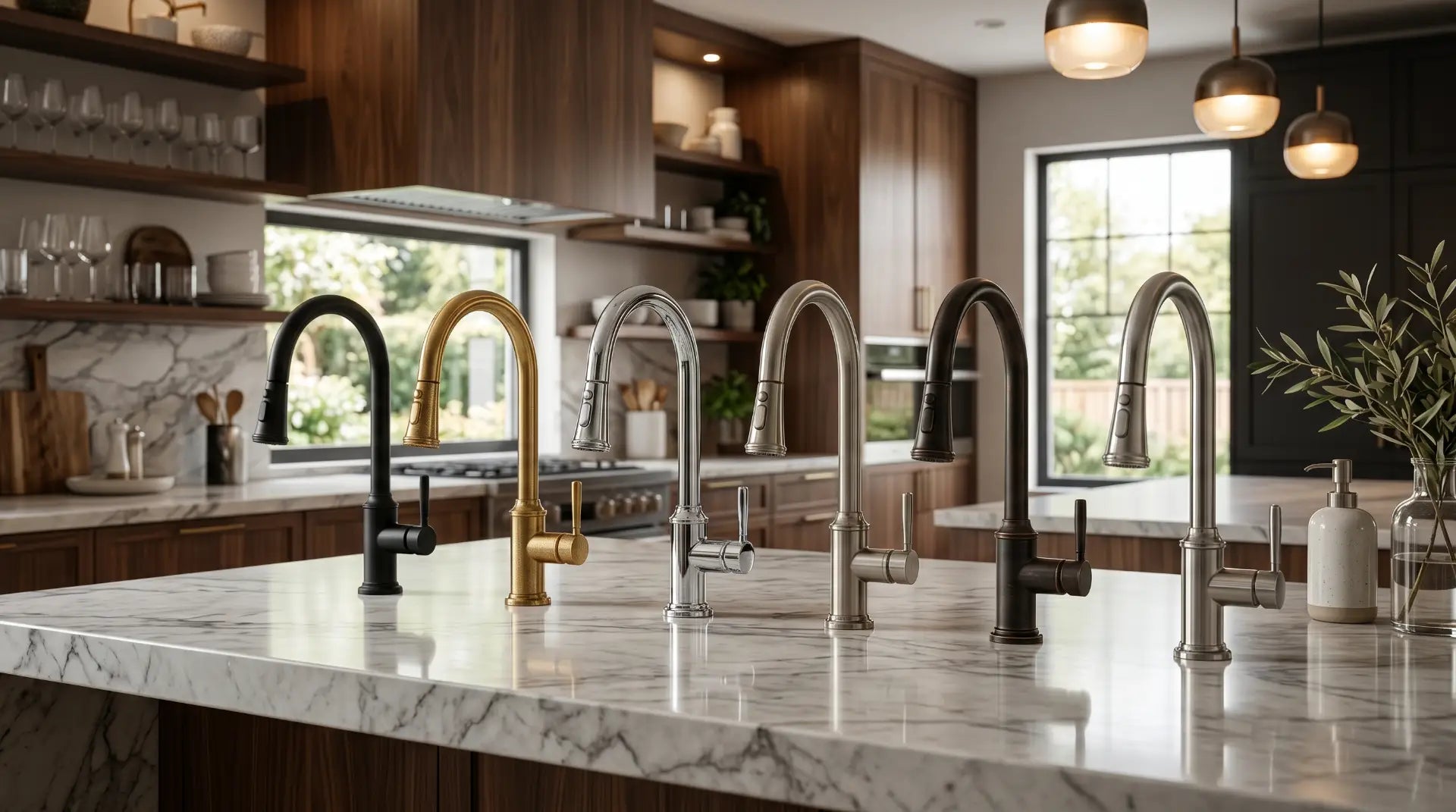
The finish you choose affects daily cleaning time, how fast the faucet shows wear, and whether the entire kitchen reads as intentionally designed. This guide covers every major kitchen faucet finish - durability, maintenance, coating technology, kitchen style pairings, and the one rule that prevents finish mismatches across your whole kitchen.
Kitchen faucet finish decisions get made on aesthetics and reversed on maintenance. Buyers choose polished chrome because it photographs well, then spend twelve months wiping water spots off the spout every day. They choose oil-rubbed bronze because it looks warm in the showroom, then discover that the living finish wears to reveal brass underneath in ways they didn't anticipate. They choose matte black because it's trending, then find a product with a lacquer-over-zinc body that starts flaking at the spout joint within three years of daily use.
This guide prevents all three outcomes. It covers the six major kitchen faucet finish categories in the US market - matte black, polished chrome, brushed nickel, oil-rubbed bronze, brushed gold, and spot-resist stainless - explaining exactly what each finish is made of, how it performs under daily kitchen use, what cleaning it requires, which kitchen styles it pairs with, and what to look for in product specs to distinguish a quality PVD coating from a lacquer that will fail. It also covers the one finish-matching rule that determines whether your kitchen reads as intentionally designed or accidentally assembled.
Before selecting a faucet finish, establish: (1) What is the dominant metal finish in your kitchen right now - cabinet hardware pulls, light fixtures, and range hood accents? That finish is your anchor, and your faucet should match it or be the only exception if you're making a deliberate mixed-metal choice. (2) What is your cleaning tolerance - are you the type to wipe down the faucet daily, or does maintenance happen weekly at best? The answer to that second question should eliminate at least one or two finishes from your shortlist before you even look at products. Our Pull-Down vs. Pull-Out Kitchen Faucet Guide covers the functional decision; this guide handles the finish decision.
Match your kitchen's dominant hardware finish. Choose PVD coating over lacquer. Then pick the color that fits your kitchen style.
If your cabinet pulls are matte black, your faucet should be matte black. If they're brushed gold, your faucet should be brushed gold. Finish consistency across all metal surfaces in the kitchen - faucet, hardware, light fixtures, pot filler, range hood accents - is the single decision that determines whether a kitchen reads as designed or assembled. Once you have your finish category, choose a faucet that specifies PVD (Physical Vapor Deposition) coating - not lacquer, not electroplating alone - because PVD is the only coating technology that consistently delivers 10+ years of finish integrity under daily kitchen use.
For pure durability and lowest maintenance: spot-resist stainless or brushed nickel. For contemporary design impact: matte black. For warm-toned traditional kitchens: oil-rubbed bronze. For transitional kitchens with natural stone: brushed gold. For the cleanest look in a brightly lit kitchen: polished chrome - but only if you're committed to daily wiping.
Every kitchen faucet finish is a coating applied over a base material - usually brass, zinc alloy, or stainless steel. The color you see is the coating. The longevity you experience is determined by the coating technology, not the color. Two matte black faucets that look identical in a product photo can have dramatically different lifespans depending on whether the finish is PVD-deposited or lacquer-sprayed. Understanding this distinction before you buy is the single highest-value piece of knowledge in this guide.
| Coating Technology | How It Works | Expected Lifespan | Cost Impact | Verdict |
|---|---|---|---|---|
| PVD (Physical Vapor Deposition) | Metal (titanium nitride, zirconium) vaporized in a vacuum chamber and bonded to the faucet surface at the molecular level. The finish becomes part of the metal, not a coating on top of it. | 10-20+ years with normal use. Resistant to tarnish, corrosion, and most household chemicals. | Adds $50-$200 to faucet cost. Worth it at every price point it's available. | Specify This |
| Electroplating (Chrome, Nickel) | Metal dissolved in solution and electrically deposited onto the faucet body. Creates a true metal surface rather than a coating, but thickness and adhesion vary by manufacturer. | 7-15 years for quality electroplating. Variable - thickness and process quality determine longevity. | Industry standard at mid-range and premium price points. Look for "lifetime warranty" as a proxy for electroplating quality. | Acceptable |
| Lacquer / Powder Coat | Colored lacquer or powder coat sprayed over the faucet body and baked. Creates a surface coating - not bonded to the metal at the molecular level. Most common in budget faucets under $150. | 2-5 years before chipping, flaking, or color shift begins. Accelerated by hard water, acidic cleaners, and high heat exposure near cooktops. | Lowest cost - typically how budget faucets achieve exotic colors (matte black, brushed gold) at low price points. | Avoid |
How to identify PVD in a product listing: Reputable manufacturers using PVD explicitly say so - look for "PVD finish," "PVD coating," or brand-specific names like Moen's "Spot Resist" or Kohler's "Vibrant" finishes, both of which use PVD technology. If a product listing mentions only "matte black finish" or "powder coat" without specifying the coating process, assume lacquer. A lifetime finish warranty is a reliable secondary indicator of PVD - manufacturers don't offer lifetime warranties on lacquer coatings because they know they'll fail.

Matte black is the dominant kitchen faucet finish in new US kitchen renovations in 2026, overtaking brushed nickel for the first time. Its appeal is concrete and practical: the non-reflective surface diffuses light rather than reflecting it, which means fingerprints and water spots don't catch light the way they do on polished or metallic finishes. In a busy cooking kitchen where the faucet gets touched hundreds of times a week, a matte black faucet will visually look cleaner between wipes than chrome or polished nickel - not because it's actually cleaner, but because the surface texture hides the evidence of use.
The design case is equally strong. Matte black is finish-neutral in the sense that it pairs with both warm and cool color palettes - dark navy cabinetry, white shaker cabinets, gray quartz, concrete countertops, and natural wood all accommodate matte black hardware without conflict. It is the finish that contemporary kitchen designers default to when the client wants everything to feel cohesive without having to match warm and cool metal tones across fixtures.
The caveat that applies to matte black more than any other finish: coating technology is everything. A PVD matte black faucet on a solid brass body from a brand like Kohler, American Standard, or a premium line at Bathify will hold its finish under daily kitchen use for a decade or more. A lacquer-coated matte black faucet from an unknown brand - the kind that shows up in large quantities at $50-$80 price points on mass-market platforms - will show finish deterioration within two to three years of use, especially at the spout joint and handle base where water pools.

Polished chrome is the original kitchen faucet finish - the standard against which all others developed as alternatives. It is a true metal surface created by electroplating chromium over a brass or zinc body, and when done at quality (thick chrome layer, quality brass substrate), it is one of the most durable finishes in the category. Chrome is also the hardest to damage by chemical cleaners - it tolerates mild acids and harder cleaning products better than matte coatings or living finishes.
The maintenance reality is why chrome has lost ground to brushed and matte alternatives: the mirror surface shows every water drop, every fingerprint, and every smear from the moment they land. In a kitchen used daily, chrome requires wiping after essentially every use if you want it to look like the showroom photos. Homeowners who commit to this - wiping the faucet with a dry microfiber cloth after each sink use - are rewarded with a finish that genuinely looks like new indefinitely. Homeowners who don't are looking at a spotty, fingerprinted faucet within a week of installation.
Polished chrome is the right choice for kitchens with abundant natural light (where the reflections look intentional, not harsh) and for homeowners who genuinely maintain their fixtures - not aspirationally, but habitually. It is not the right choice for busy family kitchens where multiple people use the sink throughout the day. It also performs best in cool-toned kitchens: stainless appliances, white or gray cabinetry, marble or white quartz countertops.

Brushed nickel was the dominant kitchen faucet finish from approximately 2005 through 2023, and while matte black has overtaken it in new construction in 2026, brushed nickel remains the most universally compatible finish across kitchen styles. The brushed texture - created by mechanically abrading the nickel surface with fine bristles before or after plating - scatters reflected light rather than bouncing it back as a single reflection, which is why it hides fingerprints and water deposits so effectively. The same physics that make chrome challenging to maintain make brushed nickel forgiving.
Brushed nickel reads as a cool-neutral: it lacks the warmth of brushed gold or oil-rubbed bronze but is softer than polished chrome. This positions it as the most versatile choice for kitchens that span multiple style directions - transitional kitchens with both warm (wood) and cool (quartz) elements, updated traditional kitchens where replacing everything at once isn't feasible, and any kitchen where the hardware finish decision was made before the cabinet and countertop selections were finalized.

Oil-rubbed bronze is one of the few genuinely "living" finishes in the kitchen faucet category - meaning it is designed to change appearance over time through use. The finish is created by chemically treating a bronze or bronze-toned base to produce a dark, mottled surface that highlights high-use areas (handle tops, spout tip) as the oil treatment wears away, revealing lighter bronze beneath. This patination process is intentional and considered part of the finish's character by its designers and advocates.
The appeal is a handcrafted, aged aesthetic that photograph-ready modern finishes can't replicate. In a kitchen with traditional cabinetry, warm wood elements, farmhouse-style hardware, or Tuscan or Mediterranean design influence, oil-rubbed bronze creates a finish depth and character that no other single-color finish matches. It pairs naturally with cream or off-white cabinetry, butcher block or soapstone countertops, and copper or terracotta tile accents.
The consideration that buyers must understand: if you want the faucet to look the same in five years as it does on day one, oil-rubbed bronze is not the right finish. The living quality is not a defect - it is the finish's design intent. Buyers who understand this and want an aged, evolving fixture will be satisfied. Buyers who expected a consistent dark finish and find it lightening at contact points will not be. Ask explicitly before purchasing whether the product uses a genuine living finish or a sealed fixed-color coating - some manufacturers sell "oil-rubbed bronze" as a fixed lacquer color that doesn't change, while others sell a true living finish that does.

Brushed gold is the premium finish statement in the current kitchen faucet market. Where matte black communicates contemporary restraint, brushed gold communicates warmth, intention, and luxury - the kitchen equivalent of the statement piece that elevates the entire space. In transitional kitchens with white shaker cabinets and Carrara-look quartz, brushed gold hardware (faucet, cabinet pulls, light fixtures, pot filler) is the single change that most consistently elevates the space from standard to designed.
Champagne bronze - a softer, slightly more muted gold with bronze undertones - occupies the space between brushed gold and oil-rubbed bronze, reading as warm but less emphatically gold. It pairs with the same warm-toned kitchens as brushed gold but handles cream cabinetry and butcher block more naturally than pure gold, which can read as too bright against very warm tones. Both brushed gold and champagne bronze are available at Bathify in kitchen faucets, pot fillers, and matching hardware lines.
The critical specification for brushed gold: PVD coating is mandatory, not optional. Gold-toned finishes applied via traditional electroplating have a known failure mode - they drift from gold toward a yellowed or greenish tone as the base metal oxidizes through a thinning plating layer. PVD-deposited gold finishes bond at the molecular level and maintain their color with no shift over the product's lifespan. If a brushed gold faucet listing doesn't mention PVD, ask - or avoid. A gold finish that shifts color in three years is worse than a brushed nickel finish that holds its tone for fifteen.

Spot-resist stainless is not a pure stainless steel finish - it is a brushed stainless look with an added polymer or PVD top coat engineered specifically to repel fingerprints and water deposits. Moen pioneered this finish category and maintains it as a signature offering; Kohler offers equivalent technology under different branding. The practical result is a faucet that looks brushed stainless but requires significantly less maintenance than true stainless or brushed nickel to maintain that appearance in a daily-use kitchen.
In a kitchen where the primary concern is finding a finish that requires the least intervention to look clean - families with young children, heavy daily cooking households, anyone who finds fixture maintenance genuinely burdensome - spot-resist stainless is the functional answer. It pairs naturally with stainless appliances (the color match is close enough to read as intentional without needing to be exact), and with gray, white, or light warm cabinetry. It doesn't carry the design punch of matte black or brushed gold, but in a kitchen where the faucet is meant to work rather than to be noticed, that's exactly right.
| Finish | Maintenance Level | Durability (with quality coating) | Water Spot Visibility | Fingerprint Visibility | Kitchen Style Fit | Coating to Specify |
|---|---|---|---|---|---|---|
| Matte Black | Low | 10-20 yrs (PVD); 2-5 yrs (lacquer) | Very Low | Very Low | Contemporary, industrial, modern farmhouse | PVD - mandatory |
| Polished Chrome | High | 15+ yrs (quality electroplating) | Very High | Very High | Traditional, transitional, bright modern | Thick electroplate; lifetime warranty |
| Brushed Nickel | Low | 10-15+ yrs | Low | Low | All styles - universal | Electroplating; PVD available at premium |
| Oil-Rubbed Bronze | Low | Variable - living finish changes by design | Medium | Low-Medium | Traditional, farmhouse, Tuscan, rustic | Living finish - confirm it's intentional |
| Brushed Gold | Low | 10-20 yrs (PVD); color shift risk (electroplate only) | Low | Low | Transitional, contemporary glam, eclectic | PVD - mandatory for color stability |
| Spot-Resist Stainless | Very Low | 10-15+ yrs | Very Low | Very Low | Contemporary, transitional, family kitchen | PVD + polymer top coat; brand-specific |
The finish pairing question has two layers: which finishes work aesthetically with which kitchen styles, and which color temperatures (warm vs. cool) are compatible without requiring everything to be rebuilt. These style grids cover both - use the first to confirm your current kitchen style, then confirm finish compatibility within that style.
- Matte black - first choice
- Brushed nickel - strong second
- Spot-resist stainless - functional match
- Polished chrome - only in bright, minimalist spaces
- Avoid: oil-rubbed bronze, champagne bronze
- Polished chrome - the historical anchor finish
- Oil-rubbed bronze - warm traditional depth
- Brushed nickel - neutral contemporary update
- Avoid: matte black (too contemporary)
- Avoid: brushed gold unless softer champagne tone
- Matte black - dominant choice in new farmhouse kitchens
- Oil-rubbed bronze - traditional farmhouse aesthetic
- Brushed nickel - always works
- Avoid: polished chrome (too modern, too clean)
- Avoid: brushed gold (not typically farmhouse)
- Brushed gold - the transitional premium choice
- Brushed nickel - safe and always compatible
- Champagne bronze - warm transitional bridge finish
- Matte black - works with cool-tone transitional kitchens
- Avoid: oil-rubbed bronze (too warm/aged)
- Matte black - the industrial standard
- Spot-resist stainless - industrial workhorse
- Polished chrome - acceptable in cleaner industrial spaces
- Avoid: brushed gold (too refined)
- Avoid: oil-rubbed bronze (wrong warm tone)
- Brushed nickel - clean, minimal metallic
- Matte black - bold Scandinavian accent
- Spot-resist stainless - functional, invisible aesthetic
- Avoid: oil-rubbed bronze (too ornate)
- Avoid: polished chrome (too flashy for Scandinavian restraint)
Kitchen finishes split into two color temperature families - warm (gold, bronze, brass, champagne) and cool (chrome, nickel, stainless, matte black). Mixing within a family looks intentional. Mixing across families - brushed gold faucet with chrome cabinet pulls - usually looks accidental. Matte black is the only finish that bridges both families comfortably.
Every kitchen design resource covers this rule, and most buyers still underestimate it: choose one dominant metal finish across all metal surfaces in the kitchen, then apply it consistently. Faucet, cabinet pulls, light fixtures, pot filler, range hood accent trim, and appliance handles - all in the same finish. This single decision is what makes a kitchen look designed rather than assembled from whatever was on sale at four different stores.
If your kitchen faucet is matte black, your cabinet pulls should be matte black, your light fixtures should have a matte black frame or shade, your range hood should have matte black accents or be a matte black unit, and if you have a pot filler, it should be matte black. Every departure from the dominant finish introduces a visual inconsistency the eye will find. The kitchen in the Bathify kitchen sink buying guide is explicit about this: "one dominant finish across all metal surfaces - faucet, cabinet hardware, range hood accents, and light fixtures - produces a kitchen that reads as designed rather than assembled." Browse kitchen faucets and pot fillers in matching finishes at Bathify to apply this principle across your kitchen.
Mixed-metal kitchens - where two finish families are deliberately combined - are a valid design choice when done intentionally. The rules for mixing: choose a dominant finish (70-80% of all metal surfaces) and one accent finish (20-30%); the accent should be in the same color temperature family as the dominant (warm with warm, cool with cool), with matte black as the only cross-family exception. Common successful combinations: brushed gold dominant + matte black accent (gold hardware, matte black faucet); brushed nickel dominant + matte black accent (nickel fixtures, black faucet); matte black dominant + brushed gold accent (black faucet, gold pulls).
Start with your cabinet hardware, not your faucet: Cabinet pulls are typically the most expensive and most permanently installed metal elements in the kitchen. If you already have cabinet pulls in place, match your faucet to them - not the other way around. If you're selecting everything new, decide the cabinet pull finish first (it will influence the most square footage of visible metal), then match the faucet, then the light fixtures, then the pot filler. Working in that sequence prevents the most common finish mismatches.
Faucet finish failure is almost always caused by cleaners rather than use. The number-one cause of premature finish deterioration across all kitchen faucet finishes is the application of harsh chemical cleaners - bleach, ammonia-based products, acidic scale removers (CLR, lime-away), and abrasive scrubbing pads. Every finish in this guide will be damaged or destroyed by these products, regardless of coating technology or price point.
| Finish | Daily Routine | Weekly Clean | For Mineral Deposits | Never Use |
|---|---|---|---|---|
| Matte Black | Wipe with dry microfiber after heavy use - optional | Damp cloth with mild dish soap; rinse and dry | Diluted white vinegar on cloth (never undiluted); rinse immediately | Abrasive pads, bleach, CLR, ammonia, wax |
| Polished Chrome | Wipe with dry microfiber after every use - required for showroom appearance | Damp cloth with mild soap; buff dry with microfiber | Diluted white vinegar or lemon juice - chrome tolerates mild acids better than other finishes | Abrasive pads, steel wool, undiluted bleach |
| Brushed Nickel | Not required - wipe when visibly dirty | Warm water and mild soap; rinse and dry; wipe with grain direction | Diluted vinegar on cloth applied with grain direction; rinse promptly | Steel wool, abrasive cleaners, polishing compounds (disturb brushed texture) |
| Oil-Rubbed Bronze | Not required - the living finish hides daily use marks | Dry microfiber or barely damp cloth only; no soap needed | Warm water only; dry immediately; mineral deposits should be left to the natural patination process | Any chemical cleaner, vinegar, wax, polish - all disrupt the living finish process |
| Brushed Gold (PVD) | Not required with PVD | Warm water and mild soap; rinse; dry with soft cloth | Damp cloth with very mild soap - avoid any acid on gold tones | Abrasive pads, acidic cleaners (vinegar), polishing compounds, wax |
| Spot-Resist Stainless | Not required - the coating repels most deposits | Damp cloth; for stubborn spots, mild dish soap | Manufacturer-approved stainless cleaner; rinse immediately | Steel wool, abrasive cleaners, bleach |
Match your hardware. Choose PVD. Then pick the color that fits your kitchen - in that order.
The kitchen faucet finish decision is made in the wrong order by most buyers: they pick the color they like, then discover it conflicts with their cabinet pulls, or the coating fails in three years, or they've created a finish mismatch across their kitchen that no amount of accessories will fix. The correct order: identify your dominant kitchen hardware finish → select a faucet in that finish with explicit PVD coating confirmation → apply the same finish to all remaining metal surfaces in the kitchen.
Choose matte black if: your kitchen is contemporary, industrial, or modern farmhouse; you want the lowest-maintenance finish with the strongest design impact; and you will verify PVD coating before purchasing.
Choose brushed nickel if: you want universal compatibility with any kitchen direction; you're renovating in phases and can't commit to a design direction yet; or you want the safest finish choice with proven long-term market compatibility.
Choose brushed gold or champagne bronze if: your kitchen is transitional with white or light cabinetry and warm countertops; you want the finish that most effectively signals a deliberately designed kitchen; and you will confirm PVD coating for color stability.
Choose polished chrome if: your kitchen is traditional or brightly lit contemporary; you are genuinely committed to wiping the faucet dry after daily use; and you want the finish with the strongest visual presence in a well-lit space.
Choose oil-rubbed bronze if: your kitchen is farmhouse, traditional, or Tuscan in style; you appreciate an evolving, aged finish that changes with use; and you understand the living finish is a feature, not a defect.
In all cases: match the faucet finish to your cabinet hardware, light fixtures, pot filler, and range hood accents. One dominant finish across all metal surfaces is the rule that produces a kitchen that looks designed. Browse Bathify's kitchen faucets, pot fillers, and range hoods in consistent finishes to apply this across your whole kitchen.
Shop kitchen faucets at Bathify - free shipping across the USA
Browse kitchen faucets in matte black, brushed nickel, brushed gold, oil-rubbed bronze, and chrome - pull-down, pull-out, and pot filler styles. Free shipping on orders over $50 to the continental US.


