







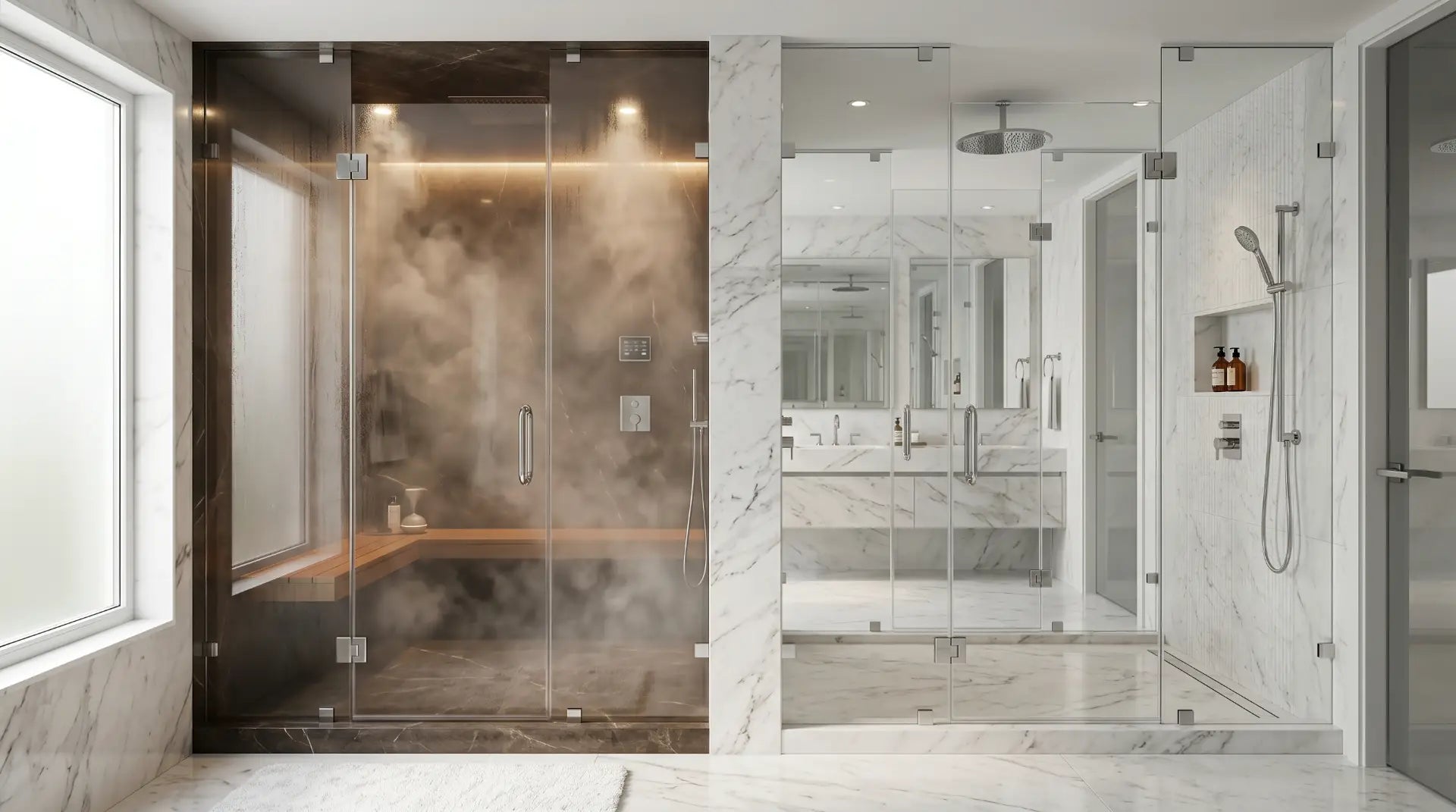
A regular shower gets you clean in five minutes. A steam shower turns that same enclosure into a private spa - but it costs more, needs a sealed room, and isn't right for everyone. This guide lays out the real costs, the genuine benefits, what daily use actually feels like, and exactly who should (and shouldn't) build one.
A regular shower has one job: get you clean, quickly and reliably. A steam shower keeps that job but adds another - turning the enclosure into a warm, humid retreat you sit in to unwind. That second job is the entire reason people consider one, and it's also why the comparison isn't really "which is better." It's "is the spa experience worth the cost, the space, and the build requirements for your home?"
The honest headline: a steam shower is a genuine luxury upgrade with real day-to-day appeal, and it's surprisingly water-efficient - but it's also several thousand dollars, it needs a fully sealed enclosure, and it's best planned during a remodel rather than bolted on later. A regular shower, especially one fitted with a good thermostatic shower system or rain head, delivers 90% of the everyday satisfaction for a fraction of the price and effort.
Below, we compare both across the seven factors that decide whether a steam shower earns its place - cost, running costs, benefits, build requirements, maintenance, daily use, and resale - then cover whether you can convert an existing shower, who should actually build one, and what your very first steam session will feel like. If you're planning the whole shower from scratch, pair this with our complete shower systems buying guide.
Will you actually use the steam regularly - two, three, four times a week - and are you remodeling anyway? If yes, a steam shower can be a deeply rewarding upgrade that you'll reach for after workouts and on cold mornings. If the steam would be an occasional novelty, or your bathroom isn't being renovated, the money is almost always better spent making a regular shower excellent. Be honest about how often you'll really use it before you commit several thousand dollars.
A steam shower is worth it if you'll use it regularly, you're remodeling, you own your home, and you have the budget ($2,500-$6,000+). For tight budgets, renters, finished bathrooms, or quick everyday washing, a well-equipped regular shower is the smarter value.
Choose a steam shower for at-home relaxation, post-workout recovery, and a spa-like routine - provided your bathroom can be fully sealed and you're already doing the construction. Choose a regular shower if you want the best value, a fast everyday wash, renter-friendly flexibility, or you simply don't want the cost and upkeep of a generator and sealed enclosure. The two aren't enemies: a steam shower is a regular shower with a wellness mode added on top, at a meaningfully higher price.
Read the full breakdown below, or skip to the decision matrix to see which fits your situation in 30 seconds.
Here's how the two compare across what most people weigh. We unpack each row further down.
| Factor | Steam Shower | Regular Shower | Edge |
|---|---|---|---|
| Upfront cost | $2,500-$6,000+ installed | $300-$2,000 (fixtures) | Regular |
| Water per session | ~1 gallon (15 min) | 20-25 gallons (10 min) | Steam |
| Wellness experience | Spa-level; warm, humid | Standard; quick & clean | Steam |
| Build requirements | Fully sealed enclosure + generator | Standard waterproofing | Regular |
| Time to use | 10-15 min to heat up | Instant | Regular |
| Maintenance | Generator care + sealed door | Standard cleaning | Regular |
| Resale appeal | Strong in higher-end markets | Expected baseline | Steam |
| Best for | Owners remodeling for wellness | Everyone, especially value & renters | Depends |
A steam shower is a fully enclosed shower that adds a steam generator - a small appliance, usually tucked into a nearby closet, vanity, or wall cavity, that boils water and pipes warm vapor into the sealed enclosure through a steam head. You set a temperature and time on a digital control, the generator brings the space up to roughly 110-115°F at near-100% humidity, and you sit and relax in the warm mist. Crucially, it's still a normal shower too: the showerhead and valve work exactly as before, so one enclosure does double duty.
The non-negotiable part is the enclosure. For steam to build and stay, the space must be vapor-tight - sealed walls, a sealed ceiling (ideally sloped so condensation runs to the walls rather than dripping on you), and a fully sealed door with no open transom or gap at the top. This is why steam pairs naturally with a fully enclosed design rather than an open layout, a distinction we cover in walk-in shower vs shower enclosure, and why it needs a sealed glass door like the ones in our frameless vs semi-frameless shower doors guide.
A regular shower is the standard setup almost every home already has: a showerhead and valve delivering heated water on demand, in an enclosure or open walk-in that's waterproofed but not sealed for vapor. There's no generator, no heat-up wait, and no special enclosure requirement beyond normal tile or panel waterproofing. You turn it on, it works instantly, and you're done in minutes.
What a regular shower lacks in spa theater it makes up for in value and flexibility. For a few hundred dollars in fixtures you can dramatically upgrade the experience - a rain head or handheld, a quality shower valve, or a full shower panel system - and if water pressure is your real complaint, that's often fixable too, as covered in our guide to the best shower heads for low water pressure.

This is where the regular shower wins decisively. Upgrading a regular shower with great fixtures runs a few hundred to a couple thousand dollars, and much of it is DIY-friendly. A steam shower is a different financial category: most residential installs land between $2,500 and $6,000, and premium builds with high-end enclosures and extras can pass $10,000.
Where does the money go? The steam generator itself is usually $1,000-$2,500, sized to the volume of your enclosure. The digital control adds $200-$600. Then there's professional installation - dedicated electrical, plumbing, a fully waterproofed and vapor-sealed enclosure, and often a sloped ceiling - which typically adds $1,000-$3,000 or more depending on your bathroom and local labor rates. None of that is optional, which is why steam is a remodel decision rather than an upgrade you bolt on.

Here the steam shower flips the script. A steam generator uses only about a gallon of water for a 15-minute session, because it's converting a small amount of water into vapor rather than pouring gallons down the drain. A standard showerhead at 1.8-2.5 gallons per minute uses 20-25 gallons over a 10-minute shower. On water alone, a steam session is dramatically cheaper.
The offset is electricity: the generator draws power to boil water into steam, adding a modest amount to each session's cost. In practice, the very low water use often makes a steam session comparable to - or cheaper than - a long, hot regular shower, especially in areas with high water and sewer rates. The catch is the heat-up time (10-15 minutes) before you can use it, which the regular shower never has.

This is the steam shower's reason for being. People reach for steam to relax and de-stress, to ease tired muscles after a workout, to temporarily relieve nasal and sinus congestion during a cold, and for the feeling of opened pores and hydrated skin. The warm, enveloping humidity is genuinely soothing in a way a standard shower isn't, and many owners describe their daily routine becoming something they look forward to rather than rush through.
It's worth being honest about the framing: these are general wellness and comfort uses, not medical treatments, and individual results vary. Warm, humid heat can feel great and help you unwind, but a steam shower isn't a cure for any condition. A regular shower offers its own modest version of this - a hot shower relaxes muscles and the steam from hot water can briefly ease congestion - just without the sustained, controlled humidity of a true steam session.

A steam shower has strict build requirements that a regular shower simply doesn't. You need a fully sealed, vapor-tight enclosure: waterproofed walls and ceiling, a ceiling ideally sloped about 2 inches per foot so condensation runs off to the sides instead of dripping, a sealed door that closes top to bottom with no open gap, and a spot for the generator within a reasonable pipe run. Built-in seating - a bench or a quality shower stool - is effectively required, since you sit through a session.
A regular shower asks for none of this beyond standard waterproofing, and it works fine as an open walk-in. That makes the regular shower vastly easier to fit into existing bathrooms, small footprints, and homes where a full reseal isn't practical. If you're weighing storage and seating inside an enclosure, our shower niche vs corner caddy guide helps you plan the interior.

A regular shower is about as low-maintenance as fixtures get: clean the tile and glass, keep the valve and head in good shape, and that's largely it. A steam shower adds a generator to the mix, which means periodic flushing or descaling to manage mineral scale (especially in hard-water areas), occasional checks on the steam head and control, and keeping the door seal in good condition so steam doesn't escape.
None of this is onerous, and a quality generator can last many years, but it is more system to own. The enclosure itself also sees constant high humidity, so ventilation and good sealing matter even more than in a regular shower to keep everything drying out between uses. Plan on a little routine generator care as part of the package.

The two fit different rhythms. A regular shower is instant and efficient - ideal for busy mornings and quick rinses. A steam shower is a ritual: you start the generator, wait 10-15 minutes for it to reach temperature, then settle in for a 10-20 minute session, often followed by a regular rinse. That heat-up time is the practical downside; it rewards planned, unhurried use far more than a dash before work.
In practice, most steam-shower owners use the steam mode a few times a week - after workouts, on cold evenings, when they're sore or stuffed up - and use the same enclosure as a normal shower the rest of the time. So you don't lose the quick everyday shower; you gain a relaxation mode on top of it, with a short wait as the price of entry.

A well-executed steam shower is a genuine showpiece that can help a home stand out, particularly in mid-to-higher-end markets where buyers expect spa-style amenities. It signals a quality, considered renovation and gives listing photos and tours a memorable feature. In the right neighborhood, it can be a real differentiator.
That said, it's not a universal value-add. In entry-level markets, buyers may see it as a nice extra rather than something they'll pay a premium for, and a poorly built or aging steam setup can even read as a maintenance question mark. A clean, modern regular shower is the expected baseline everywhere - it rarely wins points, but it never loses them either. As with the door and fixture choices in our shower systems buying guide, build quality is what buyers actually respond to.
Steam-shower pricing varies widely by enclosure size, finishes, and local labor, but here's a realistic breakdown of the components so you can see what drives the total. Treat these as planning ranges, not quotes.
| Component | Typical Cost | Notes |
|---|---|---|
| Steam generator | $1,000-$2,500 | Sized to enclosure volume; the core of the system |
| Digital control / panel | $200-$600 | Temperature, timer; premium models add presets |
| Sealed enclosure & ceiling | Varies widely | Waterproofing, sloped ceiling, vapor-tight door |
| Electrical & plumbing | $1,000-$3,000+ | Dedicated wiring, water line, drainage; labor-heavy |
| Seating (bench / stool) | $150-$600+ | Effectively required; built-in bench or a quality stool |
| Optional extras | $100-$1,500+ | Aromatherapy, chromotherapy lighting, sound, presets |
| Typical all-in | $2,500-$6,000+ | Premium builds can exceed $10,000 |
For comparison, transforming a regular shower into a great everyday experience - a quality valve, a rain head or handheld, maybe a panel system - typically runs $300-$2,000 in fixtures, much of it installable without major construction. That gap is the heart of the decision: you're paying a large premium specifically for the steam experience, not for getting clean.
Sometimes - but it's a renovation, not an add-on. To convert a regular shower, you generally need to enclose and seal the space top to bottom, add a steam generator with dedicated electrical and plumbing, waterproof (and ideally slope) the ceiling, fit a fully sealed door, and ensure proper drainage and ventilation. An open walk-in shower usually can't be converted without first building it into a sealed enclosure.
The practical takeaway: steam is far easier and cheaper to plan into a full bathroom remodel than to retrofit later. If a remodel is on your horizon, that's the moment to decide. If your shower is finished and you're not renovating, converting it is rarely worth the disruption and cost - and your money goes further upgrading the regular shower instead. If you are building or remodeling, our step-by-step shower system installation guide covers the wall-open stages where steam components are roughed in.
Even if you're not ready to install steam now, you can "rough in" for it during a remodel - run the electrical, plan the generator location, and seal the enclosure - so adding the generator later is straightforward. It's a low-cost way to keep the option open without committing to the full system today.
Find the row that fits your situation and follow the recommendation.
If you've never used one, here's how a typical session goes so there are no surprises. You start the generator from the control panel and give it about 10-15 minutes to bring the enclosure up to temperature. You step into a warm, humid space - around 110-115°F at near-total humidity, which feels enveloping rather than scorching - and sit on the bench or stool. Most people stay 10-20 minutes, breathing slowly and relaxing, then finish with a quick cool rinse using the regular showerhead.
A few things to know going in: it's normal to sweat, the glass will fully fog, and you'll want to stay hydrated. Keep early sessions short until you know how your body responds, and step out if you ever feel lightheaded. Afterward, leave the door open and the fan running so the enclosure dries out. Used this way - planned, unhurried, a few times a week - a steam shower becomes the part of the day you look forward to. Pair it with built-in seating and the right interior, and it's a true at-home retreat.
Build a steam shower if you're remodeling, you'll use it regularly, and the $2,500-$6,000+ fits your budget. Otherwise, put the money into making a regular shower excellent - it's the better value for almost everyone.
The "steam shower vs regular shower" question isn't really a contest between two ways to get clean. A steam shower is a regular shower with a wellness mode added at a significant premium. If you'll genuinely use that mode - after workouts, on cold mornings, to unwind - and you're already opening up the bathroom, it can be one of the most rewarding upgrades in the house, and it sips water in the process. The keys are a fully sealed enclosure, built-in seating, and honest expectations about the heat-up wait and routine generator care.
For everyone else - tight budgets, renters, finished bathrooms, small or un-sealable spaces, or anyone who mainly wants a fast, great daily shower - a well-equipped regular shower wins on value, simplicity, and flexibility. A quality valve, a rain head or handheld, and good water pressure deliver most of the everyday pleasure for a fraction of the cost. Decide based on how often you'll really steam and whether your bathroom can support it - not on the showroom appeal alone.
Upgrading your shower either way? Explore shower systems & faucets, shower benches & stools for seated comfort, and the full showers collection at Bathify. Free shipping on all orders over $50 to the continental US.
Costs, temperatures, and water-use figures in this guide are general planning estimates for US homes and vary by product, enclosure size, local rates, and installation. This article is for general information, not medical advice - consult a healthcare professional about steam bathing if you have health concerns, and confirm product specs and quotes before purchasing.


