







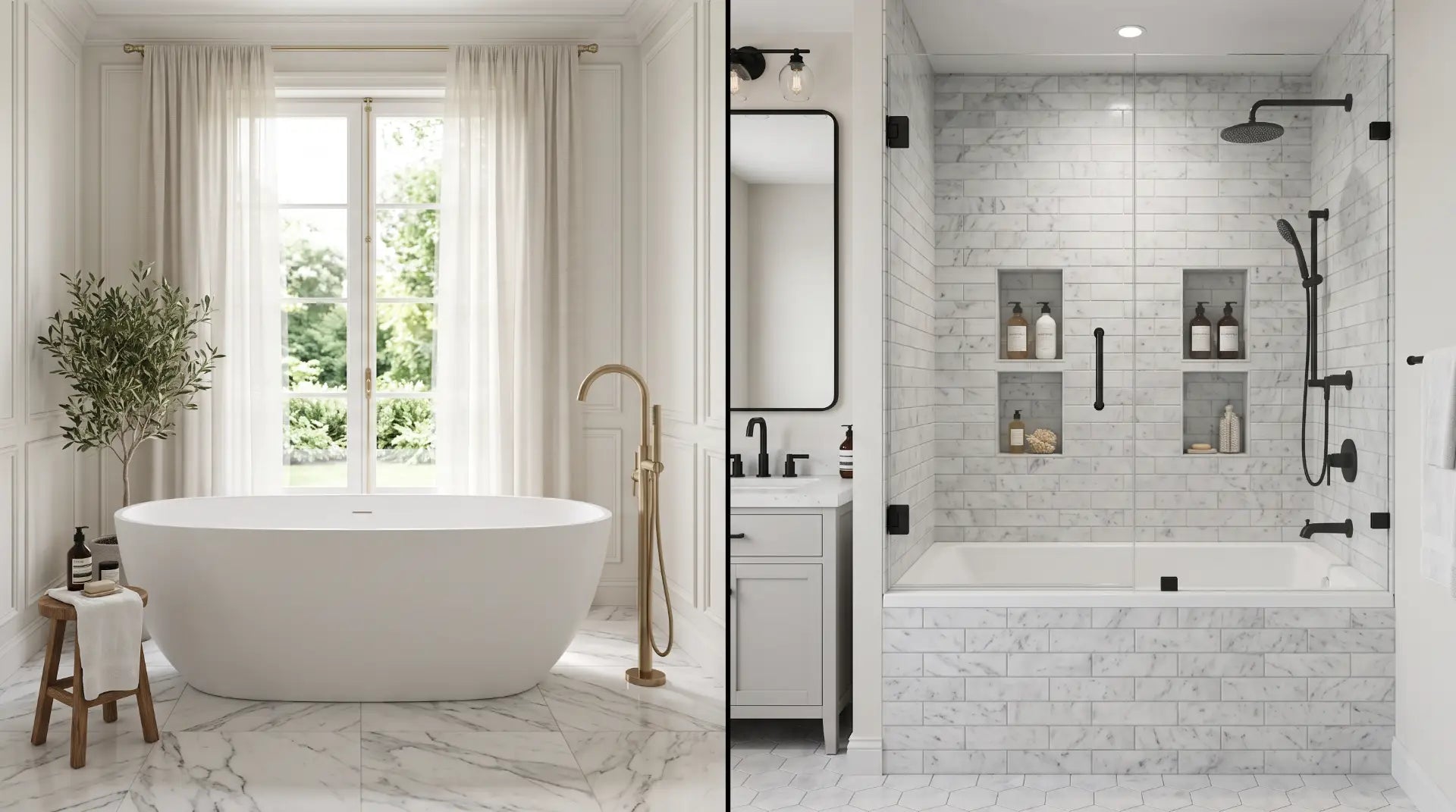
The two biggest bathtub decisions come down to one question: does the tub stand on its own, or does it build into the room? This guide breaks down cost, space, installation, soaking depth, cleaning, and resale value - so you buy the right style the first time.
Choose a built-in tub if you want the practical, affordable option that fits a standard bathroom, doubles as your daily shower, and keeps installation simple. An alcove built-in tub is the default for most US bathrooms for a reason - it uses the least floor space, costs the least to install, and satisfies the one thing most home buyers want: a tub and shower in the same fixture.
Choose a freestanding tub if the bathroom is large enough to give it breathing room, you already have (or are building) a separate walk-in shower, and you want a genuine statement piece with a deeper, more comfortable soak. Freestanding tubs cost more, take more room, and are less convenient to shower in - but nothing else transforms the look of a primary bathroom the same way.
Everything below explains the trade-offs in detail - and if you're still deciding on tub type overall, start with our complete bathtub buying guide, which covers every type, size, and material before you narrow down to installation style.
Don't fall in love with a tub before you measure. The right order is Space → Type → Material → Features → Budget. That sequence stops you from choosing a freestanding tub that can't fit through the door, can't line up with the existing drain, or needs a floor rebuild you didn't budget for. Measure the room and the delivery path first, then decide freestanding vs built-in.
Here's the confusion most guides skip over: "built-in" is not a single tub - it's an umbrella term for any tub that installs into the structure of the room rather than standing alone. That covers three distinct styles, and knowing which one you're comparing to freestanding changes the entire decision. A freestanding tub, by contrast, is finished on all sides and simply sits on the floor, connected only at the drain.

Finished on every side, sits directly on the floor away from walls, and connects only to a floor drain. Includes oval flat-bottom soakers, slipper tubs, and pedestal styles. Needs a freestanding or wall-mount filler and clearance all around. The luxury centerpiece choice.

Nested into a three-wall recess with a finished front panel (apron) and an integral tiling flange. The classic tub-shower combo. Most affordable to buy and install, space-efficient, and the standard 60-inch size fits most existing bathroom layouts.

A tub shell with a finished rim and unfinished sides that "drops" into a custom-built deck. The surround can be tiled, stone, or wood to match the room. Deeper soaking than most alcoves, flexible placement (corner, island, window bay), but the surround adds cost and build time.

Similar to an alcove but with a factory-finished skirt (apron) already attached to the visible side. Installs against one or more walls without building a deck. A middle ground - cleaner than a bare drop-in, simpler than a tiled surround.
Before the section-by-section breakdown, here's the honest one-line summary that most buyers land on: built-in tubs win on price, space, and shower compatibility; freestanding tubs win on looks, soaking depth, and placement freedom. Neither is objectively "better" - the right answer depends entirely on your bathroom size, whether you have a separate shower, and whether the tub is a daily-use fixture or a weekly indulgence.
If your bathroom is on the smaller side, or the tub has to serve as your shower too, the decision is effectively made for you: built-in. If you have a spacious primary bath with a separate shower and you want the tub to be the visual anchor of the room, freestanding earns its premium. The gray area - mid-size bathrooms with room to spare but a tight budget - is where the rest of this guide does its work.
This is the factor that most often decides the debate before any other consideration matters. A built-in alcove tub is engineered to be space-efficient: it tucks into a three-wall recess and shares those walls with the rest of the room, so it consumes almost no "extra" floor area. The standard footprint is roughly 60 inches long by 30-32 inches wide, and it fits the layout most US bathrooms were already framed for.
A freestanding tub is the opposite. It needs breathing room on every side - not just for looks, but for entry, exit, cleaning, and reaching the faucet. Freestanding tubs run about 55-72 inches long and 27-32 inches wide, and the real footprint is larger than the tub itself because you're also fitting the person who walks around it. Plan for at least 4-6 inches of clearance to any wall for cleaning access, and ideally 24 inches or more on one long side for comfortable use. Drop into a small bathroom and a freestanding tub feels cramped and awkward rather than luxurious.
Measure the delivery path, not just the room. One of the most expensive bathtub mistakes is ordering a tub that fits the bathroom but can't make the corner into it. Before buying, measure the narrowest hallway point, the doorway width, and any tight turns between the front door and the bathroom. For exact sizing by tub type, see our bathtub sizes and dimensions guide.
Verdict on space: Small or mid-size bathroom → built-in (alcove). Large primary bath with room to spare → freestanding is on the table. If floor area is tight, a built-in tub isn't a compromise, it's the correct engineering choice.
Sticker price is only half the story with bathtubs, and this is where a lot of budgets get blown. The tub itself is often the smaller line item; installation, plumbing, and structural work are where freestanding and built-in genuinely diverge.
A freestanding tub typically runs $800-$3,000 for the tub alone, depending on material - fiberglass at the low end, acrylic in the middle, and cast iron, stone, or copper at the top. A standard acrylic alcove tub is cheaper to buy outright, and its all-in installed cost usually lands around $1,600-$2,000 for a 60-inch model. Drop-in tub shells can be affordable, but the custom deck erases that saving.
Built-in alcove tubs are cheap to install because they reuse existing framing and plumbing. If you're replacing an old alcove tub with a new one in the same spot, the drain already lines up and there's no new construction. Freestanding tubs carry several costs that don't show on the product page:
Plumbing relocation. Freestanding tubs usually need the drain and supply lines brought to a specific point in the floor. Moving a drain can mean opening the floor or ceiling below - not a simple fixture swap. Floor reinforcement. Heavier materials like cast iron or stone can require reinforced floors before installation. A separate faucet. Freestanding tubs need a floor-mounted or wall-mount tub filler, which is a significant fixture cost on its own. Water heater capacity. Deep soakers hold far more water - a 100-gallon soaking tub needs roughly a 75-gallon heater, and most US homes ship with a 40 or 50-gallon tank, so a heater upgrade may be required to fill it hot.
Verdict on cost: Built-in (alcove) is meaningfully cheaper both to buy and to install, especially as a like-for-like replacement. Freestanding is a premium purchase before the tub even arrives. For a material-by-material cost and durability breakdown, see acrylic vs cast iron bathtub.
Built-in alcove installation is about as straightforward as bathtub work gets. The tub slides into the three-wall recess, the integral flange tucks behind the wallboard to keep water where it belongs, the apron finishes the front, and the wall-mount faucet ties into existing supply lines above the tub. For a replacement, matching the existing drain location (left, right, or center) keeps the whole job to a fixture swap.
Freestanding installation is more involved. Because the tub sits away from the walls, the plumbing has to arrive at a precise point - either through the floor for a floor-mounted filler and drain, or from the wall for a wall-mount filler positioned to reach the tub. Getting the rough-in location wrong is costly to fix after tile goes down. Drop-in tubs sit in the middle: the tub itself is easy to set, but you're also building and waterproofing the surround, and you must leave a service access panel (a clear opening of at least 12 x 18 inches is a practical target) to reach the drain and trap later.
Your tub style dictates your faucet type. Freestanding tubs pair with dramatic floor-mounted fillers; alcove and drop-in tubs use wall-mount or deck-mount fillers. Choosing the tub first, then the faucet, avoids rough-in mismatches. Our bathtub filler faucet buying guide walks through freestanding vs wall-mount options and the right fill rate.
Verdict on installation: Built-in (alcove) is the easiest and lowest-risk install, especially as a replacement. Freestanding and drop-in both demand more careful plumbing planning and, often, a professional.
If the reason you want a tub is the soak itself, this factor tilts toward freestanding and deep drop-in models. Comfort in a bath is driven less by the labeled length and more by water depth and back slope - the numbers that determine whether you're submerged to the shoulders or sitting in a shallow puddle.
A standard alcove tub typically gives you only about 12-14 inches of actual water depth to the overflow, because it's designed as a dual-purpose shower-tub. Deep soaking freestanding and drop-in tubs push that to 19-22 inches - and that added depth is the real reason people pay the freestanding premium. Freestanding soakers are also usually deeper-sided with ergonomic, body-following curves, since they aren't constrained by the shower function.
One nuance: soaking depth is about the tub model, not strictly the installation style. You can find deep alcove and drop-in soakers, and if you want jets rather than a still soak, that's a separate decision covered in soaking tub vs jetted tub. But as a general rule, freestanding tubs deliver the deepest, most comfortable soak of any single-purpose fixture.
Verdict on comfort: Freestanding (and deep drop-in) win the soak. Standard alcove tubs prioritize shower dual-use over soaking depth.
This is the factor showrooms never mention and owners discover later. The tub surface itself is easy to clean on both styles - acrylic wipes down quickly and resists staining regardless of installation. The difference is the space around the tub.
A freestanding tub has a gap between it and the wall (or all the way around, if it's centered). That gap collects dust, hair, and moisture, and it's awkward to reach behind and under. Homeowners consistently underestimate how much of a chore this becomes - the more "floating" the tub, the more floor there is to clean around and beneath it. A built-in alcove tub has no such gap on three sides, which makes routine cleaning simpler.
The trade-off runs the other way on seams. Built-in tubs rely on silicone caulk where the tub meets the wall and floor, and that caulk needs periodic recaulking to prevent mold and water intrusion. Freestanding tubs have far less caulk to maintain. So it's a wash in effort, just different: freestanding means cleaning a tight floor gap, built-in means maintaining caulk lines.
Bathtub injuries are among the most common household accidents in the US - the CDC estimates over 235,000 emergency bathroom injuries a year, largely from slips on wet surfaces. Whichever style you choose, a slip-resistant floor surface and a properly anchored grab bar on the nearest wall are worth planning in from the start, especially for freestanding tubs that offer no structural grip surface of their own.
Verdict on maintenance: Roughly even - freestanding trades caulk upkeep for a hard-to-reach floor gap. If low-effort daily cleaning matters most, the built-in alcove has a slight edge.
This is where a lot of freestanding-tub enthusiasm meets a hard reality, and it's worth being honest about. A freestanding tub photographs beautifully and can absolutely help sell a high-end home - but only in the right context. The single most important data point here: according to the National Association of Home Builders' What Home Buyers Really Want study, 72% of first-time buyers rate having both a shower stall and a tub in the primary bath as essential or desirable - the top-ranked feature out of the ones surveyed.
An alcove tub-shower combo satisfies that demand directly in one fixture. A standalone freestanding tub only makes sense for resale when the bathroom also has a separate walk-in shower - the full five-piece primary suite that luxury buyers expect. Put a freestanding tub in a starter home or a single-bathroom layout, remove the shower to make room, and you've spent more to deliver less of what the next buyer actually wants.
Verdict on resale: Built-in (alcove) is the safer, broader-appeal choice for most homes. Freestanding adds value only in a luxury bathroom that already has a separate shower.
Here freestanding wins outright, and it isn't close. A freestanding tub is a sculptural object - it reads as furniture, becomes the focal point of the room, and instantly signals a spa-like, high-end bathroom. The variety within freestanding is part of the appeal: clean oval flat-bottom soakers for modern rooms, slipper tubs with a raised end for lounging, pedestal styles, and the timeless clawfoot tub for period and farmhouse looks.
Built-in tubs are the reliable, understated choice. An alcove tub is the "jeans and a T-shirt" of bathtubs: classic, unremarkable on its own, but easy to dress up with good tile work and the right fixtures. A drop-in tub is the built-in style with the most design flexibility - because you design the surround, you can wrap it in tile, stone, or wood and integrate ledge space and storage that a freestanding tub can't offer.
Verdict on style: Freestanding is the design statement. Built-in is understated and dependable, with drop-in offering the most customization within the built-in category.
The complete head-to-head across every factor that matters. "Built-in" here reflects the most common built-in style, the alcove tub, with notes where drop-in differs.
| Factor | Freestanding | Built-In (Alcove) | Built-In (Drop-In) |
|---|---|---|---|
| Best for bathroom size | Large / primary suite | Small to standard | Mid-size to large |
| Floor space efficiency | Low | High | Medium |
| Doubles as daily shower | Impractical | Yes | Rarely |
| Typical tub price | $800-$3,000+ | ~$1,600-$2,000 installed | Shell low, surround adds cost |
| Installation cost & effort | Higher | Lowest | Higher (build surround) |
| Soaking depth | Deep (19-22") | Shallow (12-14") | Deep (16-18"+) |
| Special plumbing needed | Floor/wall filler + drain | Reuses existing rough-in | Deck plumbing + access panel |
| Cleaning around the tub | Floor gap to reach | No gaps (3 sides) | Deck surfaces |
| Resale appeal (typical home) | Only with separate shower | Broad | Luxury baths |
| Design / visual impact | Statement piece | Understated | Custom surround |
| Water heater demand | High (deep soakers) | Standard | Medium-high |
Match your situation to the recommendation below. In most cases the decision is clearer than the debate makes it sound.
Your bathroom is small or standard-sized · the tub also needs to be your shower · you're replacing an existing tub and want the simplest, lowest-cost install · you're renovating a family bath, guest bath, or starter home where broad resale appeal matters · budget is the priority. This covers the majority of US bathrooms - and it's why the alcove tub remains the default.
You have a large primary bathroom with room to spare · there's already a separate walk-in shower (or you're building one) · you want the tub to be the design centerpiece · a deep, comfortable soak is the whole point · you're building or renovating a luxury five-piece bathroom. In that context, nothing else delivers the same impact.
You have a mid-size to large bathroom and want a deeper soak with a custom, built-in look · you want deck space around the tub for toiletries or seating · you're comfortable with the added cost and construction of building a surround. Drop-in is the built-in style that comes closest to freestanding depth while keeping an integrated look.
If your decision points to freestanding, these are standout options in Bathify's collection, spanning compact to full-size. All ship free on orders over $50 across the continental US. For built-in layouts, browse the alcove bathtubs collection instead.

The Alto is the cleanest all-round freestanding pick for a modern primary bathroom. Its ergonomic pure-scape shell follows the natural curve of the body for a genuinely comfortable soak, and the contemporary oval flat-bottom profile makes the room feel more spacious rather than crowded. Built from 100% high-gloss white acrylic reinforced with fiberglass, so the color runs through the material and won't fade, with stain- and scratch-resistant, easy-clean surfaces. UPC certified.

At 55 inches, the Adonis is the freestanding option for bathrooms that want the statement look without the full 60"+ footprint. Same durable UPC-certified acrylic construction reinforced with fiberglass, easy to place anywhere with floor drain access, and simple to keep clean thanks to stain- and scratch-resistant surfaces. A smart way to bring a freestanding centerpiece into a mid-size primary bath where a larger tub would feel tight.

A full 60-inch soaker for primary bathrooms with the space to do it justice. The Pierre ships with its frame included, making it a cleaner install than many freestanding models, and delivers the deep-soak depth that makes freestanding worth the premium in the first place. The right pick when the tub is meant to anchor the room and you have a separate shower handling daily duty.
Shop: Swiss Madison Pierre 60" Freestanding Tub at Bathify →
Let the bathroom - not the showroom photo - make the call
For most US bathrooms, built-in (alcove) is the right answer. It's cheaper to buy and install, space-efficient, doubles as a daily shower, and has the broadest resale appeal. If your bathroom is small or standard-sized, or the tub has to shower too, stop here - the built-in tub is the correct choice, not a compromise.
Choose freestanding when the room earns it: a large primary bathroom, a separate walk-in shower already in place, and a genuine desire for a design centerpiece and a deep, comfortable soak. In that setting it's worth every dollar of the premium - just budget for the filler faucet, the floor drain plumbing, and possibly a water heater upgrade before you commit.
Choose drop-in when you want deep-soak comfort and a built-in, custom-surround look in a mid-size-to-large bathroom, and you're prepared for the added build cost of the deck.
Whatever you choose, measure the room and the delivery path first, match the drain location if you're replacing, and pick the faucet to suit the tub. Start with the complete bathtub buying guide if you're still narrowing down type and material.
Shop Bathtubs at Bathify
Freestanding tubs, alcove tubs, and tub fillers from Vanity Art, Swiss Madison, and more. Free shipping on orders over $50. Shipped across the USA.


