







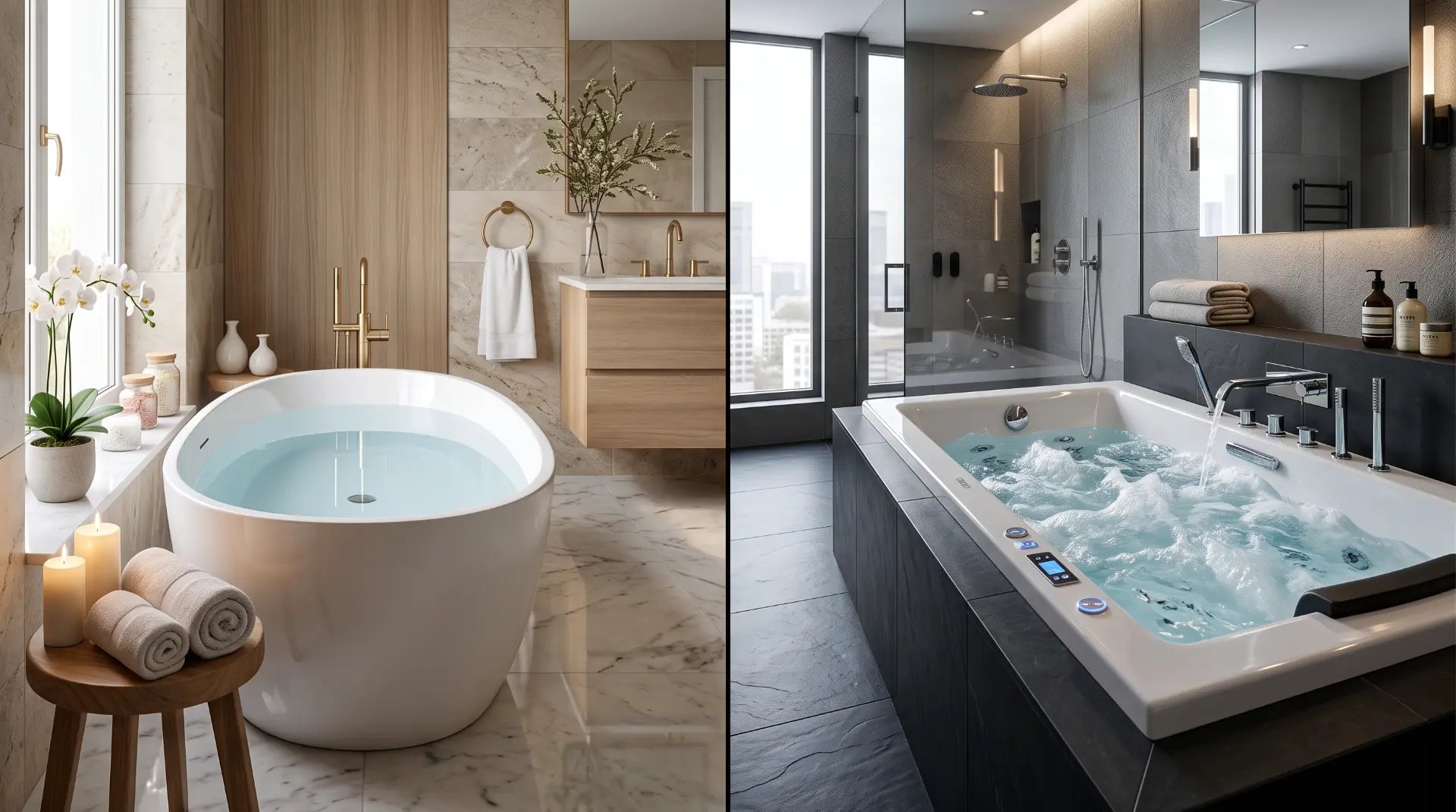
One is quiet, deep, and effortless to own. The other massages your muscles - but comes with wiring, pumps, noise, and monthly cleaning. This guide cuts through the marketing to show which tub actually fits your life, your budget, and your bathroom.
Buy a soaking tub if what you actually want is to relax - quiet, deep, warm, full-body immersion with nothing to maintain. Soaking tubs are cheaper, need no electrical work, have no pumps or pipes to clean, and never break down. For the large majority of homeowners, a good deep soaker delivers the exact stress relief they were imagining when they pictured "a nice bath."
Buy a jetted tub if you specifically want a powered massage and you accept the trade-offs. Within jetted tubs, a whirlpool (water jets) gives a strong, targeted muscle massage; an air bath gives a gentle, all-over bubble sensation. Both require dedicated wiring, run a motor you can hear, and need regular cleaning to stay hygienic. A whirlpool earns its keep for sore muscles after workouts; an air bath is the gentler middle ground.
Put simply: if the goal is calm, choose soaking. If the goal is a physical massage, choose a whirlpool. If you want gentle therapy that's still fairly quiet, choose an air bath. If you're still deciding on tub type and material overall, start with our complete bathtub buying guide.
Jetted tubs are sold on the fantasy of a home spa. In reality, a large share of jetted tubs end up rarely used - because the massage is a novelty, the noise gets old, and the cleaning becomes a chore. Before you pay the jetted premium, ask honestly: do you want a massage, or do you want to relax? Most people want to relax - and that's a soaking tub's entire job.
The confusion in this whole comparison comes from one word doing too much work. A soaking tub is simple to define: a deep bathtub designed for still-water, full-body immersion. No pump, no jets, no electricity - just hot water and quiet. Its whole purpose is depth and warmth, so you can sink in to the shoulders and stay there.
A jetted tub is any tub with a powered system that moves water or air to create a massage. That's where it splits into three distinct experiences that people constantly mix up: water jets (a whirlpool), air jets (an air bath), and combination systems that do both. They feel completely different, cost different amounts, and carry different maintenance. Comparing "soaking vs jetted" without knowing which jetted type you mean is the single most common mistake buyers make.
Before you compare jetted to soaking, you need to know which jetted experience you're actually considering. Here's how each system works and who it suits.

A pump draws bath water in, mixes it with air, and pushes it back out through a handful of directional jets positioned along the tub walls. The result is a strong, targeted, massage-like pressure you can aim at your back, shoulders, or legs. This is the classic "Jacuzzi" feel. It's the most vigorous option - great for muscle recovery, but it can be too intense on pressure points for some people, and the water sitting in the pipes between uses is the source of the hygiene concerns covered below.

A blower pushes warm air through dozens - sometimes hundreds - of pin-sized holes in the tub floor and walls, creating a soft blanket of bubbles that rises around your whole body. The sensation is gentle and effervescent rather than a targeted pummel, closer to sitting in champagne than getting a deep-tissue massage. Air baths are generally quieter, easier to keep clean (most purge the lines with a warm-air cycle after you drain), and better for people who find water jets too harsh.

A combo tub includes both systems, letting you run a strong water-jet massage, a gentle air-bubble bath, or both together. It's the most versatile - and the most expensive, most complex, and most maintenance-heavy, since you now own two systems instead of one. Worth it only if you genuinely want both experiences and will use them.
The four options you're really choosing between, in one view.
Deep, warm, full-body immersion with no motor, no pipes, and no electricity. Lowest cost, lowest maintenance, quietest, and the most modern look - especially freestanding. The default for people who want to relax and unwind.
Powerful, directional water-jet massage for sore muscles. The classic "Jacuzzi" feel. Needs wiring, runs a noticeable pump, and requires monthly line cleaning because water sits in the pipes between baths.
Warm air bubbles rise all around you for a soft, effervescent feel - not a deep massage. Quieter and easier to keep clean than a whirlpool (most self-purge the lines), but still needs a blower and electrical circuit.
Both water and air systems in one tub for maximum flexibility. Also the priciest and most complex - two systems to power, service, and clean. Only worth it if you'll genuinely use both.
The price gap between soaking and jetted is real, and it doesn't stop at the purchase.
A soaking tub is the more affordable purchase and the cheaper install, because there's no motor, no wiring, and no equipment access to build. A jetted tub of the same size and material costs more to buy - you're paying for the pump or blower, the jets, the controls, and often a heater - and then costs more again to install, because it needs a licensed electrician for its dedicated circuits. Combination tubs sit at the top of both the purchase and installation curves.
This is the part product pages leave out. A soaking tub has effectively zero running cost beyond the hot water. A jetted tub adds several ongoing line items: electricity to run the pump, blower, and any in-line heater; cleaning supplies for the monthly line-flush cycle; and eventually repair or replacement of mechanical parts - pumps, blowers, and controls are the components that fail over a tub's life, and a soaking tub simply has none of them. There's also the water heater question: any large tub, jetted or soaking, needs enough hot water to fill it, and a common rule of thumb is a heater about two-thirds the tub's water capacity (a 60-gallon tub wants roughly a 40-gallon heater), so budget a heater upgrade if you're going big.
Cost also depends heavily on the shell material, independent of jets. Acrylic is lightweight, warm to the touch, and affordable; cast iron is heavier, holds heat longer, and costs more. For a full breakdown of how material affects price, durability, and heat retention, see acrylic vs cast iron bathtub.
Verdict on cost: Soaking wins decisively - cheaper to buy, cheaper to install, and near-free to own. Jetted is a premium purchase with a permanent tail of running and repair costs.
If any single factor sends buyers from jetted back to soaking, it's this one. It deserves an honest look because it's the thing owners complain about most.
A whirlpool (water-jet) tub circulates bath water through internal pipes - and some of that water stays in the pipes after you drain. Skin cells, body oils, soap, and bath products go in with it. Left unflushed, that warm, damp, nutrient-rich environment can grow bacteria and biofilm, which then blow back into the tub the next time you run the jets. The solution is a regular cleaning cycle: fill with warm water above the jets, add a dedicated bath-system cleaner (or a diluted bleach solution), and run the jets for several minutes, then drain and rinse. Do this roughly once a month, or every ten baths. It's not difficult - but it's a permanent commitment, and skipping it is exactly how jetted tubs earn their unhygienic reputation.
An air bath is easier. Because it blows air rather than circulating bath water, there's far less to contaminate, and most models run an automatic warm-air purge cycle for a few minutes after you drain to dry out the channels. You'll still clean it periodically, but the burden is lighter than a whirlpool's.
A soaking tub has no internal plumbing whatsoever. Maintenance is identical to any standard bathtub: wipe it down. There are no lines to flush, no jets to unclog, no biofilm to worry about. This simplicity is a genuine feature, not an afterthought.
Verdict on maintenance: Soaking is effortless. Air baths are manageable. Whirlpools demand an ongoing routine - budget the habit, not just the money.
Installation is where the "powered vs unpowered" divide becomes concrete - and where jetted tubs pull in a second trade (an electrician) that soaking tubs never require.
A soaking tub connects only to the water supply and drain. Whether it's freestanding, drop-in, or alcove, there's no wiring involved. That's one of the biggest reasons soaking tubs are simpler and cheaper to install - and easier to DIY within reason.
A jetted tub runs a pump or blower, so it needs dedicated, GFCI-protected electrical circuits installed to code by a licensed electrician - often a separate circuit for the pump and, on heated models, another for the in-line heater. It also needs a service access panel so the pump/motor can be reached for maintenance and repair down the line; a clear opening of at least 12 x 18 inches is the standard target. If the tub is a drop-in inside a deck, that access panel has to be designed into the surround. Miss it, and servicing the pump later means tearing the deck apart.
Whichever tub you choose, plan the faucet and the fit early. Freestanding soakers pair with floor-mounted or wall-mount fillers; alcove and drop-in tubs use wall or deck fillers. Get the sizing and rough-in right with our bathtub sizes guide and match the right faucet using the bathtub filler faucet buying guide.
Installation style (freestanding, alcove, or drop-in) is a separate decision from soaking vs jetted - you can get a soaking or jetted version of most installation types. If you haven't settled that yet, our freestanding vs built-in bathtub guide covers it in full.
Verdict on installation: Soaking is plumbing-only and straightforward. Jetted adds electrical work, code requirements, and a permanent service-access constraint.
This is ultimately what you're buying, so it's worth being clear about what each one actually feels like - because they're not better or worse, they're different goals.

A soaking tub is about stillness. The pleasure is the quiet: deep warm water, no sound but your own breathing, the kind of bath you sink into for thirty minutes with a book or with your eyes closed. Depth and heat retention are what make it work, which is why a true deep soaker (16-22 inches of water) feels so different from a shallow standard tub. For many people this is the entire reason they wanted a tub in the first place, and a whirlpool's noise and motion would actually break the spell.

A whirlpool is about active massage. It's energizing rather than calming - a strong, targeted pressure that's genuinely useful after a workout, a long day on your feet, or for easing muscle tension. It's a doing rather than a being. An air bath lands between the two: gentle, buoyant, all-over bubbles that feel therapeutic and pleasant without the intensity of water jets, and quiet enough that you can still relax in it.
Verdict on experience: Choose soaking for calm and stillness, whirlpool for a vigorous massage, air bath for gentle therapy. Match the tub to the feeling you actually want.
An underrated deal-breaker. A soaking tub is silent - the only sound is water. A whirlpool runs a pump, and while premium models market "quiet" technology, there's always an audible motor hum while the jets are on; for a bath meant to relax you, some people find that noise defeats the purpose. Air baths are generally quieter than whirlpools but still run a blower you can hear. If your idea of a perfect bath is silence, that alone points you toward a soaking tub - or at most an air bath, not a whirlpool.
Verdict on noise: Soaking is silent, air baths are moderate, whirlpools are the loudest. If quiet matters, weigh this heavily.
Jetted tubs are often sold on wellness, and there's real substance to it - hydrotherapy (warm water plus massage) is widely used to ease muscle tension, support circulation, and aid relaxation and recovery. A whirlpool's targeted jets can genuinely help sore muscles and joints; an air bath's gentle bubbles suit people who find concentrated jets too harsh, including some with sensitive pressure points.
But it's worth being balanced. A warm soak on its own already delivers much of the relaxation and circulation benefit people associate with hydrotherapy - the jets add targeted massage, not magic. And there are sensible cautions with jetted tubs: keep the lines clean to avoid recirculating bacteria (see the maintenance section), be mindful of water temperature and time, and if you're pregnant, have cardiovascular conditions, or other health concerns, check with a doctor before regular hot hydrotherapy. None of this makes jetted tubs bad - it just means the health case isn't a blanket reason to skip a soaking tub.
Verdict on health: Jetted (especially whirlpool) offers real targeted-massage benefits; a warm soak already covers general relaxation and circulation. Choose jets if you want the massage specifically, not because you assume soaking has no wellness value.
Tastes have shifted here, and it matters if you might sell. For years, a big corner whirlpool was the aspirational primary-bath feature. Today, many buyers view jetted tubs as dated, energy-hungry, and a maintenance liability - the kind of fixture that sat unused in the last owner's house and now needs servicing. That perception hurts more than it helps in a lot of markets.
A clean, deep soaking tub - particularly a freestanding one - reads as current and desirable, and it photographs beautifully in listings. Meanwhile, in family and starter homes, the most broadly wanted setup remains a tub that also works as a shower, which is a separate consideration covered in our freestanding vs built-in guide. A jetted tub only reliably helps resale in a high-end spa bathroom aimed at buyers specifically shopping for hydrotherapy.
Verdict on resale: Soaking (especially freestanding) is the safer, more modern choice for most homes. Jetted appeals to a narrower, luxury-focused buyer.
Every factor that matters, across all four options.
| Factor | Soaking | Whirlpool (Water) | Air Bath | Combination |
|---|---|---|---|---|
| Experience | Quiet stillness | Strong massage | Gentle bubbles | Both |
| Upfront cost | Lowest | High | High | Highest |
| Running cost | ≈ $0 | Ongoing | Some | Highest |
| Electrical wiring | None | Required | Required | Required |
| Maintenance / hygiene | Wipe down | Monthly line flush | Self-purge + periodic | Two systems |
| Noise | Silent | Pump hum | Moderate blower | Loudest |
| Service access panel | Not needed | Required (12×18") | Required | Required |
| Best for | Relaxation, unwinding | Sore muscles, recovery | Gentle therapy | Wanting it all |
| Resale appeal (typical home) | Broad, modern | Seen as dated | Niche | Luxury only |
Here's the direct answer most people are searching for. A whirlpool tub is worth it in a specific situation: you genuinely want a strong, targeted water-jet massage - for athletic recovery, chronic muscle tension, or because you'll actually use it several times a week - and you're willing to accept the higher price, the electrical work, the pump noise, and the monthly cleaning routine. For that buyer, a well-made whirlpool delivers something a plain tub can't.
For nearly everyone else, it isn't - not because whirlpools are bad, but because the honest use-case rarely matches the fantasy. Most people who install jets picture relaxation, then discover the noise isn't relaxing, the massage is a novelty they stop using, and the cleaning is a chore they resent. Those buyers would have been happier, for less money and zero hassle, with a deep soaking tub. If the appeal is "gentle therapy" rather than "deep-tissue massage," an air bath is the smarter compromise: most of the wellness feel, far less of the whirlpool's downsides.
Ask yourself: "In a typical week, will I actually turn the jets on?" If you can honestly answer yes, several times, a whirlpool or air bath is worth it. If you hesitate, that hesitation is your answer - buy the soaking tub and put the savings toward a deeper, better-made shell or a beautiful freestanding design you'll use every single time.
Match your situation to the recommendation below.
You want to relax, unwind, and enjoy quiet · you value low cost and near-zero maintenance · you don't want electrical work or a service panel · you care about a clean, modern look and resale appeal · you're not sure you'd regularly use jets. This is the right answer for the large majority of homeowners - and it's Bathify's specialty.
You specifically want a strong muscle massage · you'll use it several times a week for recovery or tension relief · you're fine with the higher cost, the wiring, the pump noise, and a monthly cleaning cycle. For a committed, frequent user, it delivers real value.
You want gentle, all-over hydrotherapy without harsh jets · you find water jets too intense · you want something quieter and easier to clean than a whirlpool but more active than a still soak. It's the balanced middle path.
You genuinely want both a vigorous water massage and gentle air bubbles, you'll use both, and you accept the highest cost and most maintenance. Only for the buyer who'll actually exploit the versatility.
Bathify specializes in the option most homeowners are actually happiest with: quiet, deep soaking tubs - freestanding, alcove, and drop-in - with no pumps, no wiring, and no upkeep. If your decision points to soaking, these are standout picks, all shipping free on orders over $50 across the continental US. (If you're set on jets, look for a reputable whirlpool or air-bath specialist and apply the buying criteria above - especially the cleaning and electrical requirements.)

The Alto is the cleanest all-round soaking pick for a modern primary bathroom - and a perfect example of why a great soaker beats jets for most people. Its ergonomic pure-scape shell follows the body's natural curve for a genuinely comfortable, deep immersion, and the contemporary oval flat-bottom profile makes the room feel more spacious. Built from 100% high-gloss white acrylic reinforced with fiberglass, so the color runs through the material and won't fade, with stain- and scratch-resistant, wipe-clean surfaces. Silent, zero-maintenance, UPC certified.

At 55 inches, the Adonis brings a deep, still soak to bathrooms that can't spare the space for a full-size tub. Same durable UPC-certified acrylic construction reinforced with fiberglass, easy to place anywhere with floor drain access, and effortless to keep clean thanks to stain- and scratch-resistant surfaces. A smart way to get the relaxation of a soaking tub in a mid-size primary bath - no motor, no noise, no cleaning routine.

A full 60-inch soaker for primary bathrooms with room to make the tub a centerpiece. The Pierre ships with its frame included for a cleaner install than many freestanding models, and delivers the depth that makes soaking so restorative - the quiet, warm, full-body immersion that a whirlpool's noise and jets can't replicate. The right pick when you want the tub to anchor a spa-like room.
Buy the experience you'll actually use - and for most people, that's a soaking tub
For the majority of homeowners, a soaking tub is the smarter buy. It costs less, installs without an electrician, needs no cleaning routine, makes no noise, looks the most modern, and delivers the exact calm most people picture when they imagine a good bath. If your honest goal is to relax, stop here - a deep soaker is the answer, not a compromise.
Choose a whirlpool only if you truly want a strong muscle massage and will use it regularly, accepting the cost, wiring, noise, and monthly line-cleaning. Choose an air bath if you want gentle, quiet-ish full-body therapy without harsh jets. Choose combination only if you'll genuinely use both systems.
Whatever you pick, decide soaking-vs-jetted separately from shape and installation, size the tub and water heater correctly, and match the right faucet. Start with the complete bathtub buying guide to tie it all together, and see freestanding vs built-in to lock in the installation style.
Shop Soaking Tubs at Bathify
Deep, quiet freestanding and alcove soaking tubs from Vanity Art, Swiss Madison, and more - plus tub fillers to match. Free shipping on orders over $50. Shipped across the USA.


