







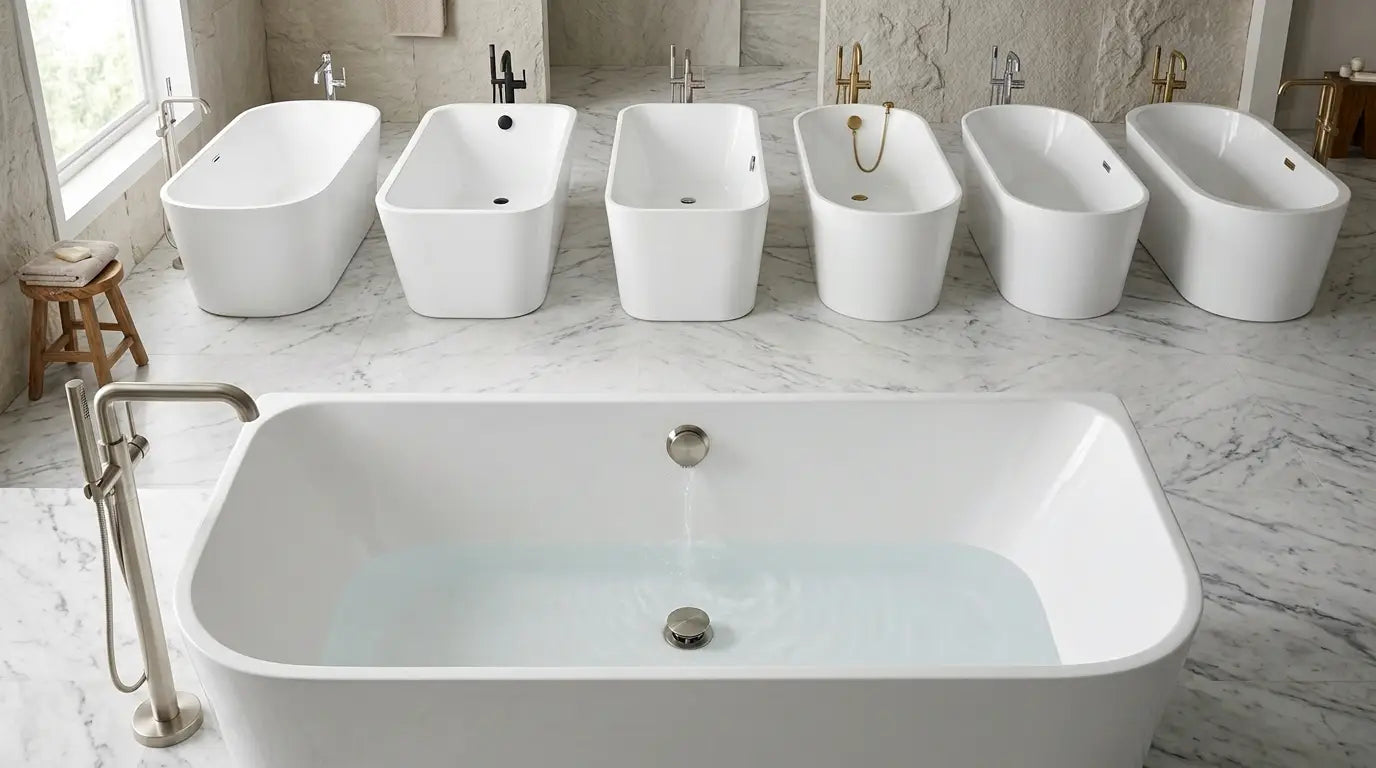
Six stopper mechanisms, one small part that decides whether your tub holds water. This guide shows you how to identify your exact bathtub drain type, the sizing and thread rules that trip people up, how to match finishes, and exactly how to replace a bathtub drain the right way.
The bathtub drain is the most overlooked part of the tub - right up until it stops holding water, drains slowly, or clashes with a freshly upgraded faucet. It's a small, inexpensive component, but getting the type right is what determines whether a fix takes ten minutes or turns into a frustrating trip back to the store for the wrong part.
There are two separate things people mean by "drain type," and confusing them is the number-one reason a replacement goes sideways. The first is the stopper mechanism - how you open and close the drain (lift-and-turn, push-pull, toe-touch, and so on). The second is the drain fitting - the size and thread of the drain body that screws into the plumbing below the tub. This guide covers both, shows you how to identify exactly what you have, and walks through replacing it. If you're planning a broader tub project, start with our complete bathtub buying guide, then use this page for the drain details.
Just want to replace a worn stopper? Skip to the stopper types and the identification guide - most stopper swaps are a quick DIY job. Replacing the whole drain body? Read the sizing and thread section first; that's the detail that determines whether the new drain will actually thread in.
Before you can identify or replace a drain, it helps to know the handful of parts involved. A standard bathtub drain is part of a connected "waste-and-overflow" assembly - the drain you see in the tub floor is only one end of it.
The finished metal ring you see at the bottom of the tub. It houses the stopper (or an open strainer) and is the part whose finish needs to match your faucet.
The moving seal. Its mechanism - how you open and close it - is what defines your "drain type." This is the part that wears out most often.
The drain body screws down into the drain shoe under the tub. This threaded connection is where coarse vs fine thread matters for a full replacement.
The cover over the overflow opening. On trip-lever systems it holds the operating lever; on others it's just a cover. It connects to the drain via the overflow tube.
The gasket (a rubber washer behind the flange) and plumber's putty or silicone under the flange create the watertight seal. When a tub develops a slow leak around the drain, a failed gasket or dried-out putty is usually the culprit - not the drain itself.
Nearly every bathtub drain in a US home uses one of these six stopper mechanisms. Here's how each one works, how to recognize it, and what it's like to live with.
A small knob sits on top of the stopper. You lift it and rotate (usually a quarter turn) to lock it open or closed. It's often held on by a small set screw under the knob. Reliable and common, but the set screw can loosen over time, and you have to reach down to operate it. If your stopper twists to open and close, it's lift-and-turn.
Visually almost identical to lift-and-turn - same low-profile stopper with a knob - but you operate it by simply pulling the knob up to open and pushing it down to close, with no twisting. It's the easiest to confuse with lift-and-turn; the difference is entirely in how it moves. Simple and intuitive, though the internal seal wears with use.
A spring-loaded stopper you operate by pressing down with your toe or foot - press once to close, press again to open. No bending required, which makes it a favorite for accessibility and everyday convenience. The spring and seal are the wear points; a toe-touch that stops holding water usually just needs a fresh stopper.
Here the control is a lever on the overflow plate, not at the drain. Behind the plate, a brass plunger rides up and down inside the overflow tube. Flip the lever down and the plunger drops to block flow; flip it up and water drains. The giveaway: the drain opening itself is just an open strainer with no visible stopper. Common in older tubs, durable, but the internal linkage can fall out of adjustment.
Also operated by a trip lever on the overflow plate, but instead of a hidden plunger, a visible rocker-arm stopper at the drain rises and falls. Move the lever and the stopper pops up to drain or drops to seal. It combines the convenience of a lever with a visible, easy-to-clean stopper. Many modern freestanding tubs come with a pop-up drain included.
A self-contained stopper with a small toggle lever on top that you flip from side to side to seal or open. It installs into the existing drain with an O-ring - no tools and no overflow linkage - which makes it the go-to quick upgrade or replacement when the original mechanism fails. Great for a fast fix; the O-ring is the part to replace when it eventually wears.
You can identify your exact drain type in under a minute by checking two spots: the overflow plate on the wall below the faucet, and the stopper in the tub floor. Work through it in that order.
Lift-and-turn vs push-pull is the trickiest call. Grip the knob and try to twist it. If it turns to lock open or closed, it's lift-and-turn. If it only moves up and down with no rotation, it's push-pull. Also check under the knob for a tiny set screw - that points to lift-and-turn.
Here's the good news and the catch. The good news: the drain opening on virtually every US bathtub is a standard 1.5-inch (1-1/2") diameter. That's why replacement stoppers are so widely cross-compatible - a universal stopper will fit almost any tub.
The catch: if you're replacing the entire drain body (not just the stopper), the drain threads into the drain shoe below the tub in one of two thread pitches - coarse thread or fine thread - and they are not interchangeable. Buy the wrong one and it simply won't thread in. This is the single most common bathtub-drain buying mistake.
If you only need to swap the stopper itself, thread type doesn't matter - the 1.5-inch opening means most universal stoppers drop right in. Thread only comes into play when you unthread the drain body from the shoe. For choosing the right tub dimensions around all of this, see our bathtub sizes and dimensions guide.

The drain and its overflow cover are among the most visible pieces of hardware on the tub - yet they're the ones people forget to coordinate. A chrome drain against brushed-nickel faucet hardware is one of the most common design inconsistencies in an otherwise well-planned bathroom. When you upgrade a drain, match it to your dominant tub hardware.
| Finish | Pairs With | Look |
|---|---|---|
| Polished Chrome | Chrome faucets, modern/transitional | Bright, classic, easy to clean |
| Brushed Nickel | Brushed-nickel hardware, transitional | Warm, low-glare, hides water spots |
| Matte Black | Black or mixed-metal schemes, modern | Bold, high-contrast, on-trend |
| Brushed Gold / Champagne | Warm-metal faucets, contemporary luxe | Rich, statement finish |
| Oil-Rubbed Bronze | Bronze hardware, traditional | Dark, warm, heritage feel |
The safest approach is to match the drain finish to your tub filler. If you're updating both, pick the faucet first and match the drain to it - browse coordinating options in the Bathify tub faucets collection, and see our bathtub filler faucet buying guide for how flow rate and mounting factor in.
Not every drain problem needs a new drain. Here's how to tell which path you're on.
If the tub drains slowly, the usual cause is hair and soap scum around the stopper, strainer, or in the overflow - clearing it restores flow. If a trip-lever tub won't seal, the internal linkage may simply need adjustment. Start here before buying anything.
If the stopper no longer holds water even after cleaning - a worn seal on a toe-touch, a loose set screw on a lift-and-turn, a perished O-ring on a flip-it - a fresh stopper is a cheap, quick fix. This is the most common bathtub-drain repair.
If the drain flange is corroded, cracked, or badly pitted, if the finish is worn and dated, or if you're switching mechanisms (say, from an old plunger to a modern pop-up), replace the full drain and overflow. Also replace when there's a persistent leak that cleaning and re-sealing won't cure.
When the drain problem shows up alongside a stained, chipped, or dated tub, upgrading the whole tub is often the better long-term value - and modern freestanding tubs arrive with a fresh, matched pop-up drain already included. If you're weighing a refinish instead, our guide on how to refinish a bathtub compares the costs honestly.
Replacing a bathtub drain is a manageable DIY project for most homeowners, provided the old drain isn't seized. You'll need a drain removal tool (a drain key or "smart dumbbell" that grips the crossbars), pliers or an adjustable wrench, a screwdriver, plumber's putty or silicone, and a rag.
Identify the drain type and confirm parts
Decide whether this is a stopper-only swap or a full drain-body replacement. For a full swap, confirm the 1.5" opening and the coarse-vs-fine thread so your new drain matches the shoe.
Remove the old stopper or drain body
Unscrew or unclip the stopper. For a full replacement, insert the drain removal tool into the drain's crossbars and turn counterclockwise to back the drain body out of the shoe. If it's stubborn, apply penetrating oil and give it time.
Clean the drain seat thoroughly
Scrape away every trace of old putty, silicone, and debris from the tub's drain seat. A clean surface is what lets the new flange seat flush and seal - skipping this is the top cause of a re-leak.
Seal and install the new drain
Roll a rope of plumber's putty under the new flange (or use manufacturer-specified silicone). Thread the new drain into the shoe by hand, then snug it with the removal tool. Wipe away the putty that squeezes out.
Test for leaks before you finish
Fill the tub, close the stopper, and check that it holds. If you can access the plumbing below, look for drips at the drain and overflow connections. No leaks means you're done; a drip means re-seat the flange or check the gasket.
| Problem | Likely Cause | Fix |
|---|---|---|
| Tub won't hold water | Worn stopper seal, loose set screw, or misadjusted linkage | Clean/adjust; replace the stopper if it still won't seal |
| Slow drain | Hair & soap clog in stopper, strainer, or overflow | Remove stopper and clear the clog; clear the trap |
| Stopper wobbles or won't stay put | Loose set screw or worn O-ring | Tighten the set screw or replace the O-ring/stopper |
| Leak around the drain flange | Dried putty or failed gasket | Remove, clean, re-seal with fresh putty and a new gasket |
| Dated or corroded finish | Age and mineral buildup | Replace the full drain + overflow in a matched finish |

When you replace a bathtub drain, buy the drain and its matching overflow cover together as a set. There are two reasons. First, finish matching: finish calibrations vary by manufacturer, so a drain and overflow from different brands rarely match exactly - even in the same named finish like brushed nickel. Second, function: a matched set guarantees the overflow gasket seals correctly and, on trip-lever systems, that the lever and linkage are designed to work together.
Buying as a set is also the only clean way to switch mechanisms. Converting an old trip-lever plunger to a modern pop-up, for example, changes both the drain and the overflow plate - so they have to be replaced together. For the full picture on coordinating tub hardware, see our bathtub accessories guide.

If you have a freestanding tub, the drain works differently from an alcove tub. Instead of a waste-and-overflow assembly running behind a wall, a freestanding tub uses a freestanding drain kit that routes down through the floor to the drain rough-in, often with a flexible connector. Many freestanding tubs come with a coordinating pop-up drain already included - so the "drain type" decision is made for you when you buy the tub.
That's a key point for anyone replacing a failing drain in an old built-in tub: switching to a freestanding tub gets you a brand-new, matched drain as part of the package, plus a fresh surface. If you're weighing formats, our guides on freestanding vs built-in bathtubs and the best freestanding bathtubs of 2026 cover the trade-offs and the standout models.
Match the drain location to your rough-in. Freestanding tubs specify the drain position (center or end). Confirm it lines up with your floor drain rough-in before you buy, or plan for the plumbing to be adjusted during installation.
| Type | How You Operate It | Overflow Lever? | Ease of Use | DIY Swap |
|---|---|---|---|---|
| Lift-and-turn | Lift & twist the knob | No | Moderate (reach down) | Easy |
| Push-pull | Pull up / push down | No | Easy | Easy |
| Toe-touch | Press with your toe | No | Very easy | Easy |
| Trip-lever (plunger) | Lever on overflow plate | Yes | Easy | Moderate |
| Pop-up (trip-lever) | Lever raises visible stopper | Yes | Very easy | Moderate |
| Flip-it / toggle | Flip lever on the stopper | No | Easy | Very easy |
Whether you're matching a finish, upgrading a mechanism, or replacing a dated tub entirely, here's where to find the right parts at Bathify - with free shipping on orders over $50, USA-wide.
Coordinating sink and shower drains and stoppers in the finishes that matter - chrome, brushed nickel, matte black, and more - so your drain hardware matches the rest of your bathroom rather than clashing with it. The right place to start when you're pulling a room's metals together.
The drain should match the filler. Bathify's tub faucet range - freestanding floor-mount and wall-mount fillers - lets you coordinate the whole tub in one finish. Pick the faucet first, then match your drain and overflow to it for a cohesive, high-end look.
Shop: Tub Faucets at Bathify →
If the drain problem comes with a dated or damaged tub, the cleanest fix is a new one. Bathify's freestanding acrylic and stone-resin tubs from Vanity Art arrive with a coordinating pop-up drain included - so you get a fresh surface, a matched drain, and no thread-matching headaches, all in one purchase.
Identify first, then match the fix to the problem
Just need it to hold water again: Identify your stopper type, clean it, and if it still won't seal, replace the stopper - a $10-$25 fix that solves most cases.
Replacing the whole drain: Confirm the 1.5" opening and, critically, the coarse-vs-fine thread before buying. Get the drain and overflow as a matched set in a finish that matches your faucet.
Want the easiest everyday operation: A toe-touch or pop-up is the most convenient - no bending, no twisting. A flip-it is the fastest no-tools upgrade from a worn or basic stopper.
Dated tub and dated drain together: Upgrade the tub. A freestanding model comes with a fresh, matched pop-up drain included - the best long-term value when both are failing.
Whatever you choose, match the drain finish to your tub filler, and don't force a seized drain - protect the tub and the subfloor by calling a pro if it won't budge.
Upgrade Your Tub Hardware at Bathify
Coordinating drains, tub fillers, and freestanding bathtubs with matched pop-up drains included - everything to complete or replace your tub setup. Free shipping on orders over $50, shipped across the USA.


