







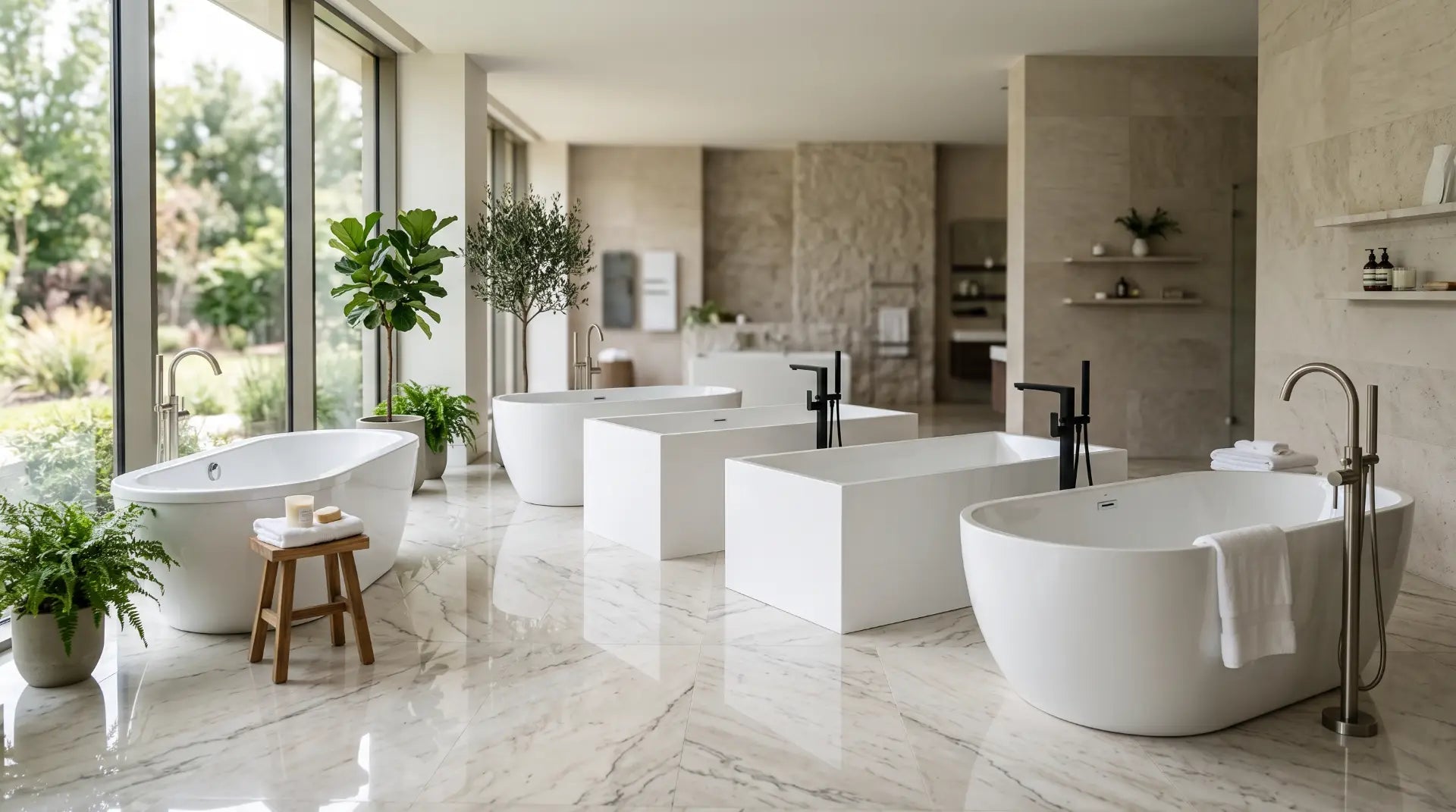
Five standout freestanding tubs, evaluated the way you'd actually choose one - by style, by the size that fits your bathroom, and by the material that lasts. Real specs, real prices, and the picks worth buying from Bathify right now.

Nothing changes the character of a bathroom faster than a freestanding tub. Unlike a built-in alcove tub tucked between three walls, a freestanding model stands alone as a sculptural object - the single element the eye lands on when you walk in. That's exactly why it's worth choosing carefully: the freestanding tub is doing design work and functional work at the same time, and the wrong size or the wrong style undermines both.
This guide reviews the best freestanding bathtubs you can buy in 2026, judged by the three factors that actually determine whether you'll love the tub for a decade: style (does the shape suit your bathroom and your body), size (does it fit the room and give a real soak), and material (will it stay warm, resist damage, and last). If you're still deciding between a freestanding and a built-in tub in the first place, start with our freestanding vs built-in bathtub comparison, then come back here for the picks.
If you already know the size you need, jump to the picks or the comparison table via the contents above. If you're starting from scratch, read our criteria first, skim the five reviews, then use the size and material sections to confirm your choice. Every tub featured here is in stock at Bathify with free USA shipping on orders over $50 and a 30-day return window.
Rather than rank tubs on looks alone, we scored every freestanding model in Bathify's range against the criteria that matter after installation day - the things you notice on the hundredth bath, not the first. Here's what we weighed.
How deep the water sits, whether the backrest supports your spine, and how well the interior length fits real adults. Exterior size means nothing if the inside is shallow.
Whether the tub suits small, standard, and large US bathrooms with proper clearance for cleaning and the faucet - and whether it can physically get through the door.
All five picks are UPC-certified acrylic reinforced with fiberglass - warm to the touch, heat-retaining, chip and stain resistant, and light enough for standard floors.
Price against what you get, whether drain and overflow hardware is included, and how straightforward the plumbing rough-in is for a standard installation.
Short on time? Here's the quick verdict on each of our five picks, matched to the buyer they suit best. Full reviews follow below.
The ergonomic pure-scape oval balances comfort, footprint, and price better than anything else in the range - the tub most bathrooms should buy.
At 54.7" long, the Adonis brings a genuine soak to tight spaces where most freestanding tubs simply won't fit.
A textured non-slip base and the lowest price in the lineup make the Palma the smart choice for families and older bathers.
Crisp rectangular lines for contemporary bathrooms, with generous interior length for a full-body soak.
A 71" oval with a brushed-nickel drain and room to stretch out - the pick for spacious primary baths and taller bathers.
Compare every finish and size in one place in the freestanding bathtubs collection at Bathify.
Every tub below is 100% acrylic reinforced with fiberglass, UPC certified, and ships free within the continental USA, typically dispatching in 1-3 days by freight with delivery scheduled by appointment. Prices are current at time of writing.

The Alto is the tub we'd recommend to most people renovating a primary bathroom. Vanity Art's ergonomic "pure-scape" oval is engineered to hold your body in the correct soaking position rather than letting you slide, and the gentle sloping backrest follows the natural curve of your spine for genuinely long soaks. The 59-inch flatbottom footprint fits standard US bathrooms without dominating the room, while the glossy white acrylic - reinforced with fiberglass and colored all the way through, never painted - keeps its finish and holds heat far better than a steel or thin-shell tub. It's the sweet spot of comfort, size, and price in the range.

Most freestanding tubs assume you have space to spare. The Adonis doesn't. At 54.7" long by 28.3" wide, it's the pick for compact primary baths, guest bathrooms, and older homes where a 67-71" tub would swallow the floor - yet it still delivers a proper deep soak rather than a shallow bath. The same UPC-certified acrylic-and-fiberglass construction as the larger models means it stays warm and resists chips and stains. If you've been told your bathroom is "too small for a freestanding tub," this is the model that proves otherwise.
Shop: Vanity Art Adonis 55" Freestanding Bathtub at Bathify →

The Palma is the value champion of the lineup, and it earns the safety pick too. Its standout feature is a textured non-slip base - a genuinely useful detail that most freestanding tubs skip, and one that matters for families with kids, for older bathers, and for anyone who's ever felt a wet acrylic floor shift underfoot. You get the same flatbottom stability, gentle sloping sides, and stain-resistant, easy-clean acrylic surface as the pricier models, at the lowest price in this guide. For a first freestanding tub where practicality outranks statement design, the Palma is hard to beat.
Shop: Vanity Art Palma 59" Non-Slip Freestanding Bathtub at Bathify →

Where the ovals soften a room, the Trent sharpens it. Its clean rectangular geometry is the natural match for contemporary and modern bathrooms with straight-line tile, angular vanities, and minimalist hardware. At 67 inches, the interior length is generous enough for a full-body soak with room to extend your legs, and the flatbottom design sits flush and stable on the floor. Finished in white with a polished chrome drain and overflow, it reads architectural rather than decorative - the tub for people who want the bathroom to feel designed, not just furnished.
Shop: Vanity Art Trent 67" Freestanding Bathtub at Bathify →

When floor space isn't the constraint, size becomes the luxury - and the Eland delivers it. At 71 inches, this oval is roomy enough for taller bathers to fully stretch out and comfortable enough for a shared soak, with a deep water line that keeps you covered. It ships with a brushed-nickel drain and overflow that lends a slightly warmer, more transitional look than polished chrome, pairing beautifully with brushed-nickel or matte-black tub fillers. For a spacious primary bathroom or a true spa retreat, this is the centerpiece.
Shop: Vanity Art Eland 71" Freestanding Bathtub at Bathify →
Freestanding tubs come in a handful of recognizable silhouettes, and the right one is mostly about matching the tub's geometry to the rest of the bathroom. Here's how the main styles differ in practice.
Oval and rounded tubs are the most versatile shape and the easiest to live with. Their soft curves suit transitional, soft-modern, and traditional bathrooms, and the tapered interior naturally supports a reclined soak - which is why the Alto and Eland ovals anchor this guide. Rectangular tubs like the Trent read crisp and architectural, and are the strongest match for contemporary rooms with straight-line tile and angular vanities. Flatbottom refers to how the tub meets the floor: a flat base sits directly and stably on the finished floor (the standard for modern freestanding tubs), versus a pedestal or clawfoot base that raises the tub on feet.
Slipper tubs raise one end into a high, angled backrest for an especially reclined, spa-like soak, while double-slipper tubs raise both ends for two bathers. If you love the vintage look, a clawfoot tub is its own decision with real trade-offs in a modern bathroom - we cover that separately in the cluster. For the deepest soaks specifically, the same principles apply whether you choose oval or rectangular; depth is set by the interior height and the overflow position, not the outline.
Echo the room's dominant geometry. Curved and organic bathroom elements (arched niches, round mirrors, wood tones) pair with oval tubs. Straight-line tile, rectangular mirrors, and flat-panel vanities pair with rectangular tubs. When in doubt, a white oval flatbottom tub is the lowest-risk choice - it works in almost any bathroom without competing with your other finishes.
The most common freestanding tub mistake isn't choosing the wrong style - it's choosing the wrong size for the room or the bather. Exterior length tells you whether the tub fits the floor; interior bathing length tells you whether it fits you. Use both. And always leave breathing room: aim for at least 4-6 inches of clearance around the tub so you can clean behind it and install the filler faucet.
For a full breakdown of standard tub dimensions and how to measure your space accurately, see the sizing section of our complete bathtub buying guide.
Freestanding tubs are made from several materials, and each has a personality. Understanding the trade-offs explains why every pick in this guide is acrylic - and when you might reach for something else.
| Material | Heat Retention | Weight (empty) | Durability | Best For |
|---|---|---|---|---|
| Acrylic + fiberglass | Very good | ~70-120 lb | Good - repairable, chip/stain resistant | Most homeowners - the best all-round balance |
| Cast iron (enameled) | Excellent | ~300-500 lb | Excellent - decades of life | Heirloom durability, if the floor is reinforced |
| Stone resin / solid surface | Excellent | ~200-400 lb | Excellent - premium feel | Luxury builds with a bigger budget |
| Copper | Very good | ~150-250 lb | Excellent - develops a patina | Statement design pieces |
For the vast majority of US bathrooms, acrylic reinforced with fiberglass is the right answer. It's warm to the touch the moment you step in (cast iron and stone feel cold until the water warms them), it retains heat well through a long soak, it's light enough that standard floors carry it without reinforcement, and small scratches or chips can be repaired rather than replaced. Cast iron holds heat superbly and lasts generations, but its weight often demands floor reinforcement and complicates installation. Stone resin and copper deliver a premium feel at a premium price.
A freestanding tub is only part of the purchase. Because it stands away from the wall, it can't use a standard wall or deck spout - it needs a dedicated freestanding tub filler. There are two mounting approaches: a floor-mounted filler that rises from the floor beside the tub (the classic freestanding look), or a wall-mounted or deck-mounted filler if the tub sits close to a wall. Whichever you choose, the plumbing supply has to be roughed into the floor or wall before the finished floor goes down and before the tub is set in place - so decide on the faucet early, not after the tub arrives.
You'll also want the drain and overflow trim to coordinate with the filler finish - chrome, brushed nickel, or matte black - for a pulled-together look. The Eland, for example, ships with brushed-nickel trim, so a brushed-nickel or matte-black floor filler completes it cleanly. Bathify carries dedicated tub filler faucets and bathtub drains sized and finished for freestanding tubs.
The single biggest freestanding-tub installation regret is roughing in the plumbing in the wrong spot. Confirm your filler type (floor, wall, or deck) and its exact position relative to the tub's drain and standing clearance before the finished floor is laid. Retrofitting a floor filler after tiling means opening the floor back up.
Freestanding tub installation is more straightforward than an alcove tub in one sense - there's no tile surround or apron to build - but the weight math deserves attention. An acrylic tub is light empty (roughly 70-120 lb), which is exactly why it's easy to place. The figure that matters, though, is the filled weight with a bather: a typical soaking tub holds 50-80 gallons, water weighs about 8.34 lb per gallon, and a full tub plus one adult commonly exceeds 600 pounds concentrated over a small footprint.
Standard US residential floors built to code handle a filled acrylic freestanding tub without modification in most cases. But if you're placing the tub on an upper floor, over a long joist span, or choosing a heavy cast-iron or stone model, have a contractor confirm the joists and add blocking or sistering as needed before installation. These tubs ship by freight with delivery scheduled by appointment, so plan for two people (and a clear path) on delivery day.
Dry-fit before you commit. Set the tub in its intended position (without connecting plumbing) and sit in it. Check that the backrest angle suits your height, that there's clearance to the wall and toilet, and that the drain lines up with your rough-in. It's far easier to adjust position now than after the filler is plumbed and the silicone is set.
One of acrylic's quiet advantages is how little maintenance it asks for. The non-porous, stain-resistant surface wipes clean with a soft cloth and a mild, non-abrasive bathroom cleaner - no harsh scouring pads or abrasive powders, which can dull the gloss over time. For occasional buildup, a paste of baking soda and water lifts residue without scratching, and a rinse keeps the shine. Avoid acetone, paint thinner, and abrasive scrubbers entirely.
Because acrylic is repairable, minor surface scratches can usually be buffed out with a fine polishing compound made for acrylic - a genuine benefit over materials that have to be professionally refinished or replaced. Wipe the tub down after use to prevent water spotting, and keep the drain and overflow clear to protect the finish around them. With that light routine, a quality acrylic freestanding tub holds its as-new look for many years.
| Tub | Size | Shape | Standout | Best For | Price |
|---|---|---|---|---|---|
| Alto | 59" | Oval | Ergonomic pure-scape | Best overall | $1,003.99 |
| Adonis | 55" | Compact | Smallest footprint | Small bathrooms | $966.99 |
| Palma | 59" | Flatbottom | Non-slip base | Value & safety | $946.99 |
| Trent | 67" | Rectangular | Architectural lines | Modern baths | $1,135.99 |
| Eland | 71" | Oval | Brushed-nickel trim | Large / two-person | $1,078.99 |
All models: 100% acrylic reinforced with fiberglass, UPC certified, free USA shipping over $50, 30-day returns. Prices current at time of writing - confirm live pricing on each product page.
Match the tub to your bathroom's size first, then its style - and confirm the faucet and floor
Just want the best all-round tub: the Vanity Art Alto 59" oval. Comfortable ergonomic shape, sensible footprint, and mid-range price make it the right call for most primary bathrooms.
Small or guest bathroom: the Adonis 55". It's the model that brings a real soak to a tight space where larger tubs won't fit.
Best value, families, or safety-first: the Palma 59". The non-slip base and lowest price make it the practical everyday choice.
Modern, straight-line bathroom: the Trent 67". Rectangular geometry and generous interior length for contemporary rooms.
Spacious bath, tall bathers, or two-person soaks: the Eland 71". Room to stretch out, with warm brushed-nickel trim. Whichever you choose, pick a coordinating tub filler, plan the plumbing rough-in early, and confirm your floor can carry the filled weight.
Shop Freestanding Bathtubs at Bathify
Acrylic soaking tubs from Vanity Art in every size from 55" to 71", plus the tub fillers and drains to match. Free shipping on orders over $50. Shipped across the USA.


