







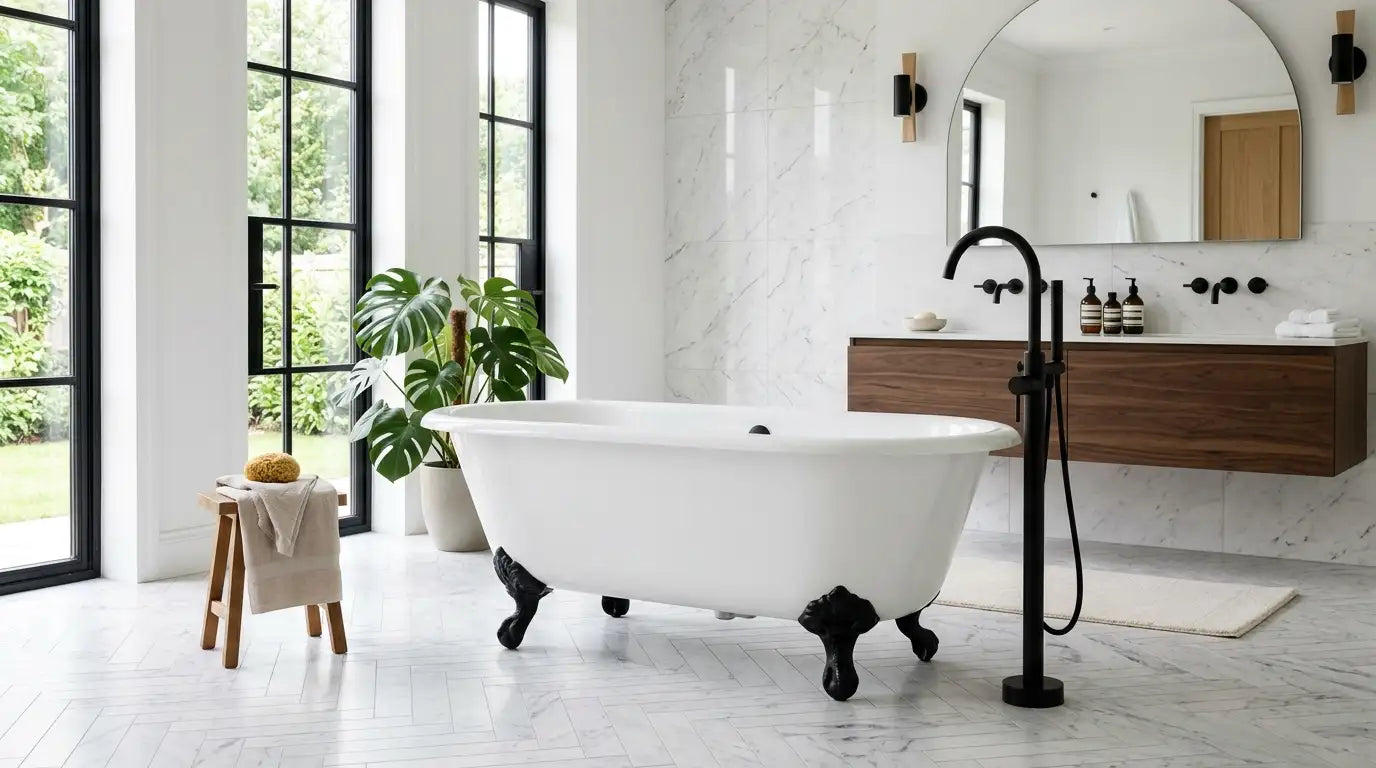
The honest 2026 verdict on clawfoot tubs - covering every style type, real material weights, what they cost installed, how to make one work in a contemporary space, and the situations where a different tub is genuinely the better choice.

A clawfoot tub is a specific type of freestanding bathtub distinguished by four decorative feet - traditionally shaped as animal claws, most commonly lion's paws, that lift the tub visibly off the bathroom floor. The style originated in the Victorian era (1860s-1900s), became the dominant bathtub form in American homes through the early 20th century, and was largely displaced by the built-in alcove tub after World War II. Its current popularity is a genuine design revival, not a retro novelty - and it is worth understanding clearly what you're getting and what you're trading away before you commit.
This guide covers everything a US homeowner needs to make an informed clawfoot tub decision in 2026: all five clawfoot styles, the real weight and cost differences between cast iron and acrylic, foot finish options, sizing for real bathrooms, the complete honest pros-and-cons list, how to make one work in a contemporary space without the room looking like a Victorian museum, plumbing rough-in requirements, and a full cost estimate including faucet and installation. If you're comparing a clawfoot to other freestanding versus built-in tub options more broadly, that guide covers the full landscape.
All clawfoot tubs are freestanding - but not all freestanding tubs are clawfoot. A modern freestanding tub sits on a solid base or integrated pedestal that sits at or near floor level, with no visible feet. A clawfoot tub is elevated on four distinct decorative feet with open floor space visible beneath the tub body. That open space beneath the tub is both a visual signature and a cleaning consideration - both worth understanding before you decide.
Clawfoot tubs are not a single shape. Within the category, five distinct silhouettes serve different soaking postures, bathroom aesthetics, and user preferences. Choosing the right one affects daily comfort as much as design outcome.

The original Victorian clawfoot silhouette - symmetrical from end to end with a gently rolled rim on all four sides. Faucet typically mounts on the rim or on a wall/floor adjacent to the tub. Both ends are identical, so there is no preferred head or foot end. The most historically accurate style and the most recognizable clawfoot form. Suits Victorian, Craftsman, farmhouse, and eclectic bathroom aesthetics most naturally.

One end of the tub is raised higher than the other, creating a built-in backrest that elevates the soaker's head and upper body for a reclining posture. The raised end is visually taller and creates an asymmetric silhouette that is particularly dramatic when the tub is viewed from the side. The faucet typically mounts at the lower end (opposite the raised back). The most comfortable clawfoot style for long soaks, and the most photographed clawfoot silhouette in interior design media.

Both ends of the tub are raised symmetrically, creating backrest support at each end with the faucet mounted centrally on the rim or on a floor-mount faucet positioned beside the tub. Designed for two-person soaking facing each other. Typically longer than single-slipper models (usually 66"-72") to accommodate both bathers comfortably. Creates the most visually dramatic clawfoot silhouette of all five styles - the symmetrical raised ends read as genuinely sculptural from across the room.

A flat-rimmed, symmetrical oval tub body on clawfeet - the most contemporary-looking clawfoot interpretation. Neither end is raised; the tub has a consistent rim height with smooth curved walls providing gentle back support at both ends. Faucet typically mounts centrally on the rim. This style bridges the gap between the Victorian clawfoot aesthetic and the clean geometry of contemporary freestanding tubs - the best choice for homeowners who want clawfeet but find the traditional slipper silhouette too period-specific.

A modern interpretation where the tub sits on four feet that are more architectural or column-like rather than traditionally claw-shaped - often straight legs, tapered feet, or geometric supports in matte black or brushed gold. These hybrids carry the spirit of the clawfoot (visible feet, elevated tub body) with a cleaner, more contemporary execution. Found in transitional and modern-transitional bathroom designs where the classic lion's paw foot would read as too traditional but a pedestal base would eliminate the visual lift beneath the tub.

Any clawfoot style can include a painted or patterned exterior - the visible outside of the tub body - while keeping the interior white. Classic Victorian installations used deep navy, forest green, black, or burgundy exteriors with white interiors and polished chrome feet. Modern versions use matte black, sage green, deep teal, or terracotta exteriors. A painted exterior clawfoot tub is the most visually assertive bathtub choice available - it dominates the room, which is either exactly right or completely wrong depending on the design intent.
Choose your clawfoot style based on your primary soaker's body posture preference, not just aesthetics. The slipper delivers the most comfortable reclining soak for a single bather who leans back for extended periods. The roll-top is best for bathers who sit upright or prefer a neutral posture. The double-ended is best when two bathers use the tub regularly at the same time. Making the wrong choice here is a daily comfort annoyance that no amount of beautiful hardware fixes.
The material choice in a clawfoot tub is one of the most consequential decisions in the purchase - it affects weight, installation cost, heat retention, long-term durability, and price. Cast iron and acrylic have genuinely different profiles that suit different buyers and bathroom situations.
| Factor | Cast Iron Clawfoot | Acrylic Clawfoot |
|---|---|---|
| Empty Weight | 250-500 lbs - requires floor load assessment on upper floors | 60-120 lbs - manageable without structural concerns on most floors |
| Material Cost | $1,200-$4,500+ for quality models | $800-$2,000 for quality acrylic clawfoots |
| Heat Retention | Excellent - cast iron holds bathwater temperature 20-30% longer | Good - retains heat adequately but loses warmth faster than cast iron |
| Surface Finish | Porcelain enamel - extremely hard, chip-resistant, but chips show rust beneath | Acrylic gel coat - seamless color, scratch-resistant, refinishable if damaged |
| Durability | Exceptional - original cast iron tubs from 1910 are still in use | Very good - quality acrylic lasts 20-30+ years with normal care |
| Installation Complexity | Higher - weight requires extra labor and floor assessment | Standard - manageable weight, routine installation |
| Bathing Feel | Cold to the touch initially - warms slowly once water runs; never fully warm-feeling to the touch | Warmer to the touch - acrylic is a thermal insulator, pleasant to kneel against or rest arms on |
| Noise | Very quiet - cast iron deadens sound completely | Some hollow resonance when filling - quality models are reinforced to reduce this |
| Upper Floor Safety | Requires structural assessment - filled weight 700-1,000+ lbs concentrated | Generally safe - filled weight 350-500 lbs, distributed on four feet |
| Best For | Ground floor primary bathrooms, serious soakers, heritage renovations, buyers who want the genuine article | Upper floor bathrooms, buyers prioritizing warmth to the touch, budget-conscious buyers, modern aesthetic |
The feet on a clawfoot tub are not a minor detail - they are the single most visible hardware element on the tub and the detail that determines whether the tub reads as Victorian, transitional, or contemporary. Choosing the right foot style and finish is as important as choosing the right tub body.

The classic Victorian clawfoot foot - a cast paw with detailed claw rendering and textured fur. This foot style is the reason the tub type is called a "clawfoot" and it is most at home in Victorian, Craftsman, and period-authentic bathroom designs. In polished chrome or polished nickel, it leans formal; in oil-rubbed bronze, it leans warm and rustic; in matte black, it becomes dramatically modern. The most detailed and most period-specific foot option.

A ball-and-claw foot has a sphere (the ball) gripped by talons (the claw) - derived from Georgian furniture design where ball-and-claw was a dominant decorative motif. Less anatomically specific than the lion's paw, more geometric and visually clean. Slightly more versatile across design styles because the abstraction makes it read as less strictly period-Victorian. Available in the same finish range as lion's paw.

A modern interpretation - straight or slightly tapered column legs that lift the tub without any period-specific ornament. Found on transitional and contemporary clawfoot-inspired models. Available in matte black, brushed gold, brushed nickel, and chrome. This foot style is the reason modern clawfoot-aesthetic tubs can work in minimalist or contemporary bathrooms - the feet read as intentional design rather than period decoration. Best paired with a flat-rim, double-ended, or oval tub body.

Polished chrome - most traditional, coordinates with silver fixtures. Matte black - the most-chosen finish for 2026, works in both Victorian-inspired and contemporary rooms. Brushed gold / satin brass - warm, luxurious, pairs with warm-toned tile and wood accents. Oil-rubbed bronze - living finish, warm and rustic, suits farmhouse and Craftsman bathrooms. Polished nickel - formal and bright, suits transitional and art deco aesthetics. The foot finish should match the tub's faucet and drain hardware for a cohesive look.
Clawfoot tubs are larger than most homeowners expect - not just in length, but in the floor clearance they require around the perimeter. The space beneath and around the tub is part of the design, and it requires real planning to avoid a bathroom that feels overwhelmed by the fixture. These are the numbers to have before you shop.
Most clawfoot tub articles are written either by enthusiasts who downplay the real disadvantages or by critics who overstate them. Here is the complete, unhedged picture - every genuine advantage and every genuine trade-off.
| Factor | Reality | Verdict |
|---|---|---|
| Visual impact | No bathtub type commands a room more strongly. A well-chosen clawfoot is the most photographed, most memorable bathroom element available. The design statement is genuine and unmatched. | Major Pro |
| Resale value | In the US real estate market, a clawfoot tub is a recognized premium feature in homes above the median price point. Buyers respond to it emotionally - it consistently appears in listing photos for a reason. | Pro |
| Bathing experience | Deeper water depth than alcove tubs, full body immersion, and the visual pleasure of the room around you (rather than staring at three tiled walls) makes clawfoot soaking genuinely superior for long baths. | Pro |
| Cleaning underneath | The open space beneath the tub collects dust, hair, and debris that requires regular cleaning. It is not difficult to clean, but it adds a maintenance step that built-in tubs don't have. A long-handled mop or vacuum handles it in two minutes. | Minor Con |
| Cleaning the tub exterior | The visible exterior of the tub - the outside of the tub body, the feet, and the supply lines - must be cleaned regularly, unlike built-in tubs whose sides are hidden in an alcove or deck. Again, manageable but adds to weekly cleaning. | Minor Con |
| No built-in shower | Clawfoot tubs do not have a showerhead unless a dedicated clawfoot shower conversion kit is added (a wraparound curtain rod + riser with a hand shower). These work but they look cluttered and reduce the visual impact of the tub. Most clawfoot tubs in a primary bathroom are bath-only unless a separate shower is in the same or adjacent space. | Real Con |
| Water temperature loss | Because the tub is freestanding and exposed on all sides, heat is lost faster than in an alcove tub surrounded by walls on three sides. Acrylic is better at retaining heat than cast iron initially, but both lose heat faster than a built-in tub in the same environment. For a 20-minute soak this is irrelevant; for a 60-minute soak, you may need to top off with hot water. | Minor Con |
| Entry and exit ease | Clawfoot tubs have higher rim heights (26"-36") than alcove tubs (18"-22"). This makes stepping in and out more challenging, particularly for bathers with mobility limitations, older adults, or young children bathing alone. This is a genuine accessibility concern worth taking seriously. | Accessibility Con |
| Space requirements | A clawfoot tub needs visible clear floor space on all sides to look right - it is not a fixture that can be pushed against a wall like a standard alcove tub. Small bathrooms under 80-90 sq ft often cannot accommodate a clawfoot with appropriate clearance. | Con for Small Baths |
| Supply lines visibility | The hot and cold supply lines connecting the floor or wall rough-in to the faucet are visible on a clawfoot tub. On a floor-mount freestanding faucet, these run externally from the floor to the faucet body. This is a known aesthetic of the style - some buyers love the industrial honesty of exposed plumbing; others find it untidy. | Style Preference |
The clawfoot tub fails in contemporary spaces most often not because of the tub itself, but because of the surrounding elements. A clawfoot in a room full of competing decorative details, or paired with traditional Victorian hardware when the rest of the bathroom is aggressively modern, creates visual friction rather than intentional contrast. The principles for getting this right are specific.
The clawfoot tub is a maximalist object. Surround it with minimalist everything else - large-format tile in a single color, a simple floating vanity, clean-lined mirrors, no competing moldings or decorative hardware patterns. The room's job is to frame the tub, not to compete with it. Bathrooms that try to have both a dramatic clawfoot tub and elaborate tilework, decorative towel bars, and ornate mirrors end up visually chaotic.
Matte black feet on a white tub body read as contemporary regardless of the foot shape - even lion's paws in matte black land in the modern side of the spectrum. Brushed gold feet in the same context create a warmer contemporary luxury feel. Polished chrome feet are the most traditional reading and require deliberate surrounding choices to avoid looking period-specific. The foot finish is the most effective single lever for moving a clawfoot tub between traditional and contemporary registers.
A freestanding floor-mount faucet in the same finish as the tub feet completes the clawfoot look while enabling a clean contemporary geometry. The faucet's silhouette matters: a clean-lined single-lever floor-mount faucet (see our tub filler buying guide for mount type explanations) reads as contemporary; an ornate two-handle cross faucet reads as period Victorian. Choose the faucet silhouette deliberately to calibrate the tub's era-specificity.
A clawfoot tub positioned awkwardly - pushed against a wall, crowded by other fixtures, or not centered in its allocated floor zone - loses the visual power that justifies its complexity. Position it in the center of the wall it anchors, with equal clear floor space on each accessible side, visible from the bathroom doorway. That first-view impact when you open the door is the moment the design decision earns its keep - or doesn't.
Victorian, Craftsman, and farmhouse homes where the tub's heritage character matches the architecture. Eclectic bathrooms deliberately mixing eras. Large primary bathrooms (100 sq ft+) where the tub has genuine room to breathe. Powder rooms or dedicated soaking rooms where the tub is the only functional fixture. Hotel-inspired bathrooms where theatrical impact is the explicit goal. If your bathroom falls into one of these categories, a clawfoot tub is almost certainly the right choice.
Clawfoot tub plumbing is straightforward compared to jetted tubs or thermostatic shower systems - but it has specific requirements that must be confirmed before the tub arrives. The two decisions that drive all other plumbing planning are faucet mount type and drain location.
Most clawfoot tub cost estimates online quote only the tub price. The complete installed cost - tub, faucet, drain hardware, and installation labor - is what you need to budget for. Here is the full picture for two scenarios: an acrylic clawfoot on an existing drain rough-in, and a cast iron clawfoot requiring a floor-mount faucet and plumber's assessment.
The faucet is 20-35% of your total clawfoot project budget - don't undershoot it. A $900 acrylic clawfoot tub paired with a $150 faucet will look exactly as mismatched as it sounds. The faucet's quality, finish, and visual weight must be proportional to the tub's quality and visual presence. A rim-mount clawfoot faucet kit (two separate handle bodies + spout on a shared base plate that mounts to the tub rim) in the $400-$700 range is the right budget for a mid-tier acrylic clawfoot tub.
Bathify carries freestanding bathtubs including clawfoot-style models from brands including Vanity Art. Here is the verified in-stock clawfoot option available with free ground shipping across the continental USA.

The Vanity Art York 69" is Bathify's flagship acrylic clawfoot model - a generous 69-inch length that suits both single-bather slipper-style soaking and two-person use, built from 100% high-gloss white acrylic reinforced with fiberglass for structural rigidity. The color is through the acrylic rather than a painted surface - this means chips and scratches do not expose a different-colored substrate underneath, and the gloss finish retains its consistency for the life of the tub. Ergonomically shaped with gently sloping walls that follow the body's natural recline position. UPC certified for US plumbing standards. The most complete clawfoot freestanding tub value at Bathify, at $945.99 with free ground shipping.
Yes - But Only If Your Bathroom, Your Habits, and Your Design Intent Align
Worth it without question: Victorian, Craftsman, farmhouse, or eclectic home with a primary bathroom of 80+ sq ft, where a dramatic bathing experience and visual impact justify the investment. You bathe regularly, value long soaks, have a separate shower in the same or adjacent bathroom, and want the tub to be the room's centerpiece.
Worth it with planning: Contemporary bathroom where the design execution is deliberate - matte black or brushed gold feet, floor-mount contemporary faucet, minimal surrounding elements, tub positioned as the sole decorative statement. The clawfoot read as intentional contrast rather than period confusion. This requires more design discipline but produces genuinely striking results in modern spaces.
Worth reconsidering: Small bathroom under 70-80 sq ft where the tub will be crowded. Primary bathroom where daily showers must happen in the tub - the clawfoot shower conversion curtain works but is not a satisfying daily shower experience. Household with mobility challenges or young children bathing alone - the high rim entry is a real accessibility concern. Upper floor installation of a cast iron model without structural assessment.
Not worth it: Strictly practical household where bathing is quick and functional rather than a ritual. Investment property where the clawfoot's maintenance requirements and cleaning demands add friction for tenants. Bathroom that will be used primarily as a shower room.
On material: Choose cast iron if you are on a ground floor, value superior heat retention, and want a tub that will genuinely last a century. Choose acrylic if you are on an upper floor, want a warmer-to-the-touch bathing surface, need easier installation, or are price-conscious. Either material in a quality clawfoot tub produces a bathing experience that no alcove tub matches. See our full acrylic vs. cast iron bathtub comparison for the detailed material breakdown.
Shop Clawfoot & Freestanding Bathtubs at Bathify
Bathify carries freestanding and clawfoot-style bathtubs from trusted brands like Vanity Art, plus matching tub faucets, drains, and bathroom accessories - all with free ground shipping across the continental USA on orders over $50.


