







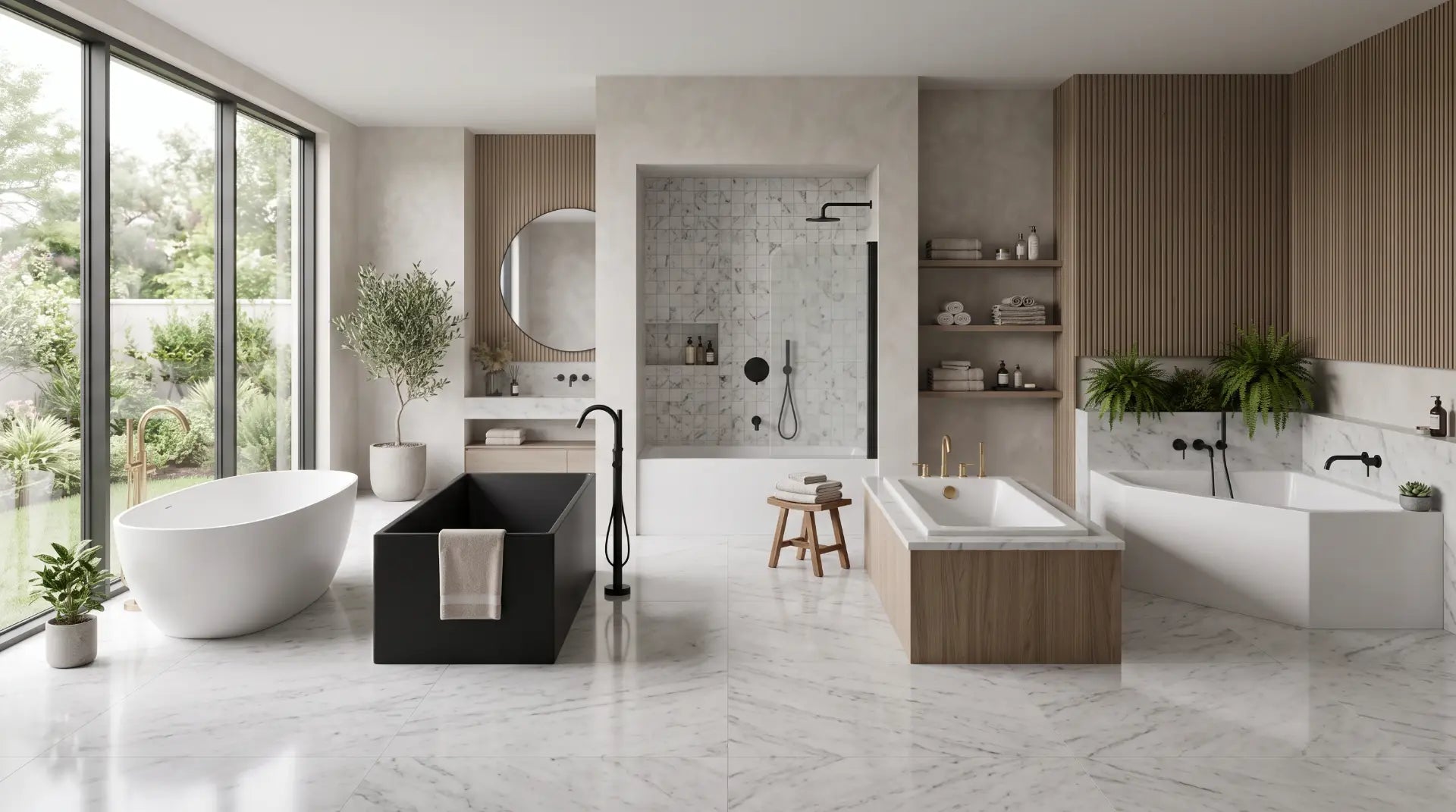
Every bathtub decision in one place. This guide walks you through installation types, materials, sizes, faucets, and drains - in the exact order you should decide them - then points you to the tubs worth buying from Bathify right now.

Most bathtub-buying mistakes happen because people start with the wrong question. They fall in love with a sculptural freestanding tub, or a specific finish, before confirming whether it physically fits their bathroom, suits how they actually bathe, or can be delivered through their front door. A bathtub is a heavy, freight-shipped fixture that's plumbed into your floor - it's not a purchase you want to reverse. Deciding in the right order prevents almost every expensive regret.
The correct order is: installation type first, size second, material third - and only then style, shape, and color. Installation type is dictated by your room's layout and plumbing. Size is dictated by your measurements and delivery path. Material is a budget-and-use decision. Style is the fun part, and it's the last thing that should constrain you. This guide follows that exact sequence, so by the end you'll have narrowed thousands of options down to a short list of tubs that genuinely fit your bathroom.
If you already know your installation type, jump to that section from the table of contents. If you're starting from scratch, read the 6 Types overview, then work through Materials and Sizes. Ready-to-buy? Skip to the verified Bathify picks. Every section links to a deeper guide if you want to go further on that one decision.
Every bathtub is defined first by how it installs into your bathroom. This is the single most important decision because it's governed by your room's walls, floor space, and plumbing - not by taste. Get the installation type right and everything else follows; get it wrong and no material or style will save the project.

A self-contained tub finished on every side, sitting on the floor or short feet. The centerpiece of spa-style bathrooms. Needs open floor space and clearance on all sides. Pairs with a freestanding or wall-mount tub filler.

Installs into a three-wall recess with only the front apron finished. The default American tub-shower combo and the most budget-friendly, space-efficient choice. Almost always sized to the standard 60-inch opening.

A tub shell dropped into a built platform or deck, with the rim resting on top. Gives a custom, built-in look and a handy ledge for bath products. Requires framing and a finished surround, so it's a renovation-scale choice.

Like a drop-in but mounted beneath the deck surface, so the stone or tile edge runs cleanly over the rim. The most seamless, high-end built-in look. Higher install cost and needs a solid, waterproofed surround.

A triangular or offset tub that tucks into a corner, using an awkward layout efficiently while still offering a wider bathing area. Great for irregular rooms - but corner tubs are large and hold a lot of water.

A tub with a watertight door and built-in seat that you step into rather than climb over. Designed for aging-in-place and limited-mobility users. You fill and drain while seated inside, so drain speed matters.

Freestanding tubs have become the defining feature of primary and spa-style bathroom renovations, and the appeal is easy to understand: a sculptural tub sitting in open space instantly reads as a luxury focal point. Because they're finished on all sides, they can be placed against a wall, floated in the center of the room, or angled beneath a window. Modern freestanding tubs are most often made from acrylic reinforced with fiberglass, which keeps the weight manageable, the surface warm and comfortable, and the price accessible relative to cast iron or stone.
The trade-off is practicality. A freestanding tub is a soaking-first fixture - it's generally not designed to carry a wall-mounted shower and surround, so it works best in a bathroom that also has a separate shower. You also need genuine clearance around it (a common guideline is a few inches to a foot on each side for both looks and cleaning), and cleaning the floor around and behind it takes more effort than wiping down an enclosed alcove tub. If those conditions match your bathroom, a freestanding tub delivers the highest visual payoff of any tub type.
Check the drain location and filled weight before you commit. Freestanding tubs specify a drain rough-in position that your plumbing must match, and the spec sheet lists the filled weight - which determines whether your floor needs any attention. For the shortlist of models worth buying, see our roundup of the best freestanding bathtubs of 2026.

If a freestanding tub is the statement, built-in tubs are the workhorses. The alcove tub is the most common bathtub in American homes for good reason: it fits a standard three-wall recess, uses space efficiently, doubles as a shower, and is the most affordable installation. Because bathrooms are typically framed for a 60-inch opening, an alcove replacement is often the simplest tub swap you can make - you're matching an established rough-in rather than rebuilding the space.
Drop-in and undermount tubs trade that simplicity for a custom look. Both drop a tub shell into a built deck; the difference is the edge. A drop-in leaves the tub's own rim visible on top of the deck, while an undermount runs the stone or tile surface cleanly over the edge for a seamless, high-end finish. Both are renovation-scale projects because they require framing, waterproofing, and a finished surround - but they let you integrate the tub into a tiled platform, add a product ledge, and control the exact dimensions of the bathing area.
Does this tub need to be your shower too? If yes, an alcove tub is almost always the right answer - it's built for a wall surround and a shower valve. If no, and you have the floor space, a freestanding tub gives you far more visual impact. We break the full comparison down in freestanding vs built-in bathtub.
Material determines four things that matter every time you use the tub: how warm it feels, how long it holds heat, how heavy it is (which affects installation and your floor), and how it ages. There's no single "best" material - there's the right material for your budget, your installation type, and how you bathe. Here's how the main options actually compare.
| Material | Feel & Heat | Weight | Durability | Best For |
|---|---|---|---|---|
| Acrylic (fiberglass-reinforced) | Warm to the touch, good heat retention | Light | Very good; scratches can be buffed/repaired | Most freestanding & alcove tubs - the value pick |
| Fiberglass (FRP/gelcoat) | Warm, but heat fades faster | Lightest | Lower; more prone to wear over time | Budget builds, rentals, low-use bathrooms |
| Cast Iron (enamel) | Cool at first, then holds heat longest | Very heavy | Excellent; lifetime enamel surface | Long hot soaks, ground-floor, lifetime fixture |
| Enameled Steel | Cool, loses heat quickly | Moderate-heavy | Good; enamel can chip if struck | Durable alcove tubs on a budget |
| Stone Resin / Solid Surface | Warm, excellent heat retention | Heavy | Excellent; matte, repairable surface | Premium freestanding soaking tubs |
| Copper | Warm, great heat retention, living patina | Moderate | Excellent, but needs specific care | Statement/vintage designs |
For the vast majority of buyers, acrylic reinforced with fiberglass is the smart default. It's light enough to simplify installation and floor loading, warm and comfortable, resistant to staining and scratching, and repairable. That's why nearly all of the freestanding soaking tubs at Bathify use UPC-certified acrylic construction. The main reason to step up to cast iron or stone resin is heat retention for long soaks - and the main reason to avoid them is weight.
Installation type and material describe how a tub is built. The other half of the decision is how it's meant to be used. Three experience-driven categories come up again and again, and they cut across installation types.
Soaking tubs are simply deeper than standard tubs - offering 14-20+ inches of water depth so the water covers more of your body. If a long, immersive bath is the whole point of adding a tub, this is the category to prioritize. Jetted and whirlpool tubs add water or air jets for a massage effect; they deliver a spa-like experience but add pumps, plumbing, cost, and cleaning/maintenance that a plain soaking tub avoids. Japanese soaking tubs (ofuro) take the soaking idea further - they're short but very deep, designed for sitting upright immersed to the shoulders, and are ideal for small bathrooms where floor area is tight but a deep soak is still wanted.
Clawfoot tubs are a specific flavor of freestanding tub: a raised tub standing on four decorative feet, tied to vintage, farmhouse, and traditional bathroom styles. Their appeal is character - few fixtures anchor a room the way a clawfoot does. They're often available in enameled cast iron for classic heat retention, or lighter acrylic reproductions that are far easier to install. The considerations are the same as any freestanding tub (clearance, filler choice, cleaning underneath) plus the visual commitment to a period look.
Whether a clawfoot still earns its place depends on your design direction and how much you value that traditional statement versus the cleaner lines of a modern freestanding tub. We weigh the pros, cons, and styling in is a clawfoot tub still worth it in a modern bathroom.
More tubs are bought in the wrong size than any other wrong attribute, and the mistake is expensive because tubs ship as heavy freight. Before you fall for a specific model, know the standard dimensions and - just as importantly - measure the path the tub has to travel to reach the bathroom. A 67-inch soaking tub that won't clear a hallway turn or a bathroom doorway is a problem you discover on delivery day.
Measure four things: the tub space itself (length, width, and the wall height for a surround); the filled depth you want for the soak; the drain rough-in position your plumbing provides; and - critically - the narrowest point on the delivery route (front door, hallway turns, bathroom doorway, and any stairs). Confirm each against the model's spec sheet before ordering.
A tub filler is a separate purchase from the tub, and how it mounts depends entirely on your tub type. Buying the tub without planning the filler is one of the most common oversights - and the two decisions are linked, because the filler style has to match both the tub and the rough-in plumbing.
The main filler types are freestanding (floor-mounted) fillers that rise from the floor beside a freestanding tub; wall-mount fillers that come out of the wall (common with alcove and some freestanding setups); deck-mount fillers that sit on the rim of a drop-in tub or its deck; and roman tub fillers designed for wide deck spreads. The right one is dictated by your tub and where your water supply is roughed in - so decide the filler alongside the tub, not after.
The drain is easy to ignore until it leaks or clogs - and then it's the most annoying part of the whole tub. Two things matter up front: the drain location must line up with your plumbing rough-in (this is set by the tub you choose), and the drain assembly and stopper style should match how you use the tub. Common stopper mechanisms include lift-and-turn, push-and-pull (toe-touch), and trip-lever styles, each with its own feel and maintenance quirks.
For walk-in and deep soaking tubs, drain speed becomes important too, since you may be waiting inside the tub for it to empty. If you're replacing a tub, identifying your existing drain type first makes the swap far smoother.
| Feature | Freestanding | Alcove | Drop-In | Corner | Walk-In |
|---|---|---|---|---|---|
| Doubles as a shower | Rarely | Yes | Sometimes | Sometimes | Some models |
| Space efficiency | Needs clearance | Excellent | Moderate | Good in corners | Moderate |
| Install complexity | Moderate | Easy-Moderate | Renovation | Renovation | Moderate-Hard |
| Visual impact | Highest | Low | Custom/High | Moderate | Functional |
| Accessibility | Step-over | Step-over | Step-over | Step-over | Best |
| Typical price range | $800-$3,000+ | $300-$1,200 | $500-$2,000+ | $700-$2,500 | $1,500-$5,000+ |
| Best bathroom | Spa / primary bath | Family / tub-shower | Renovated / custom | Irregular layouts | Aging-in-place |
Price ranges are general US market estimates for the tub itself and vary by material, size, and brand; fillers, drains, and installation are additional.
Not every tired-looking tub needs replacing. If the tub is structurally sound but the surface is dull, stained, or lightly chipped, refinishing (reglazing) can restore it for a fraction of the cost and disruption of a full replacement - no plumbing changes, no demolition. It's especially worth considering for a heavy cast iron tub that would be a major job to remove.
Replacement makes more sense when the tub is cracked, leaking, the wrong size or type for your needs, or when you're already renovating the surrounding space. The honest decision usually comes down to the condition of the tub body and whether you want to change type, size, or layout - refinishing keeps what you have; replacing lets you rethink it.
Bathify carries freestanding and drop-in bathtubs built from UPC-certified acrylic reinforced with fiberglass - light, warm, stain- and scratch-resistant, and easy to place. These are standout options across sizes and shapes, from compact soakers to full-size statement tubs. Every tub ships with free US shipping on orders over $50 and a 30-day return window.

At roughly 54.7" × 28.3", the Adonis is the compact freestanding pick - a genuine soaking tub that fits primary bathrooms where a full 67-inch tub won't. The gentle sloping interior follows the body for comfortable reclining, and the UPC-certified acrylic keeps it light, warm, and easy to place. A smart way to get the freestanding look without needing a large footprint.
Shop: Vanity Art Adonis 55" at Bathify → · $966.99

The Eiffel is the classic full-size freestanding soaking tub - 67 inches of length with the deep, curved interior that makes for a proper full-body soak. It's the do-everything centerpiece for a spa-style primary bathroom, in durable UPC-certified acrylic reinforced with fiberglass so the weight stays manageable. Pair it with a floor-mounted freestanding filler for the complete statement.
Shop: Vanity Art Eiffel 67" at Bathify → · $1,132.99

Where the Eiffel is curved and classic, the Trent is crisp and contemporary - a 67-inch flatbottom rectangular soaking tub with clean, angular lines that suit modern and minimalist bathrooms with geometric tile and hardware. Same UPC-certified acrylic-plus-fiberglass construction, same full-size soak, different design language. The pick when the rest of your bathroom is sharp and linear.
Shop: Vanity Art Trent 67" at Bathify → · $1,135.99

The Alto splits the difference at 59 inches - a mid-size oval flatbottom soaking tub with ergonomic, contemporary curves that make the room feel more spacious. Its glossy white acrylic finish is reinforced with fiberglass for strength, and the oval profile softens a bathroom full of straight lines. A versatile middle option between the compact Adonis and the full-size 67-inch tubs.

The Palma adds a practical edge to the freestanding format: a non-slip flatbottom surface, which matters for anyone prioritizing safety - including households with children or anyone stepping in and out of a deep soaker. It keeps the same body-following sloped interior and UPC-certified acrylic construction as the rest of the line, at a versatile 59-inch length that suits most primary bathrooms.
Work through type, size, and material - then let style be the fun part
You want a spa-style focal point and have the floor space: Go freestanding. Choose a full-size 67" soaker like the Eiffel (classic curves) or Trent (modern lines), and budget for a separate tub filler.
The tub also has to be your shower: Go alcove. It fits the standard 60" opening, works with a wall surround and shower valve, and is the most space- and budget-efficient choice.
You have a smaller or mid-size bathroom but still want to soak: A compact or mid-size freestanding tub like the Adonis 55" or Alto 59" delivers a real soak without needing a large footprint. A Japanese-style deep tub is another option where floor area is tight.
Safety and easy entry matter most: Prioritize a non-slip surface like the Palma 59", or a walk-in tub for genuine step-in accessibility.
Long, hot soaks are the whole point: Heat retention favors cast iron or stone resin - just confirm your floor can carry the filled weight. Otherwise, acrylic is the best all-round value for nearly every buyer.
Shop Bathtubs at Bathify
Freestanding and drop-in bathtubs, plus matching tub fillers and drains - built from UPC-certified acrylic. Free shipping on US orders over $50, with a 30-day return policy.


